Overview
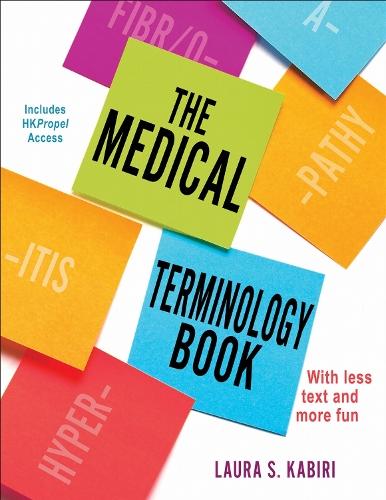
Medical terminology made approachable. Learning medical terminology can feel like reading and memorizing a dictionary—overwhelming and a bit boring. The Medical Terminology Book With HKPropel Accessstreamlines the process by teaching readers common medical terms and how to combine prefixes, root words, and suffixes to create a practical vocabulary. The text is packed with humor, mnemonics, coloring pages, activities, puzzles, and videos to maximize fun. Readers will explore medical terms used in a clinical setting and will consider the related anatomy, common abbreviations, common diagnoses, and common tests, procedures, and treatments. Part textbook and part workbook, The Medical Terminology Book makes medical terminology accessible by incorporating tools that engage readers in active learning. Stories and images make the text entertaining, while practice opportunities help reinforce learning. Learning tools include these: Anatomical Appellations that consist of black and white anatomical images to be colored and labeled Crossword puzzles using medical term definitions as clues so readers can fill in the grid Jumbled Jargon and Say What? activities that offer mixed-up medical terms or confusing patient statements for readers to translate into meaningful medical documentation Bilingual Bites that teach readers basic Spanish phrases and sentences to facilitate connection with patients In addition to these tools, short microlearning videos that are delivered through HKPropel allow readers to hear medical terms spoken to assist with proper pronunciation. These videos give instructors the flexibility to teach an in-person, hybrid, or asynchronous course. Online related resources include flash cards, interactive learning games (Quiz Quest, word searches, and crosswords), spare SOAP notes, image labeling, audio recordings of Spanish medical terms (Bilingual Bites), and a comprehensive table of medical terms. While many medical terminology texts exist on the market, most bore and overwhelm students with terminology they will never use in the field. The Medical Terminology Book takes a different approach and focuses on allied health professions and exercise science, with special attention paid to the muscular and skeletal systems. Written by a physical therapist with contributions from athletic trainers and a medical physician, the text provides an interprofessional perspective on how medical terminology is used across disciplines. There's more to medical terminology than rote memorization. The Medical Terminology Book is the ideal companion for future allied health or exercise science professionals looking to truly understand and engage with the terms they will encounter daily in a clinical setting. Note: A code for accessing HKPropel is included with all new print books.
Full Product Details
Author: Laura S. Kabiri
Publisher: Human Kinetics Publishers
Imprint: Human Kinetics
ISBN: 9781718243385
ISBN 10: 1718243383
Pages: 280
Publication Date: 30 March 2026
Audience:
College/higher education
,
Tertiary & Higher Education
Format: Paperback
Publisher's Status: Forthcoming
Availability: Not yet available

This item is yet to be released. You can pre-order this item and we will dispatch it to you upon its release.
Author Information
Laura Kabiri, PT, DPT, PhD, is a licensed physical therapist and professor in the sports medicine and exercise physiology program at Rice University in Houston, Texas. She has over 15 years of experience in higher education and has received multiple teaching and mentoring awards, including the Rice University George R. Brown Award for Superior Teaching, the Wiess School of Natural Sciences Outstanding Teaching Award, and the national Sam Drogo Technology in the Classroom Award. Kabiri is a former member of the Professional Education Committee of the American College of Sports Medicine (ACSM), served in the Education Section of the American Physical Therapy Association (APTA), and was an item writer for the National Physical Therapy Examination (NPTE). Created in conjunction with Rice Online, her Coursera course on medical terminology has enrolled over 75,000 learners worldwide. Kabiri loves to bring joy and humor to learning through her uniquely ""quirk-thentic"" (quirky, but authentic!) teaching style. In her spare time, Kabiri enjoys reading inspirational historical fiction, volunteering in the community, and exploring new places and cultures through food and music. She is absolutely obsessed with her Australian shepherd and Dalmatian mix, Margo, who rescued her in 2021 and helped inspire and coauthor this future Pulitzer Prize–winning text.