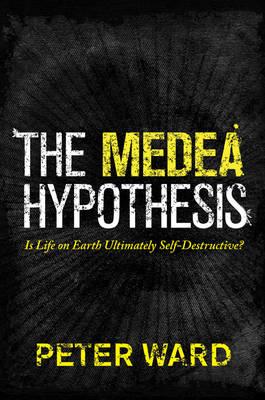
Full Product Details
Author: Peter Ward
Publisher: Princeton University Press
Imprint: Princeton University Press
Dimensions:
Width: 15.20cm
, Height: 2.30cm
, Length: 23.50cm
Weight: 0.454kg
ISBN: 9780691130750
ISBN 10: 0691130752
Pages: 208
Publication Date: 20 April 2009
Audience:
College/higher education
,
Professional and scholarly
,
General/trade
,
Tertiary & Higher Education
,
Professional & Vocational
Format: Hardback
Publisher's Status: Out of Print
Availability: In Print

Limited stock is available. It will be ordered for you and shipped pending supplier's limited stock.
Language: English
Reviews
Ward holds the Gaia Hypothesis, and the thinking behind it, responsible for encouraging a set of fairy-tale assumptions about the earth, and he'd like his new book, due out this spring, to help puncture them. He hopes not only to shake the philosophical underpinnings of environmentalism, but to reshape our understanding of our relationship with nature, and of life's ultimate sustainability on this planet and beyond. -- Drake Bennett Boston Globe Author and Earth Sciences professor Ward has authored numerous books for non-specialists; this latest is a critical response to James Lovelock's Gaia concept, which argues that homeostatic physical and chemical interactions work to maintain Earth's habitability. Ward argue, passionately, that the opposite is true--that living organisms decrease Earth's habitability, hastening its end by perhaps a billion years. PublishersWeekly.com The point of The Medea Hypothesis is that life, rather than helping to regulate the Earth 'System' by negative feedbacks, does all it can to consume the resources available--sowing the seeds of its own extinction. -- Dr. Henry Gee BBC Focus Magazine When avid science readers browse the shelves for new titles, the books that grab their attention are best described by a single adjective: thought-provoking. And no scientist/author is more provocative in his approach and innovative in his thinking than University of Washington astrobiologist Peter Ward ... [R]eaders looking for solace will not find it in Ward's latest effort, The Medea Hypothesis. This time Ward goes after motherhood itself--or at least the central idea of the Gaia ('good mother') hypothesis that has evolved to describe the relationship between life and the planet as a whole. -- Fred Bortz Seattle Times [Ward] makes his points succinctly and supports them well. -- Rebecca Wigood Vancouver Sun [The Medea Hypothesis] is an interesting intellectual exercise on the history of life. Choice Reading the book will widen your field of vision about life on earth, which is still there after about 4 billion years. -- Dr. Hein van Bohemen Ecological Engineering Ward ... adopts the tone of a planetary mortician gruesomely interested in his subject's decease. Ward is an expert on mass extinctions, and the subject seems to have infected his general outlook. He does not come across a happy camper. -- Roger Gathman Austin American-Statesman The Medea Hypothesis is a valuable and well-needed challenge to the hegemony of Gaian thought, and this is a very clearly presented and thought provoking book... Ward's book is a crucial step in opening this debate and I would certainly recommend reading it, but with a critical eye open for chinks in the argument. -- Lewis Dartnell Astrobiology Society of Britain
Author Information
Peter Ward's many books include the highly acclaimed ""Rare Earth: Why Complex Life Is Uncommon in the Universe"" and ""Under a Green Sky"" (Collins). He is professor of biology and Earth and space sciences at the University of Washington, and an astrobiologist with NASA.