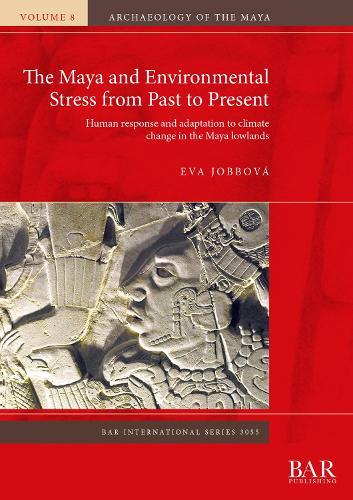
The Maya and Environmental Stress from Past to Present: Human response and adaptation to climate change in the Maya lowlands

Author:   Eva Jobbová
Publisher:   BAR Publishing
ISBN:  

9781407357287


Pages:   236
Publication Date:   29 October 2021
Format:   Paperback
Availability:   Available To Order   Availability explained
We have confirmation that this item is in stock with the supplier. It will be ordered in for you and dispatched immediately.

Our Price $142.31 Quantity:  
Add to Cart

Share |

The Maya and Environmental Stress from Past to Present: Human response and adaptation to climate change in the Maya lowlands


Overview

Both the perceived successes and failures of the Maya are often linked to their relationship with the local environment and their response to episodes of climate change over a period of nearly 2000 years. However, our understanding of human responses to environmental stress has mostly been shaped by a narrow focus on drought as a cause for societal collapse, even in relatively well-watered tropical regions. We still know little about the choices humans make in response to extreme variability in rainfall in different environmental conditions and on multiple timescales. This work responds to recent debates and new analytical opportunities in Maya studies, provided by developments such as an increased volume of paleoclimatic data, the growing field of settlement archaeology and advances in Maya epigraphy. By combining a range of evidence, the book explores the relationship between Maya society and the local environment on multiple spatial and temporal scales, while also considering socio-cultural agencies. In addition, results from ethnographic fieldwork among contemporary Maya communities provide insights into the impact of stress-inducing climatic events on people's lives and their coping strategies. These serve as a guide when looking for similar patterns in archaeological and textual evidence.

Full Product Details

Author:   Eva Jobbová
Publisher:   BAR Publishing
Imprint:   BAR Publishing
Weight:   0.941kg
ISBN:  

9781407357287


ISBN 10:   140735728
Pages:   236
Publication Date:   29 October 2021
Audience:   Professional and scholarly ,  Professional & Vocational
Format:   Paperback
Publisher's Status:   Active
Availability:   Available To Order   Availability explained
We have confirmation that this item is in stock with the supplier. It will be ordered in for you and dispatched immediately.

Table of Contents

List of Figures List of Tables Abstract 1. Introduction 2. Setting the Scene: The Physical and Human Geographies of the Central Lowlands 2.1. Environmental setting 2.2. Case study regions 2.2.1. The Belize River Valley and Peten Lakes region 2.2.2. Northern Yucatan and Northern Quintana Roo 3. Problematising Climate Change, Drought and Human Responses 3.1. From weather to climate, from present to past - the theoretical context 3.2. Examining human-environment relationships in the Maya lowlands 3.2.1. Climate impact: Regional patterns 3.2.2. Settlement survey evidence 3.2.3. Subsistence and water management strategies 3.2.4. Exploration of ritual activity in written records 4. Human Responses to Environmental Stress: Ethnographic and Ethnohistoric Insight Co-authored with Sean Downey 4.1. Introduction 4.2. Weather, climate and drought 4.3. Geographic, climatic and ethnic background of the case study areas 4.4. Interviews 4.4.1. Cayo District - San Antonio 4.4.2. Arenal/Hydro Road (North Vaca Plateau). 4.4.3. San José Succotz 4.4.4. Toledo District - Crique Sarco/Graham Creek 4.5. Contemporary religious practices related to drought 4.5.1. Drought rituals in the Toledo District 4.5.2. Drought rituals in the Cayo District 4.5.3. 'Superstitions' 4.6. Comparing people's perceptions and the rainfall data 4.6.1. Summary of rainfall data analysis 4.7. Archival data 4.8. Understanding environmental stress: combining perceptions, responses and data 5. Palaeoclimatic Reconstructions 5.1. Introduction 5.2. Long-term precipitation proxies 5.3 Palaeoclimate records - short summary 5.4. Quantitative estimates of droughts 5.5. Driving mechanisms of drought 6. Settlement Patterns 6.1. Introduction 6.2. Regional settlement histories through time 6.2.1. Belize Valley 6.2.2. Peten Lakes region 6.2.3. Northern Yucatan Peninsula 6.3. Changes in settlement patterns 6.3.1. Belize Valley and Peten Lakes 6.3.2. Northern Yucatan Peninsula 6.4. Comparison of occupation data with local palaeoclimatic records 6.4.1. Belize Valley and Peten Lakes region 6.4.2. Northern Yucatan Peninsula 6.5. Evaluation of drivers behind changes in settlement patterns 6.5.1. Distinguishing between the factors 7. Agricultural strategies and water management 7.1. Introduction 7.2. Agricultural and water management strategies - Belize Valley/Peten Lakes 7.2.1. Belize Valley 7.2.2. Peten Lakes region 7.3. Agricultural and water management strategies - The Northern Yucatan Peninsula 7.3.1. Northwestern Yucatan (northwestern karst plain) 7.3.2. Central Yucatan (northeast karst plain) 7.3.3. The northeast Yucatan3 7.4. Why did agricultural and water management strategies change? 7.4.1. Population pressure 7.4.2. Land degradation 7.4.3. Drying trends 7.4.4. Socio-political complexity 7.4.5. Implications of agricultural and water management changes 7.5. Summary 8. Epigraphic Insights into Culture, Society and Climate Change Co-authored with Christophe Helmke and Andrew Bevan 8.1. Introduction 8.2. Cultural and political history 8.2.1. Eastern Central Lowlands 8.2.2. Relationship between Naranjo, Caracol and other Central Belize sites 8.2.3. Northern Yucatan Peninsula 8.3. Changes in the written records from the Classic to the Postclassic period 8.3.1. Change in the focus of the Terminal Classic texts 8.3.2. Stelae scene composition: from captive-taking to conversation 8.3.3. Independence claims by secondary centres 8.3.4. Iconographic, stylistic and linguistic differences 8.4. Change in written records as a potential response to water scarcity 8.4.1. Rain-beckoning rituals 8.4.2. Possible Classic Maya parallels 8.4.3 Analytical approach and data 8.4.4. The seasonality of at and chok statements 8.4.5. Palaeoclimate and at and chok statements 8.4.6. Spatial patterning of at and chok statements 8.4.7. Specific occasion rituals 8.5. Discussion Appendices 9. Two millennia of human response to environmental stress in the Maya lowlands: Interweaving Narratives 9.1. Introduction 9.2. Interweaving narratives and evidence 9.2.1. Coping strategies in the written and archaeological records 9.2.2. Political disintegration 9.2.3. Demographic collapse 9.3. Recurring patterns from the Preclassic to Classic to Postclassic 9.3.1. Terminal Preclassic/Early Classic versus Terminal Classic/Postclassic 9.3.2. Maya collapse(s) 9.4. Environmental conditions and Maya resilience 9.5. Precipitating change: Lessons for the future References

Reviews

{\rtf1\ansi\ansicpg1252\deff0\deflang2057{\fonttbl{\f0\fswiss\fprq2\fcharset0 Calibri;}{\f1\fnil\fcharset0 Verdana;}} \viewkind4\uc1\pard\sa160\sl252\slmult1\f0\fs22\lquote This is a fascinating study that compiles detailed and well-researched information from several different fields to approach the question of ancient environmental stress and response in the Maya area. This work has global implications.\rquote Dr Kitty F. Emery, Florida Museum of Natural History \par \lquote This work is a great contribution to the understanding of the human-environment interactions among the Mayan communities. It will be of interest not only for specialists dealing with Maya archaeology but also for all those scholars interested in the past human-environment interactions.\rquote Dr Alessio Palmisano, Ludwig-Maximilians-Universit\'e4t M\'fcnchen \par \pard\f1\fs17\par }


{\rtf1\ansi\ansicpg1252\deff0\deflang2057{\fonttbl{\f0\fswiss\fprq2\fcharset0 Calibri;}{\f1\fnil\fcharset0 Verdana;}} \viewkind4\uc1\pard\sa160\sl252\slmult1\f0\fs22\lquote This is a fascinating study that compiles detailed and well-researched information from several different fields to approach the question of ancient environmental stress and response in the Maya area. This work has global implications.\rquote Dr Kitty F. Emery, Florida Museum of Natural History \par \lquote This work is a great contribution to the understanding of the human-environment interactions among the Mayan communities. It will be of interest not only for specialists dealing with Maya archaeology but also for all those scholars interested in the past human-environment interactions.\rquote Dr Alessio Palmisano, Ludwig-Maximilians-Universit\'e4t M\'fcnchen \par \pard\f1\fs17\par }


Author Information

Eva Jobbová is a Maya archaeologist interested in a broad range of topics including the development of Neotropical urbanism, the growth of social complexity and societal collapse, and the choices humans make in response to spatial and temporal variation in climate and environmental stress. Currently a Postdoctoral Research Fellow at University College Dublin, she is involved in a project focusing on Irish droughts.

Tab Content 6

Author Website:  

Countries Available

All regions
Latest Reading Guide

April RG 26_2


Shopping Cart
Your cart is empty
Shopping cart
Mailing List