Overview
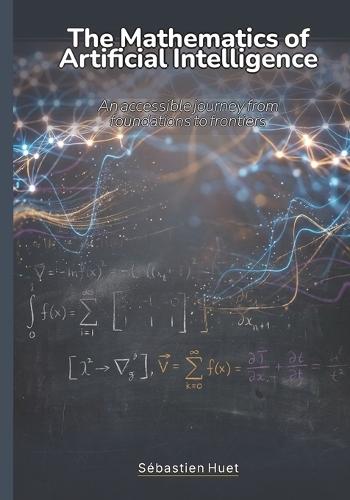
You use AI every day. You have no idea how it works. And you are tired of being told it is too complicated. This book is for you. Artificial intelligence is everywhere. ChatGPT, machine translation, image recognition, music generation. Behind all of it: maths. Not magic, not mysterious code. Functions, matrices, derivatives, probabilities. Tools you can understand, provided someone takes the time to explain them to you like a friend. The Mathematics of Artificial Intelligence rests on a simple claim: you can understand the maths of AI without being a mathematician. Not by oversimplifying, by demystifying. Not by hiding the formulas, by making them desirable. Three reading levels, three possible paths: The curious reader ( 130 pages). You read the blue boxes. Zero formulas, analogies, drawings. You understand what is going on, with no mathematical background. The student ( 300 pages). You read blue and yellow. Equations arrive, commented line by line. High school to undergraduate level. The explorer ( 400 pages). You read everything. Proofs, theorems, Python code. For those who want to go all the way. What you will build: The foundations. Functions, linear algebra, calculus, probability. The language of AI, from scratch. The bricks of a network. From the perceptron to deep networks, through optimisation and backpropagation. You build Zero, your network, brick by brick. Modern architectures. Convolutions for images, sequences for text, attention and Transformers for the language models of today. The frontiers. Geometry of learning, theoretical limits, ethics of the maths, a tribute to Turing. Four characters walk with youLea, a curious designer, asks the questions everyone is thinking. Samir, a computer science student, bridges intuition and formulas. Prof. Okoye, a demanding researcher, flags when a simplification has gone too far. And Zero (the neural network itself) comments on its own construction, from chapter 1 where it is just a function to chapter 14 where it generates text. Honest about difficultySome of this is hard. We say so. When a theorem is an existence theorem and not a constructive one, we say so. When nobody really understands why something works, we write it. No false simplicity, no false rigour. Just the honesty of telling you where you stand. Practical appendicesMathematical notation, Python code to extend each chapter, and an index to navigate between the levels. The book you wish you had before diving into deep learning. To understand what your AI is really computing, with no prior degree and no blind spots, order your copy today.
Full Product Details
Author: Sébastien Huet
Publisher: Independently Published
Imprint: Independently Published
Dimensions:
Width: 17.80cm
, Height: 1.10cm
, Length: 25.40cm
Weight: 0.358kg
ISBN: 9798195159801
Pages: 202
Publication Date: 01 May 2026
Audience:
General/trade
,
General
Format: Paperback
Publisher's Status: Active
Availability: Available To Order

We have confirmation that this item is in stock with the supplier. It will be ordered in for you and dispatched immediately.