Overview
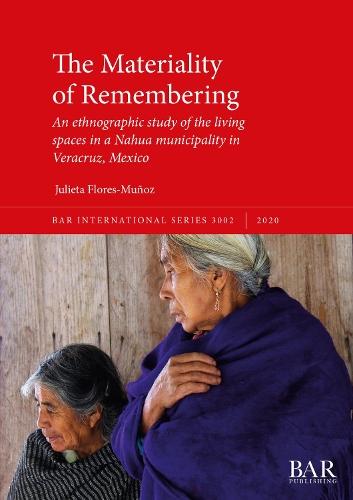
Although oral narrations are the way in which history has survived in Mexican indigenous contexts, they have been long disregarded as a valid source of information for archaeological research. The Materiality of Remembering argues that orality as a tool for research does not only provide clues for exploring indigenous uses of space, but that these narrations become central when investigating the way materiality changes through the act of remembrance. It is then through oral histories that materiality becomes fluid-moves and changes-through the constant process of remembrance. Then, by exploring orality in Mixtla de Altamirano in the Zongolica Mountain Range, Flores-Muñoz provides a corpus of data that helps us explore the interwoven relationship established between people (in this case the Nahuas in Mixtla de Altamirano) and their material world in the process of accounting history.
Full Product Details
Author: Julieta Flores-Muñoz
Publisher: BAR Publishing
Imprint: BAR Publishing
Weight: 0.686kg
ISBN: 9781407357034
ISBN 10: 1407357034
Pages: 172
Publication Date: 29 September 2020
Audience:
Professional and scholarly
,
Professional & Vocational
Format: Paperback
Publisher's Status: Active
Availability: Available To Order 
We have confirmation that this item is in stock with the supplier. It will be ordered in for you and dispatched immediately.
Table of Contents
List of Figures List of Maps Foreword and Acknowledgements Introduction: A Nahua Melody: Material Rhythms of Houses Aims of the book Structure of the book 1. Nahuas and Their Houses: Pieces in a Puzzle 1.1. The first piece: Mixtla's official historical background 1.2. The second piece: the language Nahuatl 1.3. The third piece: the study of the 'large house' concept in Mesoamerican archaeology 1.4. The fourth piece: the uniqueness of Mixtla de Altamirano 1.5. The fifth piece: cohabitating with the past 1.6. Putting together the pieces of the puzzle: a theoretical path to exploring Mixtla's everyday life 1.6.1. Building a home: the trialectics of the space, people and things in the everyday life 1.6.2. The westernised house as a unit 1.6.3. The self-construction process: the house as a reflection of the self 1.6.4. The trialectics of the space: the daily life of houses studied in Mixtla de Altamirano 1.6.4.1. Everyday life a theory of semantic field, moments and rhythms: the fluid rhythms of material changes 1.7. Brief conclusions 2. Drawing Boundaries: Defining the Material Expression that Builds the Houses 2.1. Approaching Mixtla de Altamirano 2.1.1. Ethnography: a method, a way of analysis and a form of writing 2.1.2. When archaeologists use ethnography: a brief history of a methodological flirtation 2.1.3. Cartography: maps, drones and other equipment 2.2. From an etic to an emic approach: an intercultural dialogue 2.2.1. Interviewing elders 2.3. Other sources 2.4. Analysing the interviews: database to explore the house 2.4.1. The materials of the Nahua houses: objectivising a remembered space 2.4.2. Considerations 2.5. Ethics, politics and a brief conclusion 3. The Nahua Household: A Mishmash of Shapes and Sizes 3.1. The household in photographs: using the camera to document an 'intimate space'? 3.1.1. The house of Eli 3.1.2. The house of Matlatecoya 3.1.3. The house of Barrio Cuarto 3.1.4. Houses that float: an unplanned visit 3.1.5. The pink rooms and the CDI houses 3.1.6. The house of Alicia (a story of migration) 3.2. Representing the house through drawings 3.2.1. Mixtla's oldest household: the interviews in Barrio Cuarto 3.2.2. Drawing the government rooms 3.2.3. The map of Tlachicuapa 3.2.4. The house of Alicia in a drawing 3.3. Houses that are remembered: the materiality of a conversation 3.3.1. Structure, shape, materials and outside components of the households 3.3.2. Everyday life materials 3.3.3. The production of tochan (the use of the landscape) 3.4. Brief conclusions 4. From Smoky Kitchens to Houses: Living in Mixtla de Altamirano 4.1. Houses that reconcile time 4.2. Underlining the importance of houses: conversations with elders 4.3. Living, cooking and walking with Eli 4.3.1. The first meeting with Eli 4.3.2. Three knowledges, three generations: grandmother, mother and daughter 4.4. Tochan 'the house of all of us': one big interconnected household 4.5. The centrality of space in oral tradition: does the past become flat in the elders' accounts? 4.6. Brief conclusions 5. 'El costumbre' Summing Up Lessons, Eli and the Elders: Post-marital Residence, Inheritance and the Fight for the Smoky Kitchen 5.1. Post-marital residence 5.2. Inheriting and building the house 5.2.1. The lack of space and the equal rights between men and women 5.3. Becoming godfather 5.3.1. The Tonal among the Nahuas in Mixtla de Altamirano 5.3.2. The compadrazgo during the death ritual: fieldwork notes 5.4. The tequitl/faenas: 'the work that we do that benefits all of us' 5.5. Brief conclusions 6. Mapping to Understand the Experience of Space: The Everyday Life Activities and the Narrations that Modify Materiality 6.1. Materials that speak to us: the heart of the household and the importance of saints, fire and smoke 6.2. Spaces that tell stories: rhythms of everyday life, oral tradition and living memory 6.3. Materials that build the self, collective practices and the objects that transcend time and space: flute and drum that made the house 6.4. Narrating materials: archaeologists as storytellers reinforcing oral tradition 6.5. Brief conclusions Conclusion, Summary and Further Research Suggestions for future work Bibliography Appendix A
Reviews
{\rtf1\ansi\ansicpg1252\deff0\deflang2057{\fonttbl{\f0\fswiss\fprq2\fcharset0 Calibri;}{\f1\fnil\fcharset0 Verdana;}} \viewkind4\uc1\pard\sa160\sl252\slmult1\f0\fs22\lquote The data are new and fascinating in many ways, especially in revealing some very interesting features of the history and social circumstances of the Nahua, their relationship with the land and dwelling. The spatial variation in architecture with a single social group is fascinating. This is one of the most interesting and absorbing discussions of ethnographic re-orientation (changing the nature and subject of research through encounter and engagement) that I have read for some time.\rquote Professor Colin Richards, University of the Highlands and Islands\par \pard\f1\fs17\par }
{\rtf1\ansi\ansicpg1252\deff0\deflang2057{\fonttbl{\f0\fswiss\fprq2\fcharset0 Calibri;}{\f1\fnil\fcharset0 Verdana;}} \viewkind4\uc1\pard\sa160\sl252\slmult1\f0\fs22\lquote The data are new and fascinating in many ways, especially in revealing some very interesting features of the history and social circumstances of the Nahua, their relationship with the land and dwelling. The spatial variation in architecture with a single social group is fascinating. This is one of the most interesting and absorbing discussions of ethnographic re-orientation (changing the nature and subject of research through encounter and engagement) that I have read for some time.\rquote Professor Colin Richards, University of the Highlands and Islands\par \pard\f1\fs17\par }
Author Information
Julieta Flores-Muñoz holds a PhD in Archaeology from the University of Southampton. She has a strong interest in Mesoamerican landscape and urban understandings and the way people preserve knowledge. Julieta has wide experience working within indigenous communities from different parts of Mexico.
Tab Content 6
Author Website:
Countries Available
All regions
|