Awards
- Joint winner of A TLS (Times Literary Supplement) Book of the Year 2024 (UK)
Overview
Michael Goldfarb's translator and guide when covering the Second Gulf War for NPR in 2003 was Ahmad Shawkat, an Iraqi Kurd who longed for Iraq to be free from tyranny. Not long after the USA had declared victory, Shawkat was assassinated by one of the Islamic terror groups he had railed about. Ahmad Shawkat was an Iraqi Kurd who edited his own radical magazine-Bilattijah-during the last years of Saddam Hussein's rule and wrote enthusiastically about Iraq's future as a state free from tyranny, secular and religious, for which he was imprisoned and tortured on four different occasions. When Michael Goldfarb went to Iraq the cover the Second Gulf War for the US's National Public Radio in 2003, Shawkat became his translator, guide and close friend, and they planned to stay in close contact after Saddam was toppled and Goldfarb returned home. Their plans did not work out. Shortly after the USA military had declared victory, Shawkat was shot to death outside his office in Mosul by one of the Islamic terror groups he had railed about. The identity of his killers has never been established but Goldfarb swore to memorialise his life in a book, first published in 2005, now republished under a new title to mark the 21st anniversary of the war. AUTHOR: Michael Goldfarb is an award-winning author, documentarian and podcaster. A native New Yorker, he moved to London in 1985 and spent many years covering conflicts and attempts at conflict resolution in Northern Ireland, Bosnia and Iraq for NPR (National Public Radio) in the USA. Since 1993, the BBC has sent him back to America periodically to report on social and cultural changes in his homeland subsequent to his relocation. More recently he has been charting the rise, fall and persis- tence of Donald Trump in a series of radio documentaries for the BBC; on his FRDH (First Rough Draft of History) podcast (goldfarbpod.com); and at his substack, History of a Calamity (michaelgoldfarb.substack. com). His journalism has won the highest honours on both sides of the Atlantic including the DuPont-Columbia Award, the Overseas Press Club's Lowell Thomas Award in America and the Sony Gold award in Britain. He has also been a fellow at the Joan Shorenstein Center on Press and Politics at Harvard's John F. Kennedy School of Government. His life as a reporter has led to his writing books. The book on which the present volume is based-Ahmad's War, Ahmad's Peace: Surviving Under Saddam, Dying in the New Iraq-followed his experiences as an unembedded reporter in Kurdistan during the first phase of Gulf War II, between March and April 2003. It was named a New York Times Notable Book of 2005.
Full Product Details
Author: Michael Goldfarb
Publisher: EnvelopeBooks
Imprint: EnvelopeBooks
Dimensions:
Width: 12.70cm
, Height: 2.50cm
, Length: 20.30cm
Weight: 0.439kg
ISBN: 9781915023070
ISBN 10: 1915023076
Pages: 390
Publication Date: 15 September 2024
Audience:
Professional and scholarly
,
Professional & Vocational
Format: Paperback
Publisher's Status: Active
Availability: In Print

This item will be ordered in for you from one of our suppliers. Upon receipt, we will promptly dispatch it out to you. For in store availability, please contact us.
Reviews
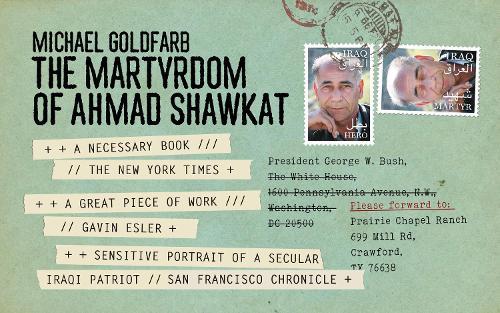
"Praise for The Martyrdom of Ahmad Shawkat, a New York Times Notable Book of the Year ""A poignant, sad tale.""-Booklist ""In the end, Goldfarb-a supporter of the U.S. war and caustic critic of Saddam- concludes that the death of his friend is symbolic of the American failure in Iraq, from not preventing the looting after the invasion to the continued inability to provide security to the freed people."" -Greg Mitchell, Editor and Publisher ""Occasionally . . . there emerge individuals who rise above the surface and remind us all what is right and true, and why humanity will always have hope. . . . Ahmad Shawkat was such a man. A Kurd raised in Mosul, a poet and a humanist, he was a lighthouse of inspiration for those who knew him. Now Ahmad's story may do the same for all of us through the vivid portrait painted with Michael Goldfarb's pen. The tragic story of his life, and murder, is one that no historian or soldier, no statesman or humanitarian, can afford to miss. . . . Read this, and you will understand."" -Robert Bateman, author of No Gun Ri: A Military History of the Korean War Incident ""Whether one supports or opposes the war, Goldfarb's book helps explain, at a person-to-person level, what is transpiring in Iraq and why."" -Bernadette Murphy, Los Angeles Times ""A sad and necessary book that distills all of the country's blighted hopes in one man. Shakwat . . . was one of the good guys."" -Dexter Filkins, New York Times Book Review ""Goldfarb does us an immense service with his sensitive, multifaceted portrait of a democratic, secular Iraqi patriot. . . . Among the best of the growing number of accounts of the Iraq War."" -John Brady, San Francisco Chronicle ""Goldfarb draws a delicate portrait of his friend and of the growing chaos and disillusionment of Iraqi society."" -Publishers Weekly ""A moving story . . . An exciting account of Kurdish survival, a poignant justification for intellectual dissent against totalitarianism, and a depiction of active faith in the universal relevance of democracy."" -Library Journal"
Praise for The Martyrdom of Ahmad Shawkat, a New York Times Notable Book of the Year “A poignant, sad tale.”—Booklist “In the end, Goldfarb—a supporter of the U.S. war and caustic critic of Saddam— concludes that the death of his friend is symbolic of the American failure in Iraq, from not preventing the looting after the invasion to the continued inability to provide security to the freed people.” —Greg Mitchell, Editor and Publisher “Occasionally . . . there emerge individuals who rise above the surface and remind us all what is right and true, and why humanity will always have hope. . . . Ahmad Shawkat was such a man. A Kurd raised in Mosul, a poet and a humanist, he was a lighthouse of inspiration for those who knew him. Now Ahmad’s story may do the same for all of us through the vivid portrait painted with Michael Goldfarb’s pen. The tragic story of his life, and murder, is one that no historian or soldier, no statesman or humanitarian, can afford to miss. . . . Read this, and you will understand.” —Robert Bateman, author of No Gun Ri: A Military History of the Korean War Incident “Whether one supports or opposes the war, Goldfarb’s book helps explain, at a person-to-person level, what is transpiring in Iraq and why.” —Bernadette Murphy, Los Angeles Times “A sad and necessary book that distills all of the country’s blighted hopes in one man. Shakwat . . . was one of the good guys.” —Dexter Filkins, New York Times Book Review “Goldfarb does us an immense service with his sensitive, multifaceted portrait of a democratic, secular Iraqi patriot. . . . Among the best of the growing number of accounts of the Iraq War.” —John Brady, San Francisco Chronicle “Goldfarb draws a delicate portrait of his friend and of the growing chaos and disillusionment of Iraqi society.” —Publishers Weekly “A moving story . . . An exciting account of Kurdish survival, a poignant justification for intellectual dissent against totalitarianism, and a depiction of active faith in the universal relevance of democracy.” —Library Journal
Author Information
Michael Goldfarb is an award-winning author, documentarian and podcaster. A native New Yorker, he moved to London in 1985 and spent many years covering conflicts and attempts at conflict resolution in Northern Ireland, Bosnia and Iraq for NPR (National Public Radio) in the USA. Since 1993, the BBC has sent him back to America periodically to report on social and cultural changes in his homeland subsequent to his relocation. More recently he has been charting the rise, fall and persistence of Donald Trump in a series of radio documentaries for the BBC; on his FRDH (First Rough Draft of History) podcast (goldfarbpod.com); and at his substack, History of a Calamity (michaelgoldfarb.substack. com). His journalism has won the highest honours on both sides of the Atlantic including the DuPont-Columbia Award, the Overseas Press Club’s Lowell Thomas Award in America and the Sony Gold award in Britain. He has also been a fellow at the Joan Shorenstein Center on Press and Politics at Harvard’s John F. Kennedy School of Government.” His life as a reporter has led to his writing books. The book on which the present volume is based―Ahmad’s War, Ahmad’s Peace: Surviving Under Saddam, Dying in the New Iraq―followed his experiences as an unembedded reporter in Kurdistan during the first phase of Gulf War II, between March and April 2003. It was named a New York Times Notable Book of 2005.