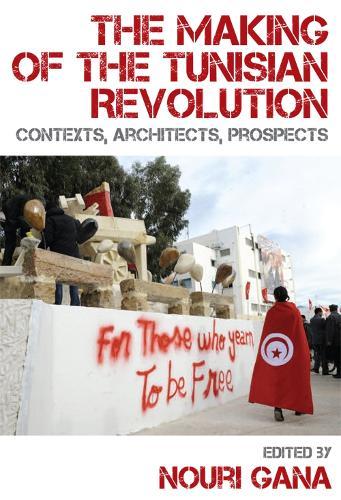
Full Product Details
Author: Nouri Gana (Associate Professor of Comparative Literature & Near Eastern Languages and Cultures, University of California, Los Angeles)
Publisher: Edinburgh University Press
Imprint: Edinburgh University Press
Dimensions:
Width: 15.60cm
, Height: 3.00cm
, Length: 23.40cm
Weight: 0.525kg
ISBN: 9780748691043
ISBN 10: 0748691049
Pages: 352
Publication Date: 07 September 2013
Audience:
College/higher education
,
Undergraduate
,
Postgraduate, Research & Scholarly
Format: Paperback
Publisher's Status: Active
Availability: Manufactured on demand

We will order this item for you from a manufactured on demand supplier.
Reviews
"Such a relatively short historical period has been treated with a rare depth and a meticulous selection of the issues and dynamics that combine to make Tunisia a case study so interesting to those who analyse the Arab world today.'-- ""British Journal of Middle Eastern Studies, Vol. 41, No. 4"" The Making of the Tunisian Revolution offers an early and impressive appraisal of the roots and results of a revolution that came to alter the political landscape of the Arab world for good.--Catherine and Bruce Bastian Professor of Global and Transnational Studies, University of Illinois ""Asef Bayat"" This is a readable, strong book whose authors individually and collectively narrate and contextualise Tunisia's revolution masterfully. No other text on the Arab World's first revolution matches this book in terms of substance, evidence, intelligence and clarity of purpose and direction. Nouri Gana and his co-authors must be applauded for finally giving readers a book the chief distinction of which is rich food for thought for all types of readers - the specialist and the lay. This is a work that reveals under-studied dimensions and new angles, presenting the revolutionary foundation in greater depth and detail than any book I have read so far in English and French on the Tunisian political tsunami of 2011. It is a definite must.--specialist on Arab democratisation, University of Exeter, Qatar University, Al Jazeera English columnist ""Larbi Sadiki"" The Making of the Tunisian Revolution is what an edited volume about Tunisia should be: holistic, polemic, and strategically incendiary. Each chapter is placed to bring into question much of what the media has presented as truth. Herein lays the opportunity to be guided by experts who lead us through the Tunisian revolution into the post-revolution present. Reading this volume compels us to reconsider the standard Tunisia we are often provided: a progressive oasis in ""the region,"" a liberal and neoliberal economic success story for international lending institutions and their cronies to hold up as proof that (so-called) free market capitalism works.--Claire Oueslati-Porter, Florida International University ""Middle East Media and Book Reviews"" The seismic event surrounding Tunisia's Arab Spring has reverberated throughout the world creating in its wake a multitude of observational accounts seeking to explain the Tunisian phenomenon. Yet few have been able to provide the kind of contextual richness and analytical sharpness as the authors of this edited volume. Conceptualized within a historically defined pathway, The Making of the Tunisian Revolution creatively intersects contexts, architects, and prospects to provide a compelling narrative within which to understand the multilayered character of the Tunisian revolutionary experience. Meticulously researched by authors with direct experience in the country, this multi-disciplinary and highly readable book should find a wide audience within academic and policy circles as it constitutes the most authoritative, fair-minded, and deeply informed account of the Tunisian revolution yet published.--Professor of Political Science at Fordham University ""John P. Entelis"""
'Such a relatively short historical period has been treated with a rare depth and a meticulous selection of the issues and dynamics that combine to make Tunisia a case study so interesting to those who analyse the Arab world today.' --British Journal of Middle Eastern Studies, Vol. 41, No. 4
'Such a relatively short historical period has been treated with a rare depth and a meticulous selection of the issues and dynamics that combine to make Tunisia a case study so interesting to those who analyse the Arab world today.' -- British Journal of Middle Eastern Studies, Vol. 41, No. 4
Author Information
Nouri Gana is Associate Professor of Comparative Literature & Near Eastern Languages and Cultures at UCLA. He is the author of Signifying Loss: Toward a Poetics of Narrative Mourning (2011) and editor of The Making of the Tunisian Revolution: Contexts, Architects, Prospects (EUP, 2013) and The Edinburgh Companion to the Arab Novel in English (Edinburgh University Press, 2013).