|
|
|||
|
||||
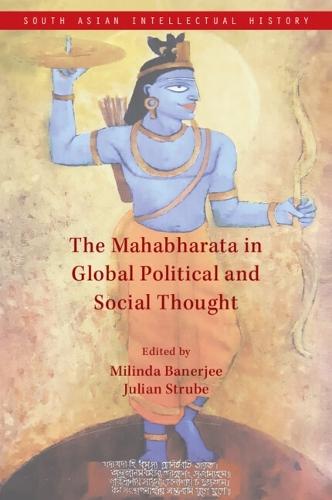
OverviewThe ancient Indian epic, Mahabharata, was first composed in Sanskrit and then rendered into Indian vernaculars and other Asian and European languages. This book demonstrates how the epic has shaped the birth of modern politics and thought across India, Europe, Japan, China, Thailand, Iran, and the Arab world. It draws on methodologies of global intellectual and religious history. The contributing authors are specialists on various world-regions. They reveal how kings and peasants, statesmen and revolutionaries, intellectuals, and activists, have invoked the epic to forge their political visions over the past centuries. The epic has thus contributed to state formation, nationalism, as well as the decolonization and democratization of the modern world. This book helps us understand the non-Eurocentric roots of modern political and social ideas, in India and across Asia and Europe. We thereby understand the global origins of contemporary politics, society, and democracy. Full Product DetailsAuthor: Milinda Banerjee (University of St Andrews, United Kingdom) , Julian Strube (Georg-August-Universität, Göttingen, Germany)Publisher: Cambridge University Press Imprint: Cambridge University Press ISBN: 9781009484688ISBN 10: 1009484680 Pages: 300 Publication Date: 06 March 2025 Audience: General/trade , General Format: Hardback Publisher's Status: Active Availability: Manufactured on demand We will order this item for you from a manufactured on demand supplier. Table of ContentsAcknowledgements; A Note on Transliteration; Introduction Milinda Banerjee and Julian Strube; 1. The Mahabharata and the Making of Modern India Milinda Banerjee; 2. 'Epic' Past, 'Modern' Present: The Mahabharata and Modern Nationalism in Colonial Western India Alok Oak; 3. The Bhagavadgita and the Gandhian Hermeneutic of Non-Violence: Globalizing Selfless Action Arkamitra Ghatak; 4. A Nostalgia for Transcendental Closure: The Relationship between the Mahabharata and Notions of Nationalism in the Works of Friedrich Schlegel, Maithilisharan Gupt, and Jawaharlal Nehru Philipp Spernervi; 5. The Production and Deconstruction of the 'Ideal Indian Woman' on the Basis of the Mahabharata in the Twentieth and Twenty-First Centuries Melanie J. Müller; 6. Rethinking Transnational Intellectual History and Epic Nationalisms through Lithographic Labour: Persian and Urdu Mahabharatas in India and Iran Amanda Lanzillo; 7. 'Philosophical Poetry' or a 'Failed Beginning'? A Metaphilosophical Enquiry into Wilhelm von Humboldt's and G. W. F. Hegel's Perspectives on the Bhagavadgita Paulus Kaufmann; 8. East Asian Uses of Indian Epic Literature: Refractions of the Mahabharata in Japan and China, Late Nineteenth–Early Twentieth Century Egas Moniz Bandeira; 9. The Reception of the Mahabharata in Siam: Evolving Conceptions of Kingship David M. Malitz; 10. Understanding Global Intellectual Exchanges through Paratexts: Wadiʿ al-Bustani's Introduction to His Arabic Translation of the Mahabharata Christopher D. Bahl and Abdallah Soufan; About the Contributors; Index.ReviewsAuthor InformationMilinda Banerjee is a lecturer in the history of modern political thought and political theory at the University of St Andrews, Scotland. His research interests lie in Intellectual History, Global History, South Asian history, and Political Thought. He is the author of The Mortal God: Imagining the Sovereign in Colonial India (2018). Julian Strube is professor of Religious Studies at the University of Göttingen. He works from a global historical perspective about the relationship between religion and politics, as well as debates about the meaning of religion, science, and philosophy. He is the author of Global Tantra: Religion, Science, and Nationalism in Colonial Modernity (Oxford University Press, 2022). Tab Content 6Author Website:Countries AvailableAll regions |
||||