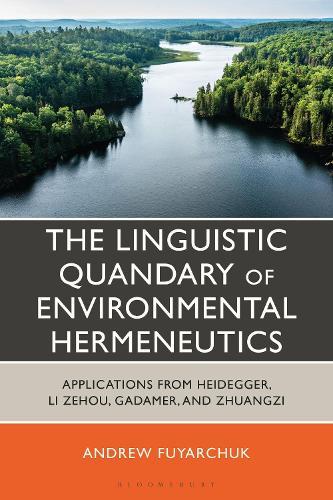
Full Product Details
Author: Andrew Fuyarchuk
Publisher: Bloomsbury Publishing Plc
Imprint: Rowman & Littlefield
Dimensions:
Width: 15.40cm
, Height: 1.80cm
, Length: 23.20cm
Weight: 0.480kg
ISBN: 9781666961096
ISBN 10: 1666961094
Pages: 214
Publication Date: 19 March 2026
Audience:
Professional and scholarly
,
Professional & Vocational
Format: Hardback
Publisher's Status: Active
Availability: Manufactured on demand

We will order this item for you from a manufactured on demand supplier.
Reviews
This book lays the groundwork for a hermeneutics of nature and the environment by relying on Gadamer’s productive metaphysical reading of Plato, which sets him apart from Heidegger’s attempt to overcome metaphysics, and by practicing a fruitful form of East-West comparative philosophy that rests on an impressive familiarity with Chinese and especially Daoist thinking. This hermeneutics of the environment practices the dialogue between world cultures that Gadamer called for. -- Jean Grondin * Université de Montréal, Canada * Andrew Fuyarchuk’s The Linguistic Quandary of Environmental Hermeneutics is a rare philosophical achievement—both erudite and quietly visionary. Through a luminous dialogue between Heidegger, Gadamer, Li Zehou, and Zhuangzi, Fuyarchuk transforms environmental hermeneutics from a theoretical field into a living art of listening. He shows that language is not a human instrument applied to nature, but the rhythm in which nature itself discloses meaning. His synthesis of phenomenology and Chinese thought reveals how understanding can become ecological—how words breathe, sediment, and return to the world that first gave them life. Original, exacting, and at times lyrical, this book invites readers to inhabit the fragile interval where speech becomes care and philosophy begins to sound like the earth thinking through us. -- Zhang Ping * Tel Aviv University, Israel * In The Linguistic Quandary of Environmental Hermeneutics: Applications from Heidegger, Li Zehou, Gadamer, and Zhuangzi, Andrew Fuyarchuk asserts that environmental hermeneutics remains lodged within an anthropocentric worldview distanced from existential preconditions of its own claims about the “thing itself.” Fuyarchuk revisits Martin Heidegger’s leap into phusis (nature) through engaging counter-arguments by Heideggerian Daoists Jay Goulding and Bret Davis as a philosophical anthropology that includes a divided ontology: being-nature and being-in-the-world. This is explored by way of Li Zehou’s theory of sedimentation and the “naturalization of human beings” during the transformation of nature, alongside an interpretation of Hans-Georg Gadamer that develops affinities with a Chinese “one-world view” from the Daoist Zhuangzi. Fuyarchuk’s incorporation of Chinese philosophy (Li Zehou, Daoist Heideggerians and Daoist ecologists) into contemporary hermeneutics attests to cross-cultural research for advancing philosophical anthropology that includes a pre-linguistic and trans-historical disposition. His understanding of conditions for a hermeneutics of nature within “nature” are above all called for in the midst of a planetary climate crisis. Fuyarchuk’s work is a valuable contribution to contemporary environmental philosophy, hermeneutics, and philosophical anthropology. Well researched and written with passion and bravado, Fuyarchuk’s book is a must read for interdisciplinary scholars, novices and specialists alike. -- Jay Goulding * York University, Canada *
This book lays the groundwork for a hermeneutics of nature and the environment by relying on Gadamer’s productive metaphysical reading of Plato, which sets him apart from Heidegger’s attempt to overcome metaphysics, and by practicing a fruitful form of East-West comparative philosophy that rests on an impressive familiarity with Chinese and especially Daoist thinking. This hermeneutics of the environment practices the dialogue between world cultures that Gadamer called for. -- Jean Grondin * Université de Montréal *
Author Information
Andrew Fuyarchuk teaches comparative religion at Yorkville University, Ontario, Canada.