|
|
|||
|
||||
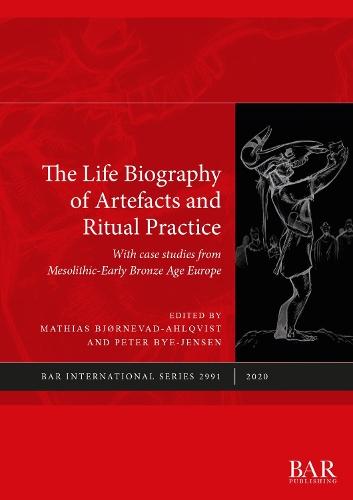
OverviewInspired by a session held at the EAA conference in Vilnius in 2016, The Life Biography of Artefacts and Ritual Practice focuses on creating biographies from material culture as a means of understanding the relationship between the life of an artefact, the temporality of ritual practices and an object's final deposition. The temporal and geographic scope of these chapters range from Mesolithic Scandinavia, Neolithic practices found across Eastern, Central, Northern and Western Europe and stretches into the Eneolithic, Copper Age and early Bronze Age of central Europe. This volume explores the idea that one can create a narrative of an artefacts' life-biography by engaging various scientific methods and theoretical approaches. With a foreword by Joshua Pollard. Full Product DetailsAuthor: Mathias Bjørnevad-Ahlqvist , Peter Bye-JensenPublisher: BAR Publishing Imprint: BAR Publishing Weight: 0.558kg ISBN: 9781407356822ISBN 10: 1407356828 Pages: 140 Publication Date: 28 July 2020 Audience: Professional and scholarly , Professional & Vocational Format: Paperback Publisher's Status: Active Availability: Available To Order We have confirmation that this item is in stock with the supplier. It will be ordered in for you and dispatched immediately. Table of ContentsPreface: Small traces, big issues Joshua Pollard Bibliography Foreword 1. Taking a closer look - causewayed enclosures through the lens of a large-scale use-wear analysis project Peter Bye-Jensen Introduction Method of investigation Selection Conclusion Bibliography 2. Endless life of tools and vessels from the Neolithic contexts in SW Poland Bernadeta Kufel-Diakowska, Marta Mozgala-Swacha, Joanna Kaluzna-Czaplinska, Angelina Rosiak, Henryk Stoksik Introduction Materials and methods Sickle blades Ceramic vessels Discussion and conclusions Acknowledgements References 3. Grinding tools and circular enclosures: Activities on late Neolithic settlements Jaroslav Rídký, Markéta Koncelová, Pavel Burgert, Radka Sumberová, and Roman Hadacz Introduction Rondels and grinding tools Grinding tools - their basic characteristics The Vchynice case site The Kolín I case site The Jaromer case site The Prísovice case site Conclusion Acknowledgements References 4. Amber discs with cross decoration from the eastern Baltic region. A research case study from the Daktariske 5 Neolithic settlement, western Lithuania Adomas Butrimas, Tomas Rimkus, and Gvidas Slah Introduction Methods Use-wear analysis FTIR and micro FT-Raman spectral analysis Daktariske 5 Neolithic settlement Location and topography Excavations and cultural layer Finds and chronology The amber disc with cross decoration Use-wear analysis FTIR and micro FT-Raman spectral analysis Discussion and final remarks Acknowledgements References 5. The role of chipped stone artefacts in the Late Neolithic burial practices at the site Alsónyék (Southern Hungary) Kata Szilágyi Introduction Materials and methods Results Raw materials and its distribution Distribution of raw material and technological categories of oval-shaped burials Distribution of raw material and technological categories of rectangular-shaped burials Discussion Conclusion Acknowledgments References 6. Useful, beautiful or ritual? The life biography of grave goods from a Prehistoric burial ground Raluca Kogalniceanu Introduction The site of Cernavoda Several starting questions 1. When does the biography of an object begins and ends? 2. How does an object gain a life biography? 3. What measuring unit should be used for life biographies? Types of life biographies A. Long life biographies B. Medium life biographies C. Short life biographies Spondylus objects Marble objects Long life biographies (II): polished stone tools Medium life biographies (various objects) Polished stone tools Animal bone tool Silicolite chipped tool Pottery Short life biographies (various objects) An overview Ritual or profane biographies? Acknowledgements References 7. Practical and symbolic aspects of the life cycle of arrowheads in Central Europe, 2,400-1,800 BC Ludmila Kanáková Introduction Methods Analysis of the life cycle of projectiles Conclusion Acknowledgements References 8. From the living to the dead: Lithics as a part of grave goods of the TRB culture in Denmark Marzena Cendrowska Flint in ritual - the symbolic meaning of lithics Approaches to ritual Symbolic meaning of artefacts Sites and artefacts Technological analysis - the birth of the artefacts Debitage Tools Use wear analysis - the life of the artefacts Lithics in graves - the burial of the artefacts Discussion Does burial reflect everyday life? - comparison with settlements Conclusions References 9. Ritual use of flint - flintscape in action Lars Larsson Introduction Wetland deposits of flint tools A case study Landscape and depositions Axes and megalithic tombs Axes and the deceased Polished and unpolished axes Axe and Palisades Passage by fire Conclusion References 10. A relational perspective on entangled biographies in Southern Scandinavian Mesolithic hoards Mathias Bjørnevad-Ahlqvist Introduction Setting the stage: A brief overview of Mesolithic hoards and the research history Theoretical and methodological framework Entangled biographies in Southern Scandinavian Mesolithic hoards Different sources Different producers Different use-life history Different degrees of curation Physical transformation via destruction Making sense of the variability: the application of relational ontologies Concluding remarks ReferencesReviews{\rtf1\ansi\ansicpg1252\deff0\deflang2057{\fonttbl{\f0\fswiss\fprq2\fcharset0 Calibri;}{\f1\fnil\fcharset0 Verdana;}} \viewkind4\uc1\pard\sa160\sl252\slmult1\f0\fs22\lquote\i The life Biography of Objects and Ritual Practice \i0 constitutes an important contribution to our knowledge on the role of artefacts found next to the dead or in sites interpreted by archaeologists as ritual. This volume collects data from a geographical area where the archaeological record is extremely rich and diverse, providing novel approaches and interpretations on the symbolic significance of objects, their lifecycles and their ultimate purpose.\rquote Dr Ana Cristina Reis Silva Ara\'fajo, CIBIO \par \pard\f1\fs17\par } Author InformationMathias Bjørnevad-Ahlqvist completed his PhD at the University of Aarhus in 2019. This research focused on the biography of Mesolithic and Neolithic ritual hoarding. Mathias also has wider interests including the application of cognitive science of religion, analysis of legacy material and Native American objects in Danish regional museums Peter Bye-Jensen completed his PhD at the University of Southampton/Cardiff University in 2019. The focus of this research was the nature and temporality of the activities centred around early Neolithic monuments, specifically causewayed enclosures. Peter now works as Heritage Manager for The Cabrach Trust, a community development organisation in North Eastern Scotland, where his role involves exploring the region's rich but little-known whisky distilling heritage. List of contributors: Mathias Bjørnevad-Ahlqvist, Pavel Burgert, Adomas Butrimas, Peter Bye-Jensen, Marzena Cendrowska, Roman Hadacz, Ludmila Kanáková, Raluca Kogalniceanu, Markéta Koncelová, Bernadeta Kufel-Diakowska, Joanna Kaluzna-Czaplinska, Lars Larsson, Marta Mozgala-Swacha, Jaroslav Rídký, Tomas Rimkus, Angelina Rosiak, Gvidas Slah, Henryk Stoksik, Radka Sumberová, Kata Szilágyi. Tab Content 6Author Website:Countries AvailableAll regions |
||||