Awards
- Winner of Winner, 2024 C.B. Macpherson Prize, Canadian Political Science Association.
Overview
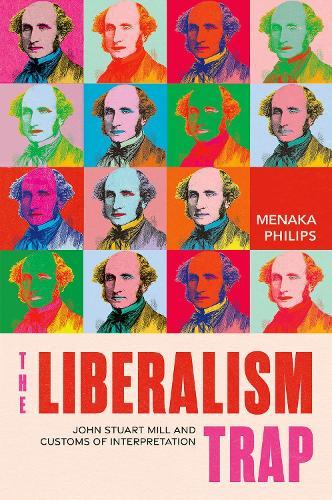
Arguments about liberalism's meanings, endurance, imminent death, or revival are widespread in modern political thought. But what effect do these preoccupations with liberalism have on the way political questions are taken up? In The Liberalism Trap, Menaka Philips argues that the focus on liberalism has become a customary limit on our political imaginations. To examine the costs of that custom, Philips turns to John Stuart Mill-the so-called paradigmatic liberal. As she argues, Mill's famed liberal status is habitually substituted for his political arguments such that the now standard association of Mill with liberalism determines how and why he is read. Philips, however, takes a break from that ready association. Her comparative reading of Mill's work concerning women's emancipation, class reform, and the British Empire recovers a thinker guided not by the ideological certainties he is often made out to represent, but by a politics of uncertainty-a politics which generated radical, gradualist, and paternalist strategies throughout his proposals on domestic and imperial questions. By reading Mill against the limits of liberalism, Philips draws out the possibilities and risks of Mill's own political practice, while inviting a critical evaluation of the customs of interpretation that shape contemporary political thought.
Full Product Details
Author: Menaka Philips (Assistant Professor of Political Science, Assistant Professor of Political Science, University of Toronto)
Publisher: Oxford University Press Inc
Imprint: Oxford University Press Inc
Dimensions:
Width: 23.70cm
, Height: 2.10cm
, Length: 16.30cm
Weight: 0.508kg
ISBN: 9780197658550
ISBN 10: 0197658555
Pages: 232
Publication Date: 11 September 2023
Audience:
Professional and scholarly
,
Professional & Vocational
Format: Hardback
Publisher's Status: Active
Availability: To order

Stock availability from the supplier is unknown. We will order it for you and ship this item to you once it is received by us.
Reviews
Philips has achieved an impressive feat. She reexamines John Stuart Mill's innovative but well-trodden theorizing about gender justice, class inequality, democracy, and colonialism in a novel way. With an emphasis on Mill's understanding of uncertainty and his incorporation of radical ideas that transgress liberal orthodoxies—despite his status as a liberal icon—Philips illuminates tensions in Mill's thought to expose the intellectual constraints of liberalism. * Bruce Baum, Associate Professor of Political Science, University of British Columbia * In The Liberalism Trap, Menaka Philips offers a superb account of liberalism and its limits. Developing an original reading of John Stuart Mill as an exponent of political uncertainty, while showing how liberalism has come to frame and constrain the political imagination, she makes an important contribution to both intellectual history and methodological debates about the character of political theory. * Duncan Bell, Professor of Political Thought and International Relations, University of Cambridge * A brilliant and profoundly original reading of John Stuart Mill's political philosophy, The Liberalism Trap unshackles Mill from the liberal straitjacket to which both admirers and critics have confined him for nearly two centuries. By recovering the subtlety and deep-seated heterodoxy of Mill's uncertain mode of thought, this book offers a welcome reminder of what we miss by treating him as little more than a liberal avatar. At once a disciplinary provocation, methodological intervention, and incisive contribution to scholarship on liberalism and the history of political thought, Philips models the kind of intellectual capaciousness that she draws out of Mill himself. Against our all-too-common lapses into doctrinal certainties, The Liberalism Trap shows us how much we stand to gain by reading what's actually on the page. * Inder S. Marwah, Associate Professor of Political Science, McMaster University * The Liberalism Trap is an elegantly constructed and important investigation into both the thought of John Stuart Mill and the status and consequences of the term 'liberalism' as a primary frame for political inquiry and public debate. Drawing on his Autobiography, Menaka Philips stresses the central role of uncertainty in Mill's thought, and traces this through a number of central issues, from women's equality to questions of empire. In so doing, The Liberalism Trap points towards a new understanding of Mill's thought and to the possibilities of political thinking unshackled from the burdens of what we have come to call 'liberalism'. * David Williams, Professor of Politics and International Relations, Queen Mary University of London *
Philips has achieved an impressive feat. She reexamines John Stuart Mill's innovative but well-trodden theorizing about gender justice, class inequality, democracy, and colonialism in a novel way. With an emphasis on Mill's understanding of uncertainty and his incorporation of radical ideas that transgress liberal orthodoxies-despite his status as a liberal icon-Philips illuminates tensions in Mill's thought to expose the intellectual constraints of liberalism. * Bruce Baum, Associate Professor of Political Science, University of British Columbia * In The Liberalism Trap, Menaka Philips offers a superb account of liberalism and its limits. Developing an original reading of John Stuart Mill as an exponent of political uncertainty, while showing how liberalism has come to frame and constrain the political imagination, she makes an important contribution to both intellectual history and methodological debates about the character of political theory. * Duncan Bell, Professor of Political Thought and International Relations, University of Cambridge * A brilliant and profoundly original reading of John Stuart Mill's political philosophy, The Liberalism Trap unshackles Mill from the liberal straitjacket to which both admirers and critics have confined him for nearly two centuries. By recovering the subtlety and deep-seated heterodoxy of Mill's uncertain mode of thought, this book offers a welcome reminder of what we miss by treating him as little more than a liberal avatar. At once a disciplinary provocation, methodological intervention, and incisive contribution to scholarship on liberalism and the history of political thought, Philips models the kind of intellectual capaciousness that she draws out of Mill himself. Against our all-too-common lapses into doctrinal certainties, The Liberalism Trap shows us how much we stand to gain by reading what's actually on the page. * Inder S. Marwah, Associate Professor of Political Science, McMaster University * The Liberalism Trap is an elegantly constructed and important investigation into both the thought of John Stuart Mill and the status and consequences of the term 'liberalism' as a primary frame for political inquiry and public debate. Drawing on his Autobiography, Menaka Philips stresses the central role of uncertainty in Mill's thought, and traces this through a number of central issues, from women's equality to questions of empire. In so doing, The Liberalism Trap points towards a new understanding of Mill's thought and to the possibilities of political thinking unshackled from the burdens of what we have come to call 'liberalism'. * David Williams, Professor of Politics and International Relations, Queen Mary University of London *
Author Information
Menaka Philips is Assistant Professor of Political Science at the University of Toronto. She writes on a range of issues in historical and contemporary political thought and has published in journals such as The American Political Science Review, European Journal of Political Theory, and Signs: Journal of Women in Culture and Society.