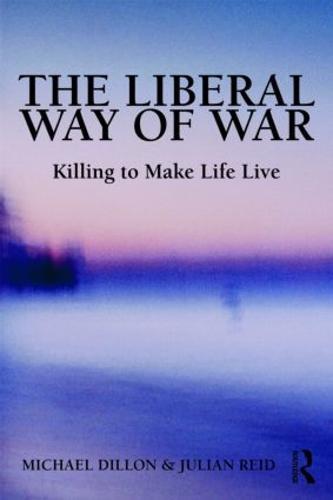
Full Product Details
Author: Michael Dillon (University of Lancaster, UK) ,
Julian Reid (University of Lapland, Finland.)
Publisher: Taylor & Francis Ltd
Imprint: Routledge
Weight: 0.452kg
ISBN: 9780415952996
ISBN 10: 0415952999
Pages: 208
Publication Date: 20 February 2009
Audience:
College/higher education
,
Professional and scholarly
,
Tertiary & Higher Education
,
Undergraduate
Format: Hardback
Publisher's Status: Active
Availability: In Print

This item will be ordered in for you from one of our suppliers. Upon receipt, we will promptly dispatch it out to you. For in store availability, please contact us.
Reviews
The Liberal Way of War is a remarkable book: theoretically sophisticated and conceptually nuanced. Building on, critiquing, and updating Foucault's analyses of biopower and liberal governmental strategies, Dillon and Reid provide a powerful and challenging account of how contemporary politics operates both globally and over life itself. Stuart Elden, Professor of Political Geography, Durham University and author of Terror and the State of Territory (University of Minnesota Press, 2009). The Liberal Way of War will prove essential reading for anyone perplexed by Foucault's pithy observation -- that 'massacres have become vital'. Not only does the book shed new light on such topics as the liberal rationalization of killing, the humanitarianization of biopolitics, and the informationalization of war; it shows there to be complex relationships between them. William Walters, Associate Professor, Department of Political Science and Department of Sociology and Anthropology, Carleton University, Canada. Although it has long been asserted that liberal democracy, like any political system, is based not simply on consensus but also on the exercise of violence, Dillon and Reid cast new light on an old problem by bringing it into the information age -- which for them is also the age of biopolitics . They argue that liberalism must be understood neither simply in terms of individual rights, nor as an economic system, but as effort to organize the reproduction of life through breeding and adaptation as being-in-formation . The militarization of politics thus emerges as a necessary correlative of a politics that increasingly identifies the protection of life -- security -- with the administration of death. A provocative thesis that will be a focus of discussion in the years to come. Samuel Weber, Avalon Professor of Humanities, Northwestern University, USA
'The Liberal Way of War is a remarkable book: theoretically sophisticated and conceptually nuanced. Building on, critiquing, and updating Foucault's analyses of biopower and liberal governmental strategies, Dillon and Reid provide a powerful and challenging account of how contemporary politics operates both globally and over life itself.' - Stuart Elden, Professor of Political Geography, Durham University and author of Terror and the State of Territory (University of Minnesota Press, 2009). 'The Liberal Way of War will prove essential reading for anyone perplexed by Foucault's pithy observation - that 'massacres have become vital'. Not only does the book shed new light on such topics as the liberal rationalization of killing, the humanitarianization of biopolitics, and the informationalization of war; it shows there to be complex relationships between them.' - William Walters, Associate Professor, Department of Political Science and Department of Sociology and Anthropology, Carleton University, Canada. 'Although it has long been asserted that liberal democracy, like any political system, is based not simply on consensus but also on the exercise of violence, Dillon and Reid cast new light on an old problem by bringing it into the information age -- which for them is also the age of biopolitics . They argue that liberalism must be understood neither simply in terms of individual rights, nor as an economic system, but as effort to organize the reproduction of life through breeding and adaptation as being-in-formation . The militarization of politics thus emerges as a necessary correlative of a politics that increasingly identifies the protection of life -- security -- with the administration of death. A provocative thesis that will be a focus of discussion in the years to come.' - Samuel Weber, Avalon Professor of Humanities, Northwestern University, USA 'The Liberal Way of War concedes to realism the inevitability of war in the system while suggesting a different account of how it comes about. Rather than looking to the pathologies of an anarchic international order, Dillon and Reid implore us to interrogate the pathologies of liberal biopolitics.' - Times Higher Education Supplement
Author Information
University of Lancaster, UK King's College. London, UK