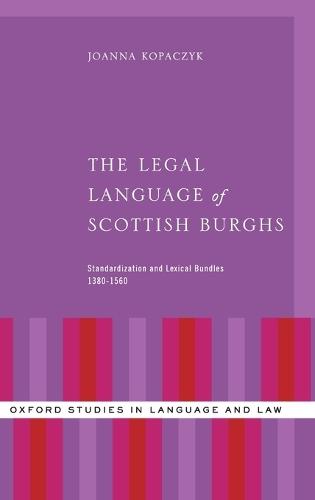
Full Product Details
Author: Joanna Kopaczyk (Assistant Professor of History of English, Assistant Professor of History of English, Adam Mickiewicz University (Poland))
Publisher: Oxford University Press Inc
Imprint: Oxford University Press Inc
Dimensions:
Width: 23.40cm
, Height: 3.30cm
, Length: 16.30cm
Weight: 0.612kg
ISBN: 9780199945153
ISBN 10: 0199945152
Pages: 368
Publication Date: 12 September 2013
Audience:
Professional and scholarly
,
Professional & Vocational
Format: Hardback
Publisher's Status: Active
Availability: Available To Order

We have confirmation that this item is in stock with the supplier. It will be ordered in for you and dispatched immediately.
Reviews
<br> This study is impressive in its scope, ranging from a detailed description of the social organization and the practice of law in medieval Scottish burghs, to reporting the results of sophisticated corpus-driven linguistic investigations of Scottish legal documents. The study is especially innovative in its application of corpus analysis to identify lexical bundles, phraseological chunks of language that are used to structure texts, tracing textual standardization patterns in Scots legal and administrative texts based on the use of lexical bundles. As such, the book will become required reading for scholars from many subfields, including the study of legal discourse, historical discourse analysis, literacy and standardization, and the application of corpus-driven methods in historical textual analysis. --Douglas Biber, Northern Arizona University<p><br> This is so much more than a historical study of legal Scots; it shows the power of an interdisciplinary approach by combining some of the hottest techniques in historical corpus linguistics with rich assessments of the socio-pragmatic context. Scholarly yet reader-friendly; it should be on reading lists! --Jonathan Culpeper, Lancaster University, UK<p><br> Joanna Kopaczyk's book is a work which demands an audience beyond the specialists who might be attracted by its title. It is indeed an important intervention in the study of the specialised legal discourse which emerged in late medieval/Early Modern Scotland. However it is also an exciting contribution to the emerging field of 'pragmaphilology' or historical pragmatics, i.e. the study of how language works in complex historical contexts. The underpinning methodology for the book, drawing on the latest techniques in the analysis of electronic corpora, should be required reading for all researchers interested in such matters. I recommend it without qualification. --Jeremy Smith, University of Glasgow, UK<p><br>
This study is impressive in its scope, ranging from a detailed description of the social organization and the practice of law in medieval Scottish burghs, to reporting the results of sophisticated corpus-driven linguistic investigations of Scottish legal documents. The study is especially innovative in its application of corpus analysis to identify lexical bundles, phraseological chunks of language that are used to structure texts, tracing textual standardization patterns in Scots legal and administrative texts based on the use of lexical bundles. As such, the book will become required reading for scholars from many subfields, including the study of legal discourse, historical discourse analysis, literacy and standardization, and the application of corpus-driven methods in historical textual analysis. --Douglas Biber, Northern Arizona University This is so much more than a historical study of legal Scots; it shows the power of an interdisciplinary approach by combining some of the hottest techniques in historical corpus linguistics with rich assessments of the socio-pragmatic context. Scholarly yet reader-friendly; it should be on reading lists! --Jonathan Culpeper, Lancaster University, UK Joanna Kopaczyk's book is a work which demands an audience beyond the specialists who might be attracted by its title. It is indeed an important intervention in the study of the specialised legal discourse which emerged in late medieval/Early Modern Scotland. However it is also an exciting contribution to the emerging field of 'pragmaphilology' or historical pragmatics, i.e. the study of how language works in complex historical contexts. The underpinning methodology for the book, drawing on the latest techniques in the analysis of electronic corpora, should be required reading for all researchers interested in such matters. I recommend it without qualification. --Jeremy Smith, University of Glasgow, UK
Author Information
Joanna Kopaczyk (Ph.D. Poznan, Poland, 2002) studies historical texts in context. She combines corpus linguistics with historical discourse analysis, especially in the study of specialized discourse in Scotland and England. She has delivered invited talks at linguistic departments in Poland, Germany, Finland and the UK, and presented her research at over thirty international conferences in the USA, Europe, and Australia, as well as in numerous peer-reviewed publications, including a monograph on a Middle Scots dialect (2004).