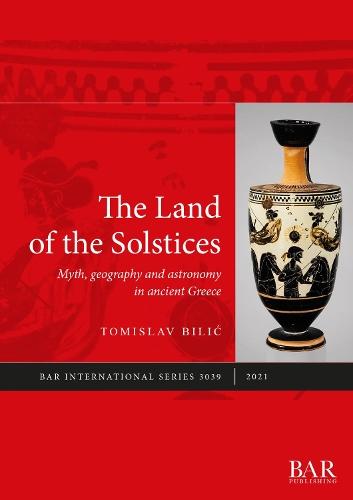
The Land of the Solstices: Myth, geography and astronomy in ancient Greece

Author:   Tomislav Bilic
Publisher:   BAR Publishing
ISBN:  

9781407358628


Pages:   212
Publication Date:   30 July 2021
Format:   Paperback
Availability:   Available To Order   Availability explained
We have confirmation that this item is in stock with the supplier. It will be ordered in for you and dispatched immediately.

Our Price $174.64 Quantity:  
Add to Cart

Share |

The Land of the Solstices: Myth, geography and astronomy in ancient Greece


Overview

Full Product Details

Author:   Tomislav Bilic
Publisher:   BAR Publishing
Imprint:   BAR Publishing
Weight:   0.845kg
ISBN:  

9781407358628


ISBN 10:   1407358626
Pages:   212
Publication Date:   30 July 2021
Audience:   Professional and scholarly ,  Professional & Vocational
Format:   Paperback
Publisher's Status:   Active
Availability:   Available To Order   Availability explained
We have confirmation that this item is in stock with the supplier. It will be ordered in for you and dispatched immediately.

Table of Contents

List of figures Abstract 1. Introduction 1.1. Selective interpretation of myth 1.2. Ethnographic context 1.3. Inclusive definitions of science 1.4. Myth and physical phenomena 1.5. Myth and ancient science 1.6. Anthropomorphisation and narrativisation 1.7. Observational data in myths 1.8. Mythic models 1.9. Conclusion Part One: Annual solar movement 2. The Laestrygonians and the geographical arctic circle 2.1. Interpreting the 'meteorological' facet of the Lastrygonian episode 2.2. Crates' interpretation of the Laestrygonian passage 2.3. Crates' interpretation and arctic circle 2.4. The limits of the annual solar movement 2.5. Arctic circle in epic poetry 2.6. Laestrygonia, the sun and the Otherworld 2.7. Conclusion 3. The Bear Mountain 3.1. The Cyzicus episode 3.2. Celestial bears at the solstice island 3.3. A pre-Homeric Argonautica 3.4. Conclusion 4. Snatched away by the gust of wind 4.1. The island of turning 4.2. The Harpies and eschatology 4.3. Other mythic snatchings 4.4. The snatchings in their solar context 4.5. An alternative model-cosmological solstice mountain 4.6. A reinterpretation of the northern mountains model 4.7. A region outside the sun's course in non-Greek traditions 4.8. Conclusion 5. The island of the sun's turning 5.1. The concept of solstices in early Greek tradition 5.2. Heliotropia and the localisations of Homeric tropai êelioio 5.3. The localisations of Homeric tropai êelioio in the context of solar movement 5.4. Pytheas' Thule and the turnings of the sun 5.5. Conclusion 6. Pytheas and Hecataeus: Britain and Hyperborea 6.1. Pytheas and the northern barbarians 6.2. Britain in the wake of Pytheas 6.3. Hecataeus' Hyperborea 6.4. Hyperboreans, Apollo and Celts 6.5. Conclusion 7. Apollo's Hyperborean voyage: a narrative model of solar movement 7.1. Delphian traditions 7.2. Athenian and Delian traditions 7.3. Beyond calendar 7.4. Apollo and the solstice island 7.5. Conclusion 8. 'Hyperborean Apollo's' swan chariot 8.1. Hyacinthus-a convergence of literary and iconographic testimonies 8.2. Archaeological evidence 8.2.1. Dupljaja 8.2.2. Northern Europe 8.2.3. Italy 8.2.4. Eastern Alpine region 8.2.5. Possible Central European parallels 8.2.6. The Aegean 8.3. Methodological procedure for comparison of literary and iconographic record 8.3.1. Material evidence for past beliefs 8.3.2. Reading the visual language 8.3.3. Structural analysis of visual language 8.3.4. The transfer of meaning 8.3.5. The transfer of beliefs 8.3.6. Transfer of complex symbolic structures 8.3.7. The Dupljaja model as a complex symbolic structure accompanied by a muthos 8.3.8. Comparison of literary sources with iconography 8.4. Concluding remarks: large-scale context, anthropomorphism and the contents of the muthos Part Two: Diurnal solar movement 9. Diurnal path of the Sun in Greek tradition 9.1. The high northern mountain 9.2. The southerly path of the sun 9.3. Diurnal solar movement in Homer 9.4. The sun's cup and its southerly course 9.5. Stesichorus' account of the sun's voyage in a cup 9.6. Hesiod's house of Night in the light of the 'uni-polar' model 9.7. The sun's cup and Heracles 9.8. Iconographical testimonies for the sun in a cup 9.9. The Presocratic tradition of the sun's bowl 9.10. Non-Greek traditions of the sun travelling in a boat 9.11. Conclusion 10. Liminal imagery in the accounts of solar movement assimilated to the world of the dead 10.1. Hesiods' concept of the daylight/night exchange 10.2. Corresponding models in Mesopotamian tradition 10.3. Homer, Hesiod and the liminal features in Hades 10.4. Gates of the otherworld assimilated to the gates of the sun 10.5. The Pylian gates 10.6. The White Rock and the Odyssey 10.7. Pherecydes' gates 10.8. Conclusion 11. Aea and the voyage of the Argonauts 11.1. The return of the Argonauts 11.2. Circe, Calypso and the Argonauts' return voyage 11.3. Conclusion 12. World of the Dead at the Antipodes 12.1. Hades at the antipodes conceived in terms of the diurnal solar movement 12.2. Later testimonies for an antipodal Hades conceived in terms of solar movement 12.3. Hades at the celestial 'antipodes' 12.4. The antipodal world of the dead in non-Greek traditions 12.5. Navigating to the Otherworld in Greek and non-Greek traditions 12.6. Conclusion 13. Beyond Odysseus: Gilgames 13.1. Gilgames breaking a path for Odysseus 13.2. The twin mountain 13.3. Scorpion-men 13.4. Gilgames on the diurnal course of the sun 13.5. Gilgames arrives at the mouth of the rivers 13.6. Dilmun 13.7. 'The mouth of the rivers' outside the Mesopotamian tradition 13.8. From Gilgames to Odysseus 13.9. Conclusion 14. Beyond Odysseus: Alexander 14.1. Hellenistic tradition 14.2. Land of Darkness 14.3. Mount Mûsas 14.4. Mount Mûsas in later tradition 14.5. Alexander in the far north in the Islamic tradition 14.6. Conclusion 15. Conclusion 15.1. An outline of the main

Reviews

{\rtf1\ansi\ansicpg1252\deff0\deflang2057{\fonttbl{\f0\fnil\fcharset0 Calibri;}{\f1\fnil\fcharset238 Calibri;}{\f2\fswiss\fprq2\fcharset0 Calibri;}{\f3\fnil\fcharset0 Verdana;}} \viewkind4\uc1\pard\sa160\sl252\slmult1\f0\fs22\lquote The Land of the Solstices is an exhaustive study of solar myths and their underlying geographical and astronomical conceptions, in the first place in Homer\rquote s Odyssey, but also in ancient Greek poetry, prose and early works on geography and astronomy, with enlightening excursions into other (mainly Mesopotamian and Egyptian) mythological traditions. It will be a treasure trove for scholars.\rquote Dr Dirk L. Couprie, Universiteit Leiden, The Netherlands\par \lquote The author left no stone unturned: there is no ancient author, to my knowledge, pertinent to this theme that is not quoted, technically and scientifically accurately, and then incorporated into his theory and re-evaluated in accordance with his theory.\rquote Professor \f1 Marina Mili\'e6evi\'e6 Brada\'e8\f0 , University of Zagreb, Croatia\f2\par \lquote This book offers a renovated look into some old issues in the field of Greek myth studies with valuable contributions, especially for myths that might be connected to astronomy and geography. This book will be of great interest to historians of religions and myth and for classical historians in general.\rquote \lang3082 Dr A. C\'e9sar Gonz\'e1lez-Garc\'eda, Institute of Heritage Sciences, Santiago de Compostela, Spain\par \pard\lang2057\f3\fs17\par }


{\rtf1\ansi\ansicpg1252\deff0\deflang2057{\fonttbl{\f0\fnil\fcharset0 Calibri;}{\f1\fnil\fcharset238 Calibri;}{\f2\fswiss\fprq2\fcharset0 Calibri;}{\f3\fnil\fcharset0 Verdana;}} \viewkind4\uc1\pard\sa160\sl252\slmult1\f0\fs22\lquote The Land of the Solstices is an exhaustive study of solar myths and their underlying geographical and astronomical conceptions, in the first place in Homer\rquote s Odyssey, but also in ancient Greek poetry, prose and early works on geography and astronomy, with enlightening excursions into other (mainly Mesopotamian and Egyptian) mythological traditions. It will be a treasure trove for scholars.\rquote Dr Dirk L. Couprie, Universiteit Leiden, The Netherlands\par \lquote The author left no stone unturned: there is no ancient author, to my knowledge, pertinent to this theme that is not quoted, technically and scientifically accurately, and then incorporated into his theory and re-evaluated in accordance with his theory.\rquote Professor \f1 Marina Mili\'e6evi\'e6 Brada\'e8\f0 , University of Zagreb, Croatia\f2\par \lquote This book offers a renovated look into some old issues in the field of Greek myth studies with valuable contributions, especially for myths that might be connected to astronomy and geography. This book will be of great interest to historians of religions and myth and for classical historians in general.\rquote \lang3082 Dr A. C\'e9sar Gonz\'e1lez-Garc\'eda, Institute of Heritage Sciences, Santiago de Compostela, Spain\par \pard\lang2057\f3\fs17\par }


Author Information

Tomislav Bilic works at the Archaeological Museum in Zagreb. He studied at the Zagreb Faculty of Humanities and Social Sciences, where he obtained his BA and Ph.D. in archaeology (prehistoric and classical). He is the author of several books, book chapters and papers published in a number of international journals.

Tab Content 6

Author Website:  

Countries Available

All regions
Latest Reading Guide

April RG 26_2


Shopping Cart
Your cart is empty
Shopping cart
Mailing List