Overview
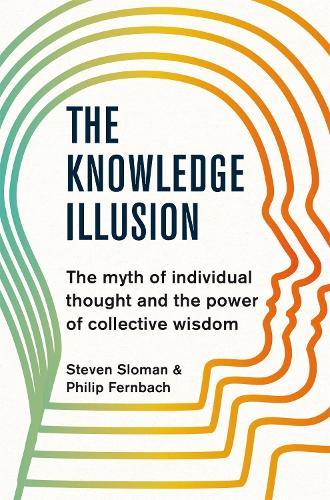
Human reasoning is remarkably shallow - in fact, our thinking and justifications just scratch the surface of the true complexity of the issues we deal with. The ability to think may still be the greatest wonder in the world (and beyond), but the way that individuals think is less than ideal. In The Knowledge Illusion, Sloman and Fernbach show that our intelligence resides not in individual brains but in the collective mind. To function, individuals rely not only on knowledge that is stored within our skulls but also on knowledge stored elsewhere, be it in our bodies, in the environment or especially in other people. Put together, human thought is incredibly impressive, but at its deepest level it never belongs to any individual alone. And yet the mind supports the most sublime, incredible phenomenon of all: consciousness. How can any of this be possible with a mind that is so imperfect? This is one of the key challenges confronted in this book. The Knowledge Illusion ties together established scientific facts whilst also considering what the mind is for. Understanding why the mind is as it is, and what it is for, will show why we need to consider it as extending beyond our skulls; why we should think about 'the mind' as far more than an extension of the brain but as an emergence from multiple brains interacting. Simply put, individuals know relatively little, but the human hive that emerges when people work together knows a lot.
Full Product Details
Author: Steven Sloman ,
Philip Fernbach
Publisher: Pan Macmillan
Imprint: Pan Books
Dimensions:
Width: 13.00cm
, Height: 1.90cm
, Length: 19.80cm
Weight: 0.216kg
ISBN: 9781509813087
ISBN 10: 150981308
Pages: 304
Publication Date: 23 August 2018
Recommended Age: From 18 years
Audience:
General/trade
,
General
Format: Paperback
Publisher's Status: Active
Availability: To order

Stock availability from the supplier is unknown. We will order it for you and ship this item to you once it is received by us.
Reviews
In The Knowledge Illusion, the cognitive scientists Steven Sloman and Philip Fernbach hammer another nail into the coffin of the rational individual . . . positing that not just rationality but the very idea of individual thinking is a myth. -- Yuval Harari, bestselling author of <i>Sapiens </i>and <i>Homo Deus</i> Sloman and Fernbach offer clever demonstrations of how much we take for granted, and how little we actually understand . . . The book is stimulating, and any explanation of our current malaise that attributes it to cognitive failures - rather than putting it down to the moral wickedness of one group or another - is most welcome. Sloman and Fernbach are working to uproot a very important problem. * Financial Times * We all know less than we think we do, including how much we know about how much we know. There's no cure for this condition, but there is a treatment: this fascinating book. The Knowledge Illusion is filled with insights on how we should deal with our individual ignorance and collective wisdom. -- Steven Pinker We radically overestimate how much we know. In this fascinating book, Steven Sloman and Philip Fernbach examine the origin and consequences of this knowledge illusion, exploring both the extent of our ignorance and the clever ways in which we overcome it. This is an exceptionally clear and well-reasoned book, and it has some important and radical things to say about everything from the allure of stories to how iPhones make us smarter to the pros and cons of democracy. This is psychology at its best. -- Paul Bloom I love this book. A brilliant, eye-opening treatment of how little each of us knows, and how much all of us know. It's magnificent, and it's also a lot of fun. Read it! -- Cass R. Sunstein, coauthor of <i>Nudge</i> and founder and director, Program on Behavioral Economics and Public Policy, Harvard Law School
In The Knowledge Illusion, the cognitive scientists Steven Sloman and Philip Fernbach hammer another nail into the coffin of the rational individual . . . positing that not just rationality but the very idea of individual thinking is a myth. -- Yuval Harari, bestselling author of <i>Sapiens </i>and <i>Homo Deus</i> Sloman and Fernbach offer clever demonstrations of how much we take for granted, and how little we actually understand . . . The book is stimulating, and any explanation of our current malaise that attributes it to cognitive failures — rather than putting it down to the moral wickedness of one group or another — is most welcome. Sloman and Fernbach are working to uproot a very important problem. * Financial Times * We all know less than we think we do, including how much we know about how much we know. There's no cure for this condition, but there is a treatment: this fascinating book. The Knowledge Illusion is filled with insights on how we should deal with our individual ignorance and collective wisdom. -- Steven Pinker We radically overestimate how much we know. In this fascinating book, Steven Sloman and Philip Fernbach examine the origin and consequences of this knowledge illusion, exploring both the extent of our ignorance and the clever ways in which we overcome it. This is an exceptionally clear and well-reasoned book, and it has some important and radical things to say about everything from the allure of stories to how iPhones make us smarter to the pros and cons of democracy. This is psychology at its best. -- Paul Bloom I love this book. A brilliant, eye-opening treatment of how little each of us knows, and how much all of us know. It's magnificent, and it's also a lot of fun. Read it! -- Cass R. Sunstein, coauthor of <i>Nudge</i> and founder and director, Program on Behavioral Economics and Public Policy, Harvard Law School
I love this book. A brilliant, eye-opening treatment of how little each of us knows, and how much all of us know. It's magnificent, and it's also a lot of fun. Read it! -- Cass R. Sunstein, coauthor of <i>Nudge</i> and founder and director, Program on Behavioral Economics and Public Policy, Harvard Law School We radically overestimate how much we know. In this fascinating book, Steven Sloman and Philip Fernbach examine the origin and consequences of this knowledge illusion, exploring both the extent of our ignorance and the clever ways in which we overcome it. This is an exceptionally clear and well-reasoned book, and it has some important and radical things to say about everything from the allure of stories to how iPhones make us smarter to the pros and cons of democracy. This is psychology at its best. -- Paul Bloom We all know less than we think we do, including how much we know about how much we know. There's no cure for this condition, but there is a treatment: this fascinating book. The Knowledge Illusion is filled with insights on how we should deal with our individual ignorance and collective wisdom. -- Steven Pinker Sloman and Fernbach offer clever demonstrations of how much we take for granted, and how little we actually understand . . . The book is stimulating, and any explanation of our current malaise that attributes it to cognitive failures - rather than putting it down to the moral wickedness of one group or another - is most welcome. Sloman and Fernbach are working to uproot a very important problem. * Financial Times * In The Knowledge Illusion, the cognitive scientists Steven Sloman and Philip Fernbach hammer another nail into the coffin of the rational individual . . . positing that not just rationality but the very idea of individual thinking is a myth. -- Yuval Harari, bestselling author of <i>Sapiens </i>and <i>Homo Deus</i>
Author Information
Author Website: https://sites.google.com/site/philfernbachswebpage/
Steven Sloman is a Professor of Cognitive, Linguistic and Psychological Sciences at Brown University where he has worked since 1992. He is currently Editor-in-Chief of the journal Cognition. Phil Fernbach is a cognitive scientist and professor of marketing at the University of Colorado at Boulder. He has written for and had his work profiled in numerous publications such as the New York Times, the Wall Street Journal and BBC World News.