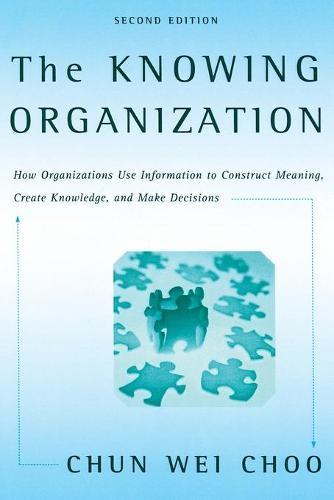
Full Product Details
Author: Choo
Publisher: Oxford University Press Inc
Imprint: Oxford University Press Inc
Edition: 2nd edition
Dimensions:
Width: 15.50cm
, Height: 1.70cm
, Length: 23.40cm
Weight: 0.508kg
ISBN: 9780195176780
ISBN 10: 0195176782
Pages: 368
Publication Date: 27 October 2005
Audience:
College/higher education
,
Tertiary & Higher Education
Format: Paperback
Publisher's Status: Active
Availability: Manufactured on demand

We will order this item for you from a manufactured on demand supplier.
Reviews
Professor Choo has taken on the enormous challenge of integrating research in organizational theory and information science in order to understand how organizations can become better information-processing systems. Working from this perspective as a professor of information studies, Choo integrates apparently divergent points of view from the literature on meaning construction and sense making, knowledge creation and building, and decision making. His purpose is to propose a framework of the 'knowing' organization. The strength of his work lies in the breadth of research he has covered in each of these domains. --Dorothy Leonard, Harvard University<br> A very readable and informative compendium and synthesis of the large array of contributions that have been made to the management and development of knowledge within organizations. A must for the knowing manager.--Russell L. Ackoff, University of Pennsylvania<br> A fluent, persuasive, elegant writer, Choo convinces us that to survive and prosper, an understanding of how people use information in organizations is fundamental.--Ethel Auster, University of Toronto<br>
<br> Professor Choo has taken on the enormous challenge of integrating research in organizational theory and information science in order to understand how organizations can become better information-processing systems. Working from this perspective as a professor of information studies, Choo integrates apparently divergent points of view from the literature on meaning construction and sense making, knowledge creation and building, and decision making. His purpose is to propose a framework of the 'knowing' organization. The strength of his work lies in the breadth of research he has covered in each of these domains. --Dorothy Leonard, Harvard University<p><br> A very readable and informative compendium and synthesis of the large array of contributions that have been made to the management and development of knowledge within organizations. A must for the knowing manager.--Russell L. Ackoff, University of Pennsylvania<p><br> A fluent, persuasive, elegant writer, Choo convinces us that to
""Professor Choo has taken on the enormous challenge of integrating research in organizational theory and information science in order to understand how organizations can become better information-processing systems. Working from this perspective as a professor of information studies, Choo integrates apparently divergent points of view from the literature on meaning construction and sense making, knowledge creation and building, and decision making. His purpose is to propose a framework of the 'knowing' organization. The strength of his work lies in the breadth of research he has covered in each of these domains.""--Dorothy Leonard, Harvard University ""A very readable and informative compendium and synthesis of the large array of contributions that have been made to the management and development of knowledge within organizations. A must for the knowing manager.--Russell L. Ackoff, University of Pennsylvania ""A fluent, persuasive, elegant writer, Choo convinces us that to survive and prosper, an understanding of how people use information in organizations is fundamental.--Ethel Auster, University of Toronto ""Professor Choo has taken on the enormous challenge of integrating research in organizational theory and information science in order to understand how organizations can become better information-processing systems. Working from this perspective as a professor of information studies, Choo integrates apparently divergent points of view from the literature on meaning construction and sense making, knowledge creation and building, and decision making. His purpose is to propose a framework of the 'knowing' organization. The strength of his work lies in the breadth of research he has covered in each of these domains.""--Dorothy Leonard, Harvard University ""A very readable and informative compendium and synthesis of the large array of contributions that have been made to the management and development of knowledge within organizations. A must for the knowing manager.--Russell L. Ackoff, University of Pennsylvania ""A fluent, persuasive, elegant writer, Choo convinces us that to survive and prosper, an understanding of how people use information in organizations is fundamental.--Ethel Auster, University of Toronto
<br> Professor Choo has taken on the enormous challenge of integrating research in organizational theory and information science in order to understand how organizations can become better information-processing systems. Working from this perspective as a professor of information studies, Choo integrates apparently divergent points of view from the literature on meaning construction and sense making, knowledge creation and building, and decision making. His purpose is to propose a framework of the 'knowing' organization. The strength of his work lies in the breadth of research he has covered in each of these domains. --Dorothy Leonard, Harvard University<p><br> A very readable and informative compendium and synthesis of the large array of contributions that have been made to the management and development of knowledge within organizations. A must for the knowing manager.--Russell L. Ackoff, University of Pennsylvania<p><br> A fluent, persuasive, elegant writer, Choo convinces us that to survive and prosper, an understanding of how people use information in organizations is fundamental.--Ethel Auster, University of Toronto<p><br>
"""Professor Choo has taken on the enormous challenge of integrating research in organizational theory and information science in order to understand how organizations can become better information-processing systems. Working from this perspective as a professor of information studies, Choo integrates apparently divergent points of view from the literature on meaning construction and sense making, knowledge creation and building, and decision making. His purpose is to propose a framework of the 'knowing' organization. The strength of his work lies in the breadth of research he has covered in each of these domains.""--Dorothy Leonard, Harvard University ""A very readable and informative compendium and synthesis of the large array of contributions that have been made to the management and development of knowledge within organizations. A must for the knowing manager.--Russell L. Ackoff, University of Pennsylvania ""A fluent, persuasive, elegant writer, Choo convinces us that to survive and prosper, an understanding of how people use information in organizations is fundamental.--Ethel Auster, University of Toronto ""Professor Choo has taken on the enormous challenge of integrating research in organizational theory and information science in order to understand how organizations can become better information-processing systems. Working from this perspective as a professor of information studies, Choo integrates apparently divergent points of view from the literature on meaning construction and sense making, knowledge creation and building, and decision making. His purpose is to propose a framework of the 'knowing' organization. The strength of his work lies in the breadth of research he has covered in each of these domains.""--Dorothy Leonard, Harvard University ""A very readable and informative compendium and synthesis of the large array of contributions that have been made to the management and development of knowledge within organizations. A must for the knowing manager.--Russell L. Ackoff, University of Pennsylvania ""A fluent, persuasive, elegant writer, Choo convinces us that to survive and prosper, an understanding of how people use information in organizations is fundamental.--Ethel Auster, University of Toronto"
<br> Professor Choo has taken on the enormous challenge of integrating research in organizational theory and information science in order to understand how organizations can become better information-processing systems. Working from this perspective as a professor of information studies, Choo integrates apparently divergent points of view from the literature on meaning construction and sense making, knowledge creation and building, and decision making. His purpose is to propose a framework of the 'knowing' organization. The strength of his work lies in the breadth of research he has covered in each of these domains. --Dorothy Leonard, Harvard University<br> A very readable and informative compendium and synthesis of the large array of contributions that have been made to the management and development of knowledge within organizations. A must for the knowing manager.--Russell L. Ackoff, University of Pennsylvania<br> A fluent, persuasive, elegant writer, Choo convinces us that to survi
Author Information
Chun Wei Choo is Professor of the Faculty of Information Studies at the University of Toronto. His recent books include The Strategic Management of Intellectual Capital and Organizational Knowledge (OUP, 2002), Information Management for the Intelligent Organization (2001), and Web Work: Information Seeking and Knowledge Work on the World Wide Web (2000).