Overview
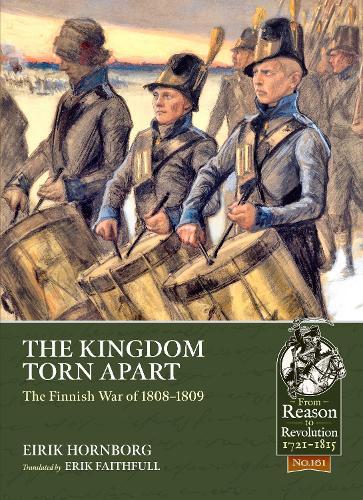
The Kingdom Torn Apart is a comprehensive study of the 1808-1809 war between Russia and Sweden-Finland. It is a translation of perhaps the best single-volume account of the conflict, written in the 1950s by Eirik Hornborg, one of Finland's leading and most prolific historical writers. On 21 February 1808, two Russian divisions spearheaded an invasion of Finland. Despite poor defensive preparations and questionable leadership, together with the early loss of the fortress of Sveaborg and much of the archipelago fleet, there was some spirited resistance and the occasional victory against the invaders, but the whole of Finland was occupied by the end of November. Following a remarkable Russian invasion of the Swedish mainland across the frozen Gulf of Bothnia in March 1809 and a coup to overthrow the unpopular King Gustav IV Adolf, the war then continued until September, when a peace settlement ceded Finland to Russia. No comprehensive study of the Finnish War of 1808-1809 has previously been available in English. The Kingdom Torn Apart, a translation of Hornborg's När riket sprängdes, aims to fill this gap. Hornborg drew first and foremost on the nine-volume Swedish General Staff History, supplemented by his meticulous research and critical analysis of source material. He aimed to create a readable and popular work whilst maintaining a strictly objective and scholarly approach. AUTHOR: Eirik Hornborg (1879-1965) was a Finnish politician, teacher, rhetorician, author and one of its leading and most prolific historical writers, much of his work relating to his country's military history. He is credited with over 1400 published writings including 54 books. He had seen brief wartime service at the age of 36 as a volunteer in a German jaeger battalion fighting the Russians on the eastern front 1916-17, and wrote of his experiences in a memoir in 1959. He was chairman of the Swedish Literary Society in Finland 1934-47 and received honorary doctorates at both the University of Stockholm (1936) and Helsinki (1950). A recent biography summarizes Hornborg's character as a 'fearless truth seeker and rights campaigner.' 51 b/w illustrations, 7 b/w photos, 26 colour illustrations, 4 colour photos, 22 b/w maps, 2 tables
Full Product Details
Author: Eirik Hornborg ,
Erik Faithfull
Publisher: Helion & Company
Imprint: Helion & Company
ISBN: 9781804519868
ISBN 10: 1804519863
Pages: 328
Publication Date: 15 March 2026
Audience:
Adult education
,
Further / Higher Education
Format: Paperback
Publisher's Status: Forthcoming
Availability: Not yet available

This item is yet to be released. You can pre-order this item and we will dispatch it to you upon its release.
Author Information
Eirik Hornborg (1879-1965) was a Finnish politician, teacher, rhetorician, author and one of its leading and most prolific historical writers, much of his work relating to his country's military history. He is credited with over 1400 published writings including 54 books. He had seen brief wartime service at the age of 36 as a volunteer in a German jaeger battalion fighting the Russians on the eastern front 1916-17, and wrote of his experiences in a memoir in 1959. He was chairman of the Swedish Literary Society in Finland 1934-47 and received honorary doctorates at both the University of Stockholm (1936) and Helsinki (1950). A recent biography summarizes Hornborg's character as a 'fearless truth seeker and rights campaigner.' Erik Faithfull has had a life-long interest in military history, most recently that of his Scandinavian ancestry. He is a descendant of both Carl Magnus Hultin and Carl Gustav Armfelt: the latter was the subject of his first translated work for Helion, Carl Gustav Armfelt and the Struggle for Finland during the Great Northern War.