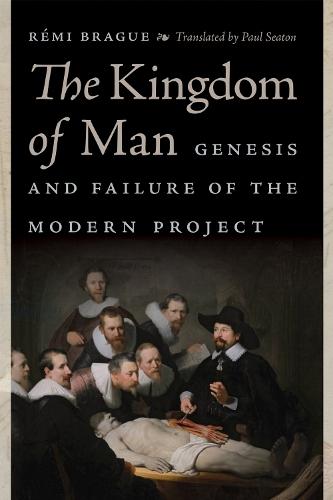
Full Product Details
Author: Rémi Brague ,
Paul Seaton
Publisher: University of Notre Dame Press
Imprint: University of Notre Dame Press
Edition: New edition
Dimensions:
Width: 15.20cm
, Height: 2.40cm
, Length: 22.90cm
Weight: 0.687kg
ISBN: 9780268104252
ISBN 10: 0268104255
Pages: 352
Publication Date: 30 October 2018
Audience:
General/trade
,
General
Format: Hardback
Publisher's Status: Active
Availability: Manufactured on demand

We will order this item for you from a manufactured on demand supplier.
Reviews
Review for the French edition: [R�mi Brague] is aiming at something more difficult than a history of ideas. The goal is to lay bare the internal logic of modern hubris, to disinter link by link from the debris of history the chain of ideas that took us from early modern theistic humanism, through atheistic humanism, to today's regnant anti-humanism. . . . The book is nothing like a jeremiad. . . . Brague is trying to do what a philosopher at the peak of his illustrious career should do, disclose to his reader the underlying logic of the age; not offer answers, but equip the reader to find them. --Touchstone
The story may be familiar in broad outline--the death of God entails the death of man--but it has never been portrayed with both such a thorough command of the broad strokes (for example, masterful compact discussions of canonical thinkers from Francis Bacon to Heidegger) and at the same time a simply amazing wealth of detail, fine brush strokes of testimony from lesser known or practically unknown authors and artists that add vivid cultural flesh to the big story. In the end, the portrait of secular humanism's collapse upon itself is stark, more than sobering, but informed by an understated but bright hope that humanity's goodness has 'anchors in the heavens.' --Ralph Hancock, Brigham Young University Amid the continuing stream of books about modernity, R mi Brague's The Kingdom of Man stands alone. His treatment of the modern age is at once complex and unified, rooted in stunning erudition and an ability to construct a compelling narrative. Completing a trilogy that includes previous books on antiquity and the middle ages, Brague provides an account of the sources--textual, political, economic, and ecclesial--of our current world for which there is no substitute and no current competitor. --Thomas S. Hibbs, Distinguished Professor of Ethics and Culture, Baylor University No one ranges over the history of ideas like R mi Brague. The Kingdom of Man is not just an index of Brague's astonishing learning but a pulsing inquiry into the dreams of our modern imagination. Those dreams, contends Brague, re-worked reality itself and proposed a human innocence that is proving far from benign. --Graham James McAleer, Loyola University Maryland Review for the French edition: [R mi Brague] is aiming at something more difficult than a history of ideas. The goal is to lay bare the internal logic of modern hubris, to disinter link by link from the debris of history the chain of ideas that took us from early modern theistic humanism, through atheistic humanism, to today's regnant anti-humanism. . . . The book is nothing like a jeremiad. . . . Brague is trying to do what a philosopher at the peak of his illustrious career should do, disclose to his reader the underlying logic of the age; not offer answers, but equip the reader to find them. --Touchstone
Review for the French edition: [R mi Brague] is aiming at something more difficult than a history of ideas. The goal is to lay bare the internal logic of modern hubris, to disinter link by link from the debris of history the chain of ideas that took us from early modern theistic humanism, through atheistic humanism, to today's regnant anti-humanism. . . . The book is nothing like a jeremiad. . . . Brague is trying to do what a philosopher at the peak of his illustrious career should do, disclose to his reader the underlying logic of the age; not offer answers, but equip the reader to find them. --Touchstone
The story may be familiar in broad outline--the death of God entails the death of man--but it has never been portrayed with both such a thorough command of the broad strokes (for example, masterful compact discussions of canonical thinkers from Francis Bacon to Heidegger) and at the same time a simply amazing wealth of detail, fine brush strokes of testimony from lesser known or practically unknown authors and artists that add vivid cultural flesh to the big story. In the end, the portrait of secular humanism's collapse upon itself is stark, more than sobering, but informed by an understated but bright hope that humanity's goodness has 'anchors in the heavens.' --Ralph Hancock, Brigham Young University . . . it was a delight to turn to R mi Brague's The Kingdom of Man: Genesis and Failure of the Modern Project. This is a genuine academic work by a scholar of remarkable erudition. --Public Discourse Amid the continuing stream of books about modernity, R mi Brague's The Kingdom of Man stands alone. His treatment of the modern age is at once complex and unified, rooted in stunning erudition and an ability to construct a compelling narrative. Completing a trilogy that includes previous books on antiquity and the middle ages, Brague provides an account of the sources--textual, political, economic, and ecclesial--of our current world for which there is no substitute and no current competitor. --Thomas S. Hibbs, Distinguished Professor of Ethics and Culture, Baylor University No one ranges over the history of ideas like R mi Brague. The Kingdom of Man is not just an index of Brague's astonishing learning but a pulsing inquiry into the dreams of our modern imagination. Those dreams, contends Brague, re-worked reality itself and proposed a human innocence that is proving far from benign. --Graham James McAleer, Loyola University Maryland Review for the French edition: [R mi Brague] is aiming at something more difficult than a history of ideas. The goal is to lay bare the internal logic of modern hubris, to disinter link by link from the debris of history the chain of ideas that took us from early modern theistic humanism, through atheistic humanism, to today's regnant anti-humanism. . . . The book is nothing like a jeremiad. . . . Brague is trying to do what a philosopher at the peak of his illustrious career should do, disclose to his reader the underlying logic of the age; not offer answers, but equip the reader to find them. --Touchstone
Author Information
Rémi Brague is emeritus professor of medieval and Arabic philosophy at the University of Paris I and Romano Guardini Chair Emeritus of Philosophy at Ludwig-Maximilians-Universität (Munich). He is a member of the Institut de France and author of many books, including Curing Mad Truths: Medieval Wisdom for the Modern Age (University of Notre Dame Press, 2019). Paul Seaton is associate professor of philosophy at St. Mary's Seminary.