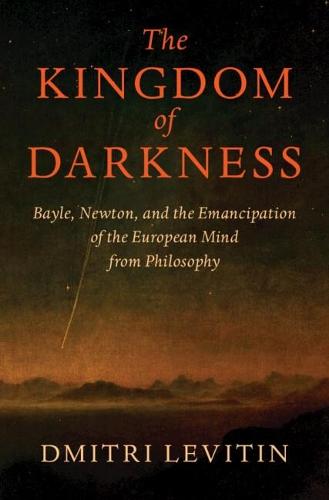
Full Product Details
Author: Dmitri Levitin (University of Oxford)
Publisher: Cambridge University Press
Imprint: Cambridge University Press
Edition: New edition
Dimensions:
Width: 15.80cm
, Height: 5.60cm
, Length: 23.60cm
Weight: 1.530kg
ISBN: 9781108837002
ISBN 10: 110883700
Pages: 980
Publication Date: 31 March 2022
Audience:
General/trade
,
General
Format: Hardback
Publisher's Status: Active
Availability: Manufactured on demand

We will order this item for you from a manufactured on demand supplier.
Reviews
'This truly monumental study calls for a Copernican revolution in our understanding of Modernity: the European Mind, Levitin argues, was not transformed by the triumph of philosophy but by emancipation from it. The evidence and acumen with which Levitin advances his bold thesis are extraordinary and will provoke debate for years to come.' Maria Rosa Antognazza, King's College London 'In his extraordinarily erudite and broad-ranging study, Levitin compels us to rethink historiographic categories such as the Scientific Revolution, the Enlightenment and the rise of modernity in Europe by charting the contingent historical conditions that prompted a momentous, yet overlooked, disciplinary reconfiguration of early-modern natural philosophy and theology; namely, the emancipation of both scientific and religious thought from traditional metaphysics and philosophical rationalism.' Niccolo Guicciardini, Universita degli Studi di Milano
'This truly monumental study calls for a Copernican revolution in our understanding of Modernity: the European Mind, Levitin argues, was not transformed by the triumph of philosophy but by emancipation from it. The evidence and acumen with which Levitin advances his bold thesis are extraordinary and will provoke debate for years to come.' Maria Rosa Antognazza, King's College London 'In his extraordinarily erudite and broad-ranging study, Levitin compels us to rethink historiographic categories such as the Scientific Revolution, the Enlightenment and the rise of modernity in Europe by charting the contingent historical conditions that prompted a momentous, yet overlooked, disciplinary reconfiguration of early-modern natural philosophy and theology; namely, the emancipation of both scientific and religious thought from traditional metaphysics and philosophical rationalism.' Niccolo Guicciardini, Universita degli Studi di Milano 'This is one of the most important publications in European intellectual history, not just of this year, but of the last decade.' Noel Malcolm, Books of the Year 2022, Times Literary Supplement
'This truly monumental study calls for a Copernican revolution in our understanding of Modernity: the European Mind, Levitin argues, was not transformed by the triumph of philosophy but by emancipation from it. The evidence and acumen with which Levitin advances his bold thesis are extraordinary and will provoke debate for years to come.' Maria Rosa Antognazza, King's College London 'In his extraordinarily erudite and broad-ranging study, Levitin compels us to rethink historiographic categories such as the Scientific Revolution, the Enlightenment and the rise of modernity in Europe by charting the contingent historical conditions that prompted a momentous, yet overlooked, disciplinary reconfiguration of early-modern natural philosophy and theology; namely, the emancipation of both scientific and religious thought from traditional metaphysics and philosophical rationalism.' Niccolò Guicciardini, Università degli Studi di Milano 'This is one of the most important publications in European intellectual history, not just of this year, but of the last decade.' Noel Malcolm, Books of the Year 2022, Times Literary Supplement '… Levitin makes a powerful case for the need to reconceptualize understanding of the Enlightenment and its subsequent history and influence on modern thought. The book is a paradigm of academic scholarship. The author's research and presentation are comprehensive and extensive … Essential.' D. B. Boersema, Choice '… a remarkably erudite and important study with a highly intricate argument that requires slow and careful reading if one is fully to grasp its insights and nuances.' Daniel Woolf, Marginalia Review of Books
Author Information
Dmitri Levitin is a Research Fellow at All Souls College, Oxford. He works on the history of knowledge: philosophical, scientific, medical, and humanistic. He has previously held positions at Trinity College, Cambridge and at the Folger Shakespeare Library in Washington DC. His first book, Ancient Wisdom in the Age of the New Science (Cambridge, 2015) was a Times Literary Supplement Book of the Year. He writes regularly for the London Review of Books, Times Literary Supplement, and The Literary Review. In 2016, he was awarded the inaugural Leszek Kolakowski Prize for the world's leading early-career historian of ideas.