Overview
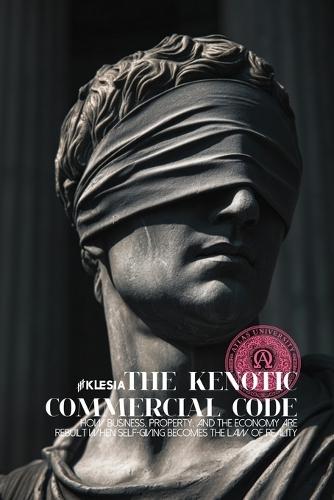
The Kenotic Commercial Code How Business, Property, and the Economy Are Rebuilt When Self-Giving Becomes the Law of RealityEvery civilization eventually confronts the same reckoning: the realization that the economic systems which once generated stability have become the primary engines of decay. Markets may continue to function, transactions may continue to occur, and wealth may continue to accumulate-but beneath the surface, trust erodes, institutions hollow, labor becomes disposable, and the moral authority of commerce quietly collapses. The Kenotic Commercial Code begins from this diagnosis. This book advances a single, uncompromising thesis: all economies fail when extraction becomes their organizing logic, and all durable civilizations emerge when self-giving becomes their law. In the economy of Yahweh, reality itself is kenotic. Any economic system that seeks long-term coherence must therefore be kenotic as well. This work is written not as persuasion, not as inspiration, and not as reformist critique. It is written as economic lawmaking for civilization. It treats commerce as moral engineering and institutional architecture-systems that encode anthropology, theology, and metaphysics whether consciously acknowledged or not. Every contract expresses a vision of the human person. Every market enacts a theology of value. Every economy reveals what a civilization truly believes about life. The modern global economy, the book argues, is governed by a false metaphysics of extraction. Human beings are treated as inputs, communities as markets, time as a resource to be consumed, and nature as a reservoir to be depleted. Financialization detaches wealth from real contribution. Shareholder primacy dissolves responsibility. Prosperity theology sanctifies accumulation. Marxist collectivism abolishes agency. Though ideologically opposed, these systems fail for the same reason: none are aligned with the actual structure of reality. The Kenotic Commercial Code replaces these paradigms entirely. Drawing from Scripture, historical economics, institutional theory, jurisprudence, and original metaphysical analysis, the book reconstructs commerce on the foundation of kenosis-self-giving as the governing law of existence. It demonstrates, with institutional clarity and historical evidence, why systems organized around covenant, trust, shared risk, and long-horizon stewardship consistently outperform extractive systems across every meaningful measure: resilience in crisis, depth of innovation, product integrity, labor loyalty, institutional legitimacy, and generational endurance. This is not moral idealism. It is economic realism. Across more than one hundred chapters, the work systematically rebuilds the architecture of economic life: - product design as an act of love rather than obsolescence - labor as participation in creation rather than expendable cost - pricing as moral signal rather than manipulation - profit as consequence of contribution rather than justification for harm - ownership as stewardship rather than domination - competition as discipline of excellence rather than warfare - finance as custodianship rather than abstraction - debt as covenantal failure rather than permanent bondage - trust as the true infrastructure of markets - growth as fruit of integrity rather than substitute for it The book moves deliberately from diagnosis to construction, from the collapse of extractive economics to the drafting of an entirely new commercial constitution. It addresses business leaders, founders, economists, jurists, policymakers, and institutional architects-those whose decisions shape the moral and material conditions of millions of lives. It assumes intellectual seriousness and civilizational responsibility.
Full Product Details
Author: Atlas University
Publisher: Independently Published
Imprint: Independently Published
Volume: 43
Dimensions:
Width: 15.20cm
, Height: 2.40cm
, Length: 22.90cm
Weight: 0.621kg
ISBN: 9798245583150
Pages: 470
Publication Date: 25 January 2026
Audience:
General/trade
,
General
Format: Paperback
Publisher's Status: Active
Availability: Available To Order

We have confirmation that this item is in stock with the supplier. It will be ordered in for you and dispatched immediately.