Overview
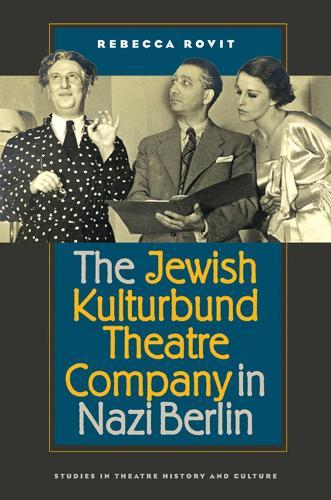
New laws enacted in the wake of Hitler's ascent to power removed all Jews from their professional workplaces and banned Jewish artists from any collaboration with their fellow citizens. In the summer of 1933, Goebbels's Prussian Theatre Commission approved an all-Jewish theatre as part of the Kulturbund Deutscher Juden, the Cultural Association of German Jewry. This network of Jewish cultural leagues and theatre ensembles across Germany coexisted with Nazi policies against Jews until the Gestapo dissolved the theatre in 1941. Revealing the complex interplay between history and human lives under conditions of duress, Rebecca Rovit focuses on the eight-year odyssey of the Berlin Kulturbund and its theatre. Rovit draws upon a wealth of primary documents - correspondence between the theatre and the Reich Ministry of Propaganda and Enlightenment, actual playscripts and rolebooks, production reviews and photographs, letters and memoirs, and interviews with artists who survived the war - to show how the increasingly restrictive German reality forced Jewish artists to define and redefine their identity and culture under wrenching conditions of censorship, compromise, danger, and deception. Integrating play analysis with cultural history, she considers first the playscript itself, then the playscript adapted by the Kulturbund, then the best reconstruction possible of the actual performance against its backdrop of the Third Reich. Proceeding chronologically through the playing seasons, she focuses on the actual repertoire performed (and forbidden) over the life of the Berlin Kulturbund theatre, covering the theatre's beginnings and its first two playing seasons, then on the playing seasons that led to the Reichskristallnacht, and finally on the ways that emigration and increased censorship affected the wartime theatre's final days. The Kulturbund's directors were repeatedly caught between escalating demands from their Nazi overseers and from their own Jewish constituents. By examining why and how an all-Jewish repertory theatre could coexist with the Nazi regime, Rovit raises broader questions about the nature of art in an environment of coercion and isolation, artistic integrity and adaptability, and community and identity.
Full Product Details
Author: Rebecca Rovit
Publisher: University of Iowa Press
Imprint: University of Iowa Press
Dimensions:
Width: 15.20cm
, Height: 2.00cm
, Length: 22.60cm
Weight: 0.428kg
ISBN: 9781609381240
ISBN 10: 1609381246
Pages: 290
Publication Date: 01 September 2012
Audience:
General/trade
,
General
Format: Paperback
Publisher's Status: Active
Availability: Available To Order

We have confirmation that this item is in stock with the supplier. It will be ordered in for you and dispatched immediately.
Reviews
The cultural and artistic life of German Jews during the Nazi era has only recently begun to attract the attention that it deserves. Rebecca Rovit's book on the Berlin branch of the Jewish Kulturbund is a major contribution to the scholarship in this area. It is the most thorough study of the Kulturbund in any language. The book very successfully integrates multiple levels of analysis, examining aesthetics, performance, the personal biographies of German Jews, Nazi policy, and the organizational challenges that confronted the leaders of the Kulturbund. Based on research in a wide range of archival collections, it makes excellent use of information garnered from interviews with some of the Kulturbund's members. Written with precision and empathy, it should be read by anyone with an interest in Jewish life in Nazi Germany. --Alan E. Steinweis, author, Art, Ideology, and Economics in Nazi Germany
The cultural and artistic life of German Jews during the Nazi era has only recently begun to attract the attention that it deserves. Rebecca Rovit s book on the Berlin branch of the Jewish Kulturbund is a major contribution to the scholarship in this area. It is the most thorough study of the Kulturbund in any language. The book very successfully integrates multiple levels of analysis, examining aesthetics, performance, the personal biographies of German Jews, Nazi policy, and the organizational challenges that confronted the leaders of the Kulturbund. Based on research in a wide range of archival collections, it makes excellent use of information garnered from interviews with some of the Kulturbund s members. Written with precision and empathy, it should be read by anyone with an interest in Jewish life in Nazi Germany. Alan E. Steinweis, author, Art, Ideology, and Economics in Nazi Germany This impressive, thoroughly researched account of the Kulturbund Theatre in Berlin documents these artists attempts to come up with a theatrical repertoire that would meet the Nazis contradictory and arbitrary notions of appropriate subject matter for Jewish theatre. Matthew Wikander, University of Toledo The cultural and artistic life of German Jews during the Nazi era has only recently begun to attract the attention that it deserves. Rebecca Rovit's book on the Berlin branch of the Jewish Kulturbund is a major contribution to the scholarship in this area. It is the most thorough study of the Kulturbund in any language. The book very successfully integrates multiple levels of analysis, examining aesthetics, performance, the personal biographies of German Jews, Nazi policy, and the organizational challenges that confronted the leaders of the Kulturbund. Based on research in a wide range of archival collections, it makes excellent use of information garnered from interviews with some of the Kulturbund's members. Written with precision and empathy, it should be read by anyone with an interest in Jewish life in Nazi Germany. --Alan E. Steinweis, author, Art, Ideology, and Economics in Nazi Germany This impressive, thoroughly researched account of the Kulturbund Theatre in Berlin documents these artists' attempts to come up with a theatrical repertoire that would meet the Nazis' contradictory and arbitrary notions of appropriate subject matter for Jewish theatre. --Matthew Wikander, University of Toledo
The cultural and artistic life of German Jews during the Nazi era has only recently begun to attract the attention that it deserves. Rebecca Rovit's book on the Berlin branch of the Jewish Kulturbund is a major contribution to the scholarship in this area. It is the most thorough study of the Kulturbund in any language. The book very successfully integrates multiple levels of analysis, examining aesthetics, performance, the personal biographies of German Jews, Nazi policy, and the organizational challenges that confronted the leaders of the Kulturbund. Based on research in a wide range of archival collections, it makes excellent use of information garnered from interviews with some of the Kulturbund's members. Written with precision and empathy, it should be read by anyone with an interest in Jewish life in Nazi Germany. --Alan E. Steinweis, author, Art, Ideology, and Economics in Nazi Germany This impressive, thoroughly researched account of the Kulturbund Theatre in Berlin documents these artists' attempts to come up with a theatrical repertoire that would meet the Nazis' contradictory and arbitrary notions of appropriate subject matter for Jewish theatre. --Matthew Wikander, University of Toledo The cultural and artistic life of German Jews during the Nazi era has only recently begun to attract the attention that it deserves. Rebecca Rovit s book on the Berlin branch of the Jewish Kulturbund is a major contribution to the scholarship in this area. It is the most thorough study of the Kulturbund in any language. The book very successfully integrates multiple levels of analysis, examining aesthetics, performance, the personal biographies of German Jews, Nazi policy, and the organizational challenges that confronted the leaders of the Kulturbund. Based on research in a wide range of archival collections, it makes excellent use of information garnered from interviews with some of the Kulturbund s members. Written with precision and empathy, it should be read by anyone with an interest in Jewish life in Nazi Germany. Alan E. Steinweis, author, Art, Ideology, and Economics in Nazi Germany This impressive, thoroughly researched account of the Kulturbund Theatre in Berlin documents these artists attempts to come up with a theatrical repertoire that would meet the Nazis contradictory and arbitrary notions of appropriate subject matter for Jewish theatre. Matthew Wikander, University of Toledo The cultural and artistic life of German Jews during the Nazi era has only recently begun to attract the attention that it deserves. Rebecca Rovit's book on the Berlin branch of the Jewish Kulturbund is a major contribution to the scholarship in this area. It is the most thorough study of the Kulturbund in any language. The book very successfully integrates multiple levels of analysis, examining aesthetics, performance, the personal biographies of German Jews, Nazi policy, and the organizational challenges that confronted the leaders of the Kulturbund. Based on research in a wide range of archival collections, it makes excellent use of information garnered from interviews with some of the Kulturbund's members. Written with precision and empathy, it should be read by anyone with an interest in Jewish life in Nazi Germany. --Alan E. Steinweis, author, Art, Ideology, and Economics in Nazi Germany This impressive, thoroughly researched account of the Kulturbund Theatre in Berlin documents these artists' attempts to come up with a theatrical repertoire that would meet the Nazis' contradictory and arbitrary notions of appropriate subject matter for Jewish theatre. --Matthew Wikander, University of Toledo
<p> The cultural and artistic life of German Jews during the Nazi era has only recently begun to attract the attention that it deserves. Rebecca Rovit's book on the Berlin branch of the Jewish Kulturbund is a major contribution to the scholarship in this area. It is the most thorough study of the Kulturbund in any language. The book very successfully integrates multiple levels of analysis, examining aesthetics, performance, the personal biographies of German Jews, Nazi policy, and the organizational challenges that confronted the leaders of the Kulturbund. Based on research in a wide range of archival collections, it makes excellent use of information garnered from interviews with some of the Kulturbund's members. Written with precision and empathy, it should be read by anyone with an interest in Jewish life in Nazi Germany. --Alan E. Steinweis, author, Art, Ideology, and Economics in Nazi Germany
Author Information
Rebecca Rovit is an assistant professor of theatre at the University of Kansas. Author of numerous articles on theatre and performance in such journals as American Theatre, PAJ, TDR, Theatre Survey, Contemporary Theatre Review, The Journal of Holocaust and Genocide Studies, and The Enzyklopädie jüdischer Geschichte und Kultur, edited by Dan Diner, she is the coeditor of Theatrical Performance during the Holocaust: Texts, Documents, Memoirs, a finalist for the National Jewish Book Award.