Awards
- Winner of Linguistic Society of America Leonard Bloomfield Book Award 2006.
- Winner of Winner of the 2006 Leonard Bloomfield Book Award.
Overview
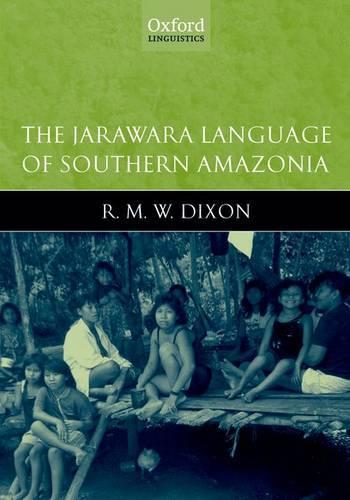
This is the first account of Jarawara, a Southern Amazonia language of great complexity and unusual interest, and now spoken by less than two hundred people. It has only two open lexical classes, noun and verb, and a closed adjective class with fourteen members which can only modify a noun. Verbs have a complex structure with three prefix and some twenty-five suffix slots. There is an eleven-term tense-modal system with an evidentiality contrast (eyewitness/non-eyewitness) in the three past tenses. Of the two genders, feminine and masculine, feminine is unmarked. There are at least eight types of subordinate clause constructions, including complement clauses, relative clauses, coreferential dependent clauses, and 'when', 'if', 'due to the lack of' and 'because of' clauses.There are only eleven consonants and four vowels but an extensive set of ordered phonological rules of lenition, vowel assimilation and unstressed syllable omission. There are four imperative inflections (with different meanings) and three explicit interrogative suffixes within the mood system. The book is entirely based on field work by the authors.
Full Product Details
Author: R.M.W. Dixon (, The Cairns Institute, James Cook University)
Publisher: Oxford University Press
Imprint: Oxford University Press
Dimensions:
Width: 16.90cm
, Height: 3.80cm
, Length: 24.70cm
Weight: 1.138kg
ISBN: 9780199600694
ISBN 10: 0199600694
Pages: 732
Publication Date: 27 January 2011
Audience:
Professional and scholarly
,
Professional & Vocational
Format: Paperback
Publisher's Status: Active
Availability: To order

Stock availability from the supplier is unknown. We will order it for you and ship this item to you once it is received by us.
Reviews
Review from previous edition This is, in many ways, a near-perfect model of how a descriptive grammar of ANY language should be presented. Although the grammatical treatment and exposition are excellent, for me, one of the best parts of the book are the examples and how they are presented. Michael W Morgan Who said a descriptive grammar should not also be a good read? Michael W Morgan A fundamental grammatical description of this sort - complete with glossed texts, dictionary materials, a wealth of diachronic insights, and authoritative social and cultural information about the speakers - might be expected to constitute the crowning achievement in a lifetime of successful effort. For this author, however, it is merely another in a long roster of outstanding linguistic accomplishments that promise to continue unabated. Edward J Vajda, Western Washington University
Author Information
R. M. W. Dixon is Adjunct Professor at the Cairns Institute, James Cook University. His pioneering fieldwork on Australian Aboriginal languages began in the 1960s and led, among many other works, to grammars of Dyirbal and Yidiñ, culminating in Australian Languages: Their nature and development (CUP 2002). His other books include A Grammar of Boumaa Fijian (U Chicago Press 1988), Ergativity (CUP, 1994), The Rise and Fall of Languages (CUP 1997) and A Semantic Approach to English Grammar (OUP 2005). The hardback edition of The Jarawara Language of Southern Amazonia (OUP 2004) was winner of the 2004-5 Leonard Bloomfield Prize,