Overview
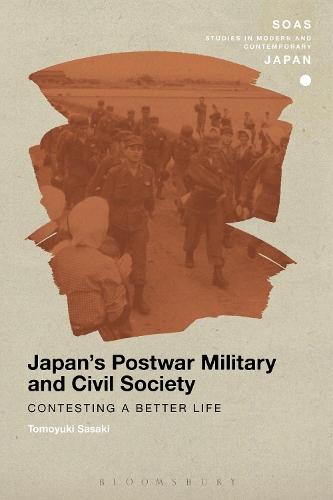
Japan's so-called 'peace constitution' renounces war as a sovereign right of the nation, and bans the nation from possessing any war potential. Yet Japan also maintains a large, world-class military organization, namely the Self-Defence Forces (SDF). In this book, Tomoyuki Sasaki explores how the SDF enlisted popular support from civil society and how civil society responded to the growth of the SDF. Japan's Postwar Military and Civil Society details the interactions between the SDF and civil society over four decades, from the launch of rearmament in 1950. These interactions include recruitment, civil engineering, disaster relief, anti-SDF litigation, state financial support for communities with bases, and a fear-mongering campaign against the Soviet Union. By examining these wide-range issues, the book demonstrates how the militarization of society advanced as the SDF consolidated its ideological and socio-economic ties with civil society and its role as a defender of popular welfare. While postwar Japan is often depicted as a peaceful society, this book challenges such a view, and illuminates the prominent presence of the military in people's everyday lives.
Full Product Details
Author: Tomoyuki Sasaki (Eastern Michigan University, USA)
Publisher: Bloomsbury Publishing PLC
Imprint: Bloomsbury Academic
Dimensions:
Width: 15.60cm
, Height: 1.40cm
, Length: 23.40cm
Weight: 0.494kg
ISBN: 9781472525550
ISBN 10: 1472525558
Pages: 224
Publication Date: 27 August 2015
Audience:
College/higher education
,
Undergraduate
,
Postgraduate, Research & Scholarly
Format: Hardback
Publisher's Status: Active
Availability: Manufactured on demand

We will order this item for you from a manufactured on demand supplier.
Reviews
This study of the SDF in Japan differs from others in focusing on the integration of military forces into Japanese civil society in the postwar period. The book is informed by broad, theoretical analysis throughout. The chapters balance larger theoretical analyses with specific historical examples in a highly readable account. Although many of the historical conditions are specific to Japan, Sasaki's analysis of the general historical processes should be widely applicable to many other locales. Wesley Sasaki-Uemura, University of Utah, USA Tomoyuki Sasaki surveys the move from Japan's total demilitarisation in 1945, to the creation of a police reserve, the creation of a Self Defence Force (Jieitai), and the increasing integration of the Jieitai into selected local communities. Despite immense popular support for the retention of Article 9 of the Constitution of Japan, which renounces belligerence, the Jietai continues to play an important, albeit contested, role in Japanese civil society. Its existence challenges the notion of a pacifist Japan. Tomoyuki Sasaki's examination of the historical development of the Jieitai and its imbrication in local communities is particularly timely, and can help inform contemporary debates on pacifism and militarism. Vera Mackie, University of Wollongong, Australia
Author Information
Tomoyuki Sasaki is Associate Professor of Japanese Studies at the College of William and Mary, USA.