Overview
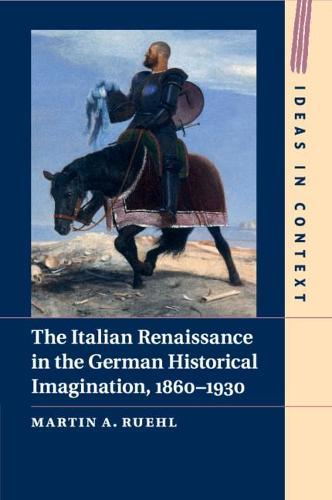
Towards the end of the nineteenth century, Germany's bourgeois elites became enthralled by the civilization of Renaissance Italy. As their own country entered a phase of critical socioeconomic changes, German historians and writers reinvented the Italian Renaissance as the onset of a heroic modernity: a glorious dawn that ushered in an age of secular individualism, imbued with ruthless vitality and a neo-pagan zest for beauty. The Italian Renaissance in the German Historical Imagination is the first comprehensive account of the debates that shaped the German idea of the Renaissance in the seven decades following Jacob Burckhardt's seminal study of 1860. Based on a wealth of archival material and enhanced by more than one hundred illustrations, it provides a new perspective on the historical thought of Imperial and Weimar Germany, and the formation of a concept that is still with us today.
Full Product Details
Author: Martin A. Ruehl (University of Cambridge)
Publisher: Cambridge University Press
Imprint: Cambridge University Press
Volume: 105
Dimensions:
Width: 15.30cm
, Height: 1.90cm
, Length: 22.90cm
Weight: 0.530kg
ISBN: 9781108468152
ISBN 10: 1108468152
Pages: 344
Publication Date: 30 August 2018
Audience:
Professional and scholarly
,
Professional & Vocational
Format: Paperback
Publisher's Status: Active
Availability: Manufactured on demand

We will order this item for you from a manufactured on demand supplier.
Reviews
'From Jacob Burckhardt and Friedrich Nietzsche to Thomas Mann, Ernst Kantorowicz and Hans Baron, the idea of the Renaissance has played an inspirational if contested role in the German cultural imagination. With great erudition and critical insight, Martin A. Ruehl traces the adventures of this idea, demonstrating its politics, complexities, and enduring appeal. Ruehl's book is simply superb, a powerful specimen of intellectual history at its very best.' Peter E. Gordon, Amabel B. James Professor of History, Harvard University, Massachusetts 'Martin A. Ruehl's study is a model of modern intellectual history: accessible yet learned, soberly objective but politically astute, and focused on large cultural shifts without neglecting careful attention to nuance and detail. Thoughtfully illustrated and engagingly written, it will change how we think about 'the Renaissance problem' in the years between the Second and Third German Empires.' Robert E. Norton, University of Notre Dame, Indiana '[Ruehl's] book is recommended to anyone wishing to understand the trajectories of this fascinating area of intellectual history.' Neil Gregor, The Art Newspaper 'Martin A. Ruehl has written a lucid, intelligent and erudite study which, moreover, is beautifully illustrated.' Henk de Berg, History Today 'Martin A. Ruehl opens his impressive study with two impressionistic vignettes that describe the respective journeys of Goethe and Thomas Mann to Italy and frame what he calls a 'transformation in the German Geschichtsbild or historical imagination'. ... tremendously compelling ... This rich account of the diverse stages of the Renaissancebild opens new territory in intellectual history and promises a new perspective on the diverse political thinkers, who, at the time, were occupied with notions of political sovereignty, most notably Carl Schmitt. Furthermore, it offers a new perspective on a larger cultural obsession with the idea of the tyrant - and dictator - as intimately wed with our construction of modernity.' Michael K. House, German History
'From Jacob Burckhardt and Friedrich Nietzsche to Thomas Mann, Ernst Kantorowicz and Hans Baron, the idea of the Renaissance has played an inspirational if contested role in the German cultural imagination. With great erudition and critical insight, Martin Ruehl traces the adventures of this idea, demonstrating its politics, complexities, and enduring appeal. Ruehl's book is simply superb, a powerful specimen of intellectual history at its very best.' Peter E. Gordon, Amabel B. James Professor of History, Harvard University, Massachusetts 'Martin Ruehl's study is a model of modern intellectual history: accessible yet learned, soberly objective but politically astute, and focused on large cultural shifts without neglecting careful attention to nuance and detail. Thoughtfully illustrated and engagingly written, it will change how we think about 'the Renaissance problem' in the years between the Second and Third German Empires.' Robert E. Norton, University of Notre Dame, Indiana '[Ruehl's] book is recommended to anyone wishing to understand the trajectories of this fascinating area of intellectual history.' Neil Gregor, The Art Newspaper 'Martin Ruehl has written a lucid, intelligent and erudite study which, moreover, is beautifully illustrated.' Henk de Berg, History Today 'Martin Ruehl opens his impressive study with two impressionistic vignettes that describe the respective journeys of Goethe and Thomas Mann to Italy and frame what he calls a 'transformation in the German Geschichtsbild or historical imagination'. ... tremendously compelling ... This rich account of the diverse stages of the Renaissancebild opens new territory in intellectual history and promises a new perspective on the diverse political thinkers, who, at the time, were occupied with notions of political sovereignty, most notably Carl Schmitt. Furthermore, it offers a new perspective on a larger cultural obsession with the idea of the tyrant - and dictator - as intimately wed with our construction of modernity.' Michael K. House, German History
Author Information
Martin A. Ruehl is Lecturer in German intellectual history at the Faculty of Modern and Medieval Languages and a Fellow of Trinity Hall, University of Cambridge. His publications include Quentin Skinner: Visionen des Politischen (2009, edited with M. Heinz), A Poet's Reich: Politics and Culture in the George Circle (2011, edited with M. Lane), and Hitler - Films from Germany: History, Cinema and Politics since 1945 (2012, edited with K. Machtans).