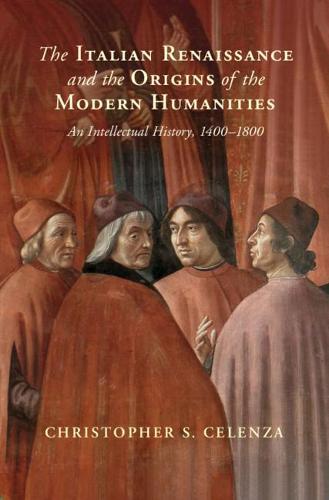
Full Product Details
Author: Christopher S. Celenza (The Johns Hopkins University, Maryland)
Publisher: Cambridge University Press
Imprint: Cambridge University Press
Dimensions:
Width: 16.00cm
, Height: 2.40cm
, Length: 23.50cm
Weight: 0.630kg
ISBN: 9781108833400
ISBN 10: 1108833403
Pages: 336
Publication Date: 09 September 2021
Audience:
Professional and scholarly
,
Professional & Vocational
Format: Hardback
Publisher's Status: Active
Availability: Manufactured on demand

We will order this item for you from a manufactured on demand supplier.
Reviews
'An engrossing story about how modernity was born when it learned to read and write the word. The parallels between the Italian Renaissance and our contemporary present are stunning. As before, so now: information glut and a rapidly evolving mediascape are challenges that only a new investment in critical sense-making - 'philology,' broadly understood - can meet. Celenza's call for a reinvigorated culture of the humanities today is both historically rich and prescient. His book is sure to bring a new dimension to the debates about the uses and reach of culture today.' James I. Porter, University of California, Berkeley 'A powerful history, cutting through the artificial line too-often drawn between Renaissance and Enlightenment to present one continuity, the quiet revolution underlying all the others: the slow, painstaking advance of the conviction that knowledge-seeking can and should be unending, unlimited, and open to everyone.' Ada Palmer, University of Chicago 'Christopher Celenza brilliantly threads the needle to produce a portrait of Italian Renaissance humanism for our time. Deeply attentive to personal experiences and personal ties, he injects agency and emotion into the celebrated practice of classical and biblical philology, astutely examining figures who include Valla, Poliziano, Decembrio, and even Descartes. Celenza's enduring claim is that philology was and remains inextricably connected with philosophy.' Kristine Haugen, California Institute of Technology
'An engrossing story about how modernity was born when it learned to read and write the word. The parallels between the Italian Renaissance and our contemporary present are stunning. As before, so now: information glut and a rapidly evolving mediascape are challenges that only a new investment in critical sense-making – 'philology,' broadly understood – can meet. Celenza's call for a reinvigorated culture of the humanities today is both historically rich and prescient. His book is sure to bring a new dimension to the debates about the uses and reach of culture today.' James I. Porter, University of California, Berkeley 'A powerful history, cutting through the artificial line too-often drawn between Renaissance and Enlightenment to present one continuity, the quiet revolution underlying all the others: the slow, painstaking advance of the conviction that knowledge-seeking can and should be unending, unlimited, and open to everyone.' Ada Palmer, University of Chicago 'Christopher Celenza brilliantly threads the needle to produce a portrait of Italian Renaissance humanism for our time. Deeply attentive to personal experiences and personal ties, he injects agency and emotion into the celebrated practice of classical and biblical philology, astutely examining figures who include Valla, Poliziano, Decembrio, and even Descartes. Celenza's enduring claim is that philology was and remains inextricably connected with philosophy.' Kristine Haugen, California Institute of Technology
Author Information
Christopher S. Celenza is the James B. Knapp Dean of the Zanvyl Krieger School of Arts and Sciences at Johns Hopkins University, where he is also Professor of History and Classics. Former Director of the American Academy in Rome, he is the author of the prize-winning The Lost Italian Renaissance (2004), Machiavelli: A Portrait (2015), and The Intellectual World of the Italian Renaissance (2017). His work has been featured in Salon, The Huffington Post, and on radio and television. Celenza has served as Dean of Georgetown College at Georgetown University and has held fellowships from the Guggenheim Foundation, the American Council of Learned Societies, the Harvard University Center for the Study of the Italian Renaissance (Villa I Tatti), the American Academy in Rome, and the Fulbright Foundation.