Overview
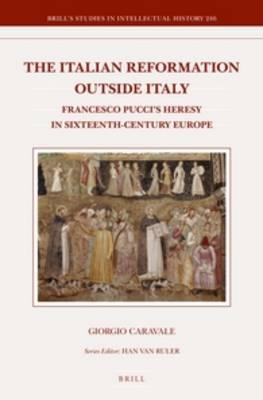
What was the legacy of the so-called Italian Reformation? What contribution did Italian humanism make to European developments in irenicism and religious tolerance? In The Italian Reformation outside Italy, Giorgio Caravale uses previously unpublished documents to reconstruct the life and intellectual career of Francesco Pucci (1543-1597). Educated in Renaissance Florence, Pucci found his vocation as a prophet in France during the Wars of Religion and embarked on a long period of peregrination, stopping off in Paris, London, Basle, Antwerp, Krakow and Prague before being imprisoned, tried and sentenced to death by the Roman Inquisition three years before Giordano Bruno. His doctrines were judged to be heretical by all religious confessions and his political proposal was a spectacular failure. Caravale presents a rich chapter of sixteenth-century European history whose main features are religious conflict, irenic tension, universalist aspirations and prophetic expectations. The translation of this work has been funded by SEPS (SEGRETARIATO EUROPEO PER LE PUBBLICAZIONI SCIENTIFICHE), Via Val d'Aposa 7, I-40123 Bologna, Italy — seps@seps.it — www.seps.it
Full Product Details
Author: Giorgio Caravale
Publisher: Brill
Imprint: Brill
Edition: 286 pp
Volume: 246
Dimensions:
Width: 15.50cm
, Height: 2.10cm
, Length: 23.50cm
Weight: 0.574kg
ISBN: 9789004244917
ISBN 10: 9004244913
Pages: 286
Publication Date: 14 August 2015
Audience:
Professional and scholarly
,
Professional & Vocational
Format: Hardback
Publisher's Status: Active
Availability: Manufactured on demand

We will order this item for you from a manufactured on demand supplier.
Reviews
Caravale's masterful and well-researched study strengthens the link between Italian Humanism and the notion of tolerance that was to become a prime feature of Enlightenment thinking: a necessary work for students of intellectual history. Damon Di Mauro, Gordon College. In: Sixteenth Century Journal, Vol. 47, No. 3 (Fall 2016), pp. 711-712. The book's excellent introduction and bold conclusion leave no doubt about its theme: Pucci was not the isolated heretic of earlier scholarship, but should be set in the great tradition of radical reformers, both within Italy and outside it. [...] Caravale's own seriousness about this disappointed wanderer pervades his immensely scholarly book. [...] Caravale's grand themes are illuminating, as is his colourful depiction of the naive and changeable Pucci: he is made part of a whole storm-tossed society living through the trauma-and the hope-generated by schism and 'reform'. [...] A great achievement. M. Anne Overell, Durham University. In: English Historical Review, Vol. 132, Issue 558 (December 2017). Cette belle biographie intellectuelle d'un personnage eminemment original pour son epoque est aussi un vrai livre d'histoire. Tout au long de son analyse fine et argumentee des idees de Pucci, Caravale veille a ne jamais les detacher de leur contexte d'elaboration et de diffusion. Et ce n'est pas la moindre qualite de cet ouvrage tres reussi. Hugues Daussy, Universite de Franche-Comte. In: Renaissance and Reformation, Vol. 41, No. 3 (summer 2018), pp. 206-208.
Caravale's masterful and well-researched study strengthens the link between Italian Humanism and the notion of tolerance that was to become a prime feature of Enlightenment thinking: a necessary work for students of intellectual history. Damon Di Mauro, Gordon College. In: Sixteenth Century Journal, Vol. 47, No. 3 (Fall 2016), pp. 711-712.
“Caravale’s masterful and well-researched study strengthens the link between Italian Humanism and the notion of tolerance that was to become a prime feature of Enlightenment thinking: a necessary work for students of intellectual history.” Damon Di Mauro, Gordon College. In: Sixteenth Century Journal, Vol. 47, No. 3 (Fall 2016), pp. 711-712. ""The book’s excellent introduction and bold conclusion leave no doubt about its theme: Pucci was not the isolated heretic of earlier scholarship, but should be set in the great tradition of radical reformers, both within Italy and outside it. [...] Caravale’s own seriousness about this disappointed wanderer pervades his immensely scholarly book. [...] Caravale’s grand themes are illuminating, as is his colourful depiction of the naïve and changeable Pucci: he is made part of a whole storm-tossed society living through the trauma—and the hope—generated by schism and ‘reform’. [...] A great achievement."" M. Anne Overell, Durham University. In: English Historical Review, Vol. 132, Issue 558 (December 2017). “Cette belle biographie intellectuelle d’un personnage éminemment original pour son époque est aussi un vrai livre d’histoire. Tout au long de son analyse fine et argumentée des idées de Pucci, Caravale veille à ne jamais les détacher de leur contexte d’élaboration et de diffusion. Et ce n’est pas la moindre qualité de cet ouvrage très réussi.” Hugues Daussy, Université de Franche-Comté. In: Renaissance and Reformation, Vol. 41, No. 3 (summer 2018), pp. 206-208.
Caravale's masterful and well-researched study strengthens the link between Italian Humanism and the notion of tolerance that was to become a prime feature of Enlightenment thinking: a necessary work for students of intellectual history. Damon Di Mauro, Gordon College. In: Sixteenth Century Journal, Vol. 47, No. 3 (Fall 2016), pp. 711-712. The book's excellent introduction and bold conclusion leave no doubt about its theme: Pucci was not the isolated heretic of earlier scholarship, but should be set in the great tradition of radical reformers, both within Italy and outside it. [...] Caravale's own seriousness about this disappointed wanderer pervades his immensely scholarly book. [...] Caravale's grand themes are illuminating, as is his colourful depiction of the naive and changeable Pucci: he is made part of a whole storm-tossed society living through the trauma-and the hope-generated by schism and `reform'. [...] A great achievement. M. Anne Overell, Durham University. In: English Historical Review, Vol. 132, Issue 558 (December 2017). Cette belle biographie intellectuelle d'un personnage eminemment original pour son epoque est aussi un vrai livre d'histoire. Tout au long de son analyse fine et argumentee des idees de Pucci, Caravale veille a ne jamais les detacher de leur contexte d'elaboration et de diffusion. Et ce n'est pas la moindre qualite de cet ouvrage tres reussi. Hugues Daussy, Universite de Franche-Comte. In: Renaissance and Reformation, Vol. 41, No. 3 (summer 2018), pp. 206-208.
Author Information
Giorgio Caravale, PhD (2000), is Professor of Early Modern European History at the University of Roma Tre. He is the author of Forbidden Prayer: Church Censorship and Devotional Literature in Renaissance Italy (Ashgate, 2011), Predicazione e Inquisizione nell’Italia del Cinquecento (Il Mulino, 2012), Storia di una doppia censura (Edizioni della Normale, 2013), George L. Mosse’s Italy (ed. with L. Benadusi, Palgrave, 2014), and Beyond the Inquisition: Ambrogio Catarino Politi and the Origins of the Counter-Reformation (Notre Dame UP, forthcoming).