|
|
|||
|
||||
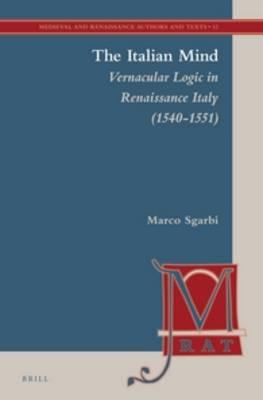
OverviewFrom the twelfth to the seventeenth century, Aristotle’s writings lay at the foundation of Western culture, providing a body of knowledge and a set of analytical tools applicable to all areas of human investigation. Scholars of the Renaissance have emphasized the remarkable longevity and versatility of Aristotelianism, but they have mainly focused on the Latin tradition. Scarce, if any, attention has gone to vernacular works. Nonetheless, several important Renaissance figures wished to make Aristotle’s works accessible and available outside the narrow circle of professional philosophers and university professors to a broad set of readers. The thesis underpinning this book is that Italian vernacular Aristotelianism, especially in the field of logic, made fundamental contributions to the thought of the period, anticipating many of the features of early modern philosophy and contributing to a new conception of knowledge. Full Product DetailsAuthor: Marco SgarbiPublisher: Brill Imprint: Brill Volume: 12 Dimensions: Width: 15.50cm , Height: 1.90cm , Length: 23.50cm Weight: 0.533kg ISBN: 9789004264090ISBN 10: 9004264094 Pages: 256 Publication Date: 13 February 2014 Audience: Professional and scholarly , Professional & Vocational Format: Hardback Publisher's Status: Active Availability: Manufactured on demand We will order this item for you from a manufactured on demand supplier. Table of ContentsAcknowledgements ..... vii Sources and Abbreviations ... ix 1. Introduction .... 1 Logic in Context ... 1 Vernacular in Context ..... 10 Prospectus ... 19 2. Language, Vernacular and Philosophy .... 23 Res vs. Verba .... 23 The Shadow of Pomponazzi ..... 31 The Accademia degli Infiammati ..... 41 3. Sperone Speroni between Language and Logic ..... 45 Wisdom and Eloquence .... 45 Speroni's Pomponazzi ..... 58 Speroni's Most Loyal Disciple: Bernardino Tomitano ... 65 4. Benedetto Varchi and the Idea of a Vernacular Logic (1540) .... 71 Aristotelian Anthropology ... 71 Varchi's Logical Library ..... 79 Varchi's Logic at the Accademia degli Infiammati ... 81 The Universals .... 106 Method and Order ..... 111 An Anonymous Dialogue ..... 120 5. Antonio Tridapale and the First Vernacular Logic (1547) .... 127 Antonio Tridapale and Knowledge as Power .... 127 The Elements of Logic .... 133 The Operations of Logic .... 142 6. Nicolo Massa's Logic for Natural Philosophy (1549) ... 154 Nicolo Massa between Philosophy and Medicine .... 154 The Elements of Argumentation ... 158 Scientific Demonstration ..... 158 7. Alessandro Piccolomini's Instrument of Philosophy (1551) ..... 175 Piccolomini in Padua ... 175 A New Instrument ... 186 The Structure of Logic .... 195 Logic for Natural Philosophy .... 205 8. Conclusion .... 213 Vernacular and Logic ... 213 The Logician in the Printing Presses ..... 219 Bibliography ... 229 Index ..... 241ReviewsAuthor InformationMarco Sgarbi is the Principal Investigator of the ERC Starting Grant 2013 ""Aristotle in the Italian Vernacular: Rethinking Renaissance and Early-Modern Intellectual History (c. 1400-c. 1650)"". He has published monographs on the impact of Aristotelianism on the making of Renaissance and early-modern philosophy, focusing on British Empiricism and Kantian Philosophy. He edited for Brill Translatio Studiorum. Ancient, Medieval, and Modern Bearers of Intellectual History (2012). Tab Content 6Author Website:Countries AvailableAll regions |
||||