Overview
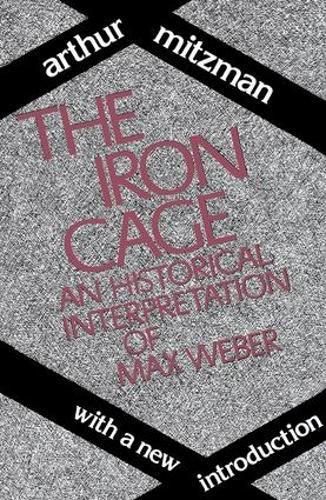
This major study of the father of modern sociology explores the intimate relationship between the events of Max Weber's personal history and the development of his thought. When it was first published in 1970, Paul Roazen described The Iron Cage as ""an example of the history of ideas at its very best""; while Robert A. Nisbet said that ""we learn more about Weber's life in this volume than from any other in the English language.""Weber's life and work developed in reaction to the rigidities of familial and social structures in Imperial Germany. In his youth he was torn by irreconcilable tensions between the Bismarckian authoritarianism of his father and the ethical puritanism of his mother. These tensions led to a psychic crisis when, in his thirties, he expelled his father (who died soon thereafter) from his house. His reaction to the collapse of the European social order before and during World War I was no less personal and profound. It is the triumph of Professor Mitzman's approach that he convincingly demonstrates how the internalizing of these severe experiences led to Weber's pessimistic vision of the future as an ""iron cage"" and to such seminal ideas as the notion of charisma and the concept of the Protestant ethic and its connection with the spirit of capitalism. The author's thesis also serves as a vehicle for describing the social, political, and personal plight of the European bourgeois intellectual of Weber's generation.In synthesizing Weber's life and thought, Arthur Mitzman has expanded and refined our understanding of this central twentieth-century figure. As Lewis Coser writes in the preface, until now ""there has been little attempt to bring together the work and the man, to show the ways in which Weber's cognitive intentions, his choice of problems, were linked with the details of his personal biography. Arthur Mitzman fills this gap brilliantly.""
Full Product Details
Author: Catherine Ross ,
Arthur Mitzman
Publisher: Taylor & Francis Inc
Imprint: Transaction Publishers
Dimensions:
Width: 13.80cm
, Height: 2.10cm
, Length: 21.60cm
Weight: 0.680kg
ISBN: 9780878559848
ISBN 10: 0878559841
Pages: 368
Publication Date: 30 January 1984
Audience:
College/higher education
,
General/trade
,
Postgraduate, Research & Scholarly
,
General
Format: Paperback
Publisher's Status: Active
Availability: Manufactured on demand

We will order this item for you from a manufactured on demand supplier.
Reviews
Mitzman's book must take its place among the four or five best works in psycho-history that we now have. It is a powerful instance of how intellectual history can be deepened and made animate with real life. </p> --Bruce Mazlish, <em>History and Theory</em></p> Professor Mitzman has written a psychoanalytically organized study of max Weber, linking Weber's personal anxieties to the development of aspects of his work and placing him in the context of a bourgeois generation faced with particularly severe psychic conflicts. </p> --Fred Weinstein, <em>The American Historical Review</em></p> <em>The Iron Cage</em> is a psychoanalytic interpretation of Max Weber's life and work. The title of the book refers to Weber's statement in <em>The Protestant Ethic</em> that modern man's life is determined by the iron cage of institutionalized asceticism. Mitzman accepts this proposition and analyzes Weber's conscious and unconscious reaction to the encagement, tracing his quest for liberation.... <em>The Iron Cage</em> is a contribution to our knowledge of Max Weber and the history of his ideas. Mitzman has combined a chronological interpretation of Weber's personal life and scholarly activity with a report of Weber's attitudes about German politics. </p> --Pat N. Lackey, <em>American Sociological Review</em></p>
<p> Mitzman's book must take its place among the four or five best works in psycho-history that we now have. It is a powerful instance of how intellectual history can be deepened and made animate with real life. <p> --Bruce Mazlish, History and Theory <p> Professor Mitzman has written a psychoanalytically organized study of max Weber, linking Weber's personal anxieties to the development of aspects of his work and placing him in the context of a bourgeois generation faced with particularly severe psychic conflicts. <p> --Fred Weinstein, The American Historical Review <p> The Iron Cage is a psychoanalytic interpretation of Max Weber's life and work. The title of the book refers to Weber's statement in The Protestant Ethic that modern man's life is determined by the iron cage of institutionalized asceticism. Mitzman accepts this proposition and analyzes Weber's conscious and unconscious reaction to the encagement, tracing his quest for liberation.... The Iron Cage is a contribution to our knowledge of Max Weber and the history of his ideas. Mitzman has combined a chronological interpretation of Weber's personal life and scholarly activity with a report of Weber's attitudes about German politics. <p> --Pat N. Lackey, American Sociological Review
-Mitzman's book must take its place among the four or five best works in psycho-history that we now have. It is a powerful instance of how intellectual history can be deepened and made animate with real life.- --Bruce Mazlish, History and Theory -Professor Mitzman has written a psychoanalytically organized study of max Weber, linking Weber's personal anxieties to the development of aspects of his work and placing him in the context of a bourgeois generation faced with particularly severe psychic conflicts.- --Fred Weinstein, The American Historical Review -The Iron Cage is a psychoanalytic interpretation of Max Weber's life and work. The title of the book refers to Weber's statement in The Protestant Ethic that modern man's life is determined by the iron cage of institutionalized asceticism. Mitzman accepts this proposition and analyzes Weber's conscious and unconscious reaction to the encagement, tracing his quest for liberation.... The Iron Cage is a contribution to our knowledge of Max Weber and the history of his ideas. Mitzman has combined a chronological interpretation of Weber's personal life and scholarly activity with a report of Weber's attitudes about German politics.- --Pat N. Lackey, American Sociological Review
A biographical study of the great sociologist - his work, milieu, character and beliefs related to his quite complicated psyche. Just because Weber is a figure well-suited for such a study, the task is overwhelming; and it represents more than faint praise to say that Mitzman has at least provided a lot of excellent raw and half-baked material. His psychological approach is rather antiquely Freudian. Mitzman investigates Weber's family background, youth and virtual imprisonment in the house of his dominant-ating-eering-father; his evolution toward liberal imperialism ; his breakdown and recovery (or what Mitzman calls his recovery); his later religious and political ideas. The tension between his passionate nationalism and his scholarly value neutrality, to note one major theme, is provocatively traced. Mitzman's concepts seem heavy-handed (don't stop to ask what he means by overstructured ), but there is a good attempt to discuss Weber's relation to fascist thought. It is indeed an interesting book. The presumptive audience will bear with its ethoi and Weltanschauungen, and look forward to Mitzman's companion volume on Tonnies, Sombart, and Michels. (Kirkus Reviews)