Overview
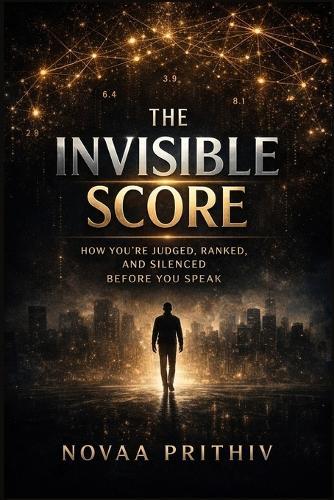
You are being evaluated long before you are understood. The Invisible Score examines the quiet systems that now determine relevance, trust, and value in modern life without ever stating their rules. There are no tests, no public judgments, and no formal announcements. Yet outcomes are decided constantly. Opportunities appear unevenly. Visibility fluctuates without explanation. Speech feels permitted, but consequences feel unpredictable. This book explains why. Rather than focusing on censorship, surveillance, or overt control, Novaa Prithiv investigates a deeper transformation. Modern systems no longer rely primarily on enforcement. They rely on evaluation. Behavior is assessed continuously through patterns, proxies, and probabilities that operate upstream of awareness. Long before individuals act, speak, or dissent, judgments have already shaped what is possible. At the center of the book is a simple but unsettling claim. Freedom did not disappear through force. It became impractical to use. When deviation carries quiet cost and alignment carries quiet reward, people adapt without being asked. Compliance emerges not from fear, but from rational adjustment to invisible incentives embedded in everyday environments. Across forty chapters, The Invisible Score maps how this environment functions. It introduces conceptual frameworks that clarify experiences many people recognize but struggle to name. Evaluation now precedes consent. Silence is interpreted as agreement. Speed outperforms thought. Likability protects more reliably than competence. Emotional resonance spreads faster than evidence. Visibility substitutes for value. These shifts did not occur because intelligence or truth lost importance. They occurred because large systems cannot easily measure depth. What cannot be detected quickly, verified cheaply, or circulated efficiently is gradually displaced. Over time, systems begin rewarding what is legible rather than what is meaningful. One of the book's central insights concerns modern punishment. People are rarely removed, banned, or openly silenced. Instead, they are quietly deprioritized. Responses slow. Invitations fade. Contributions remain technically allowed but practically irrelevant. Invisibility replaces confrontation because it leaves no evidence, provokes no collective response, and isolates individuals into self-doubt rather than resistance. The Invisible Score also explores how constant evaluation reshapes thought itself. When consequences are delayed, ambiguous, and durable, people begin editing themselves preemptively. Expression narrows. Curiosity becomes selective. Neutrality appears suspicious. Silence feels safer than precision. Over time, this adaptation feels like maturity or professionalism, even as originality and intellectual risk quietly decline. The book avoids moral panic and ideological blame. It does not argue that any single institution or authority engineered this environment. Instead, it shows how incentives converge. No conspiracy is required. Systems optimized for speed, scale, and predictability naturally favor behaviors that reduce friction. What emerges feels inevitable because no single actor controls it. Stylistically, The Invisible Score rejects motivational language and prescriptive solutions. It offers no hacks and no reassurance. Its purpose is diagnostic. Understanding, the book argues, must precede agency. You cannot choose freely inside an environment you cannot see. The book does not claim that freedom is gone. It argues that freedom has been reclassified as a personal risk rather than a shared value. Once that shift occurs, people abandon it voluntarily, not because they are coerced, but because the cost feels unjustified. And that clarity changes how everything else is seen.
Full Product Details
Author: Novaa Prithiv
Publisher: Independently Published
Imprint: Independently Published
Dimensions:
Width: 15.20cm
, Height: 1.30cm
, Length: 22.90cm
Weight: 0.308kg
ISBN: 9798278979166
Pages: 226
Publication Date: 22 December 2025
Audience:
General/trade
,
General
Format: Paperback
Publisher's Status: Active
Availability: Available To Order

We have confirmation that this item is in stock with the supplier. It will be ordered in for you and dispatched immediately.