Overview
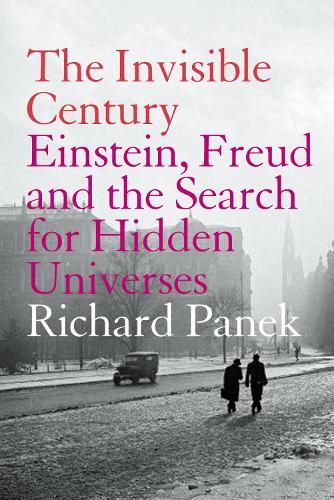
A book which offers fresh perspectives on the scientific developments of the past hundred years through the complementary work of two of the century’s greatest thinkers, Einstein and Freud. At the turn of the century there was a widespread assumption in scientific circles that the pursuit of knowledge was nearing its end and that all available evidence had been exhausted. However, by 1916 both Einstein and Freud had exploded the myth by leading exploration into the science of the invisible and the unconscious. These men were more than just contemporaries – their separate pursuits were in fact complementary. Freud’s science of psychoanalysis found its cosmological counterpart in the Astronomy of Invisible Light pioneered by Einstein. Together they questioned the little inconsistencies of Newton’s ordered cosmos to reveal a different reality, a natural order that was anything but ordered, a cosmos that was volatile and vast – an organism alive in time. These men inspired a fundamental shift in the history of human thought. They began a revolution that is still in progress and provided one of the past century’s greatest contributions to the history of science.
Full Product Details
Author: Richard Panek
Publisher: HarperCollins Publishers
Imprint: HarperPerennial
Dimensions:
Width: 12.90cm
, Height: 1.60cm
, Length: 19.80cm
Weight: 0.189kg
ISBN: 9781841152783
ISBN 10: 1841152781
Pages: 288
Publication Date: 05 September 2005
Audience:
General/trade
,
General
Format: Paperback
Publisher's Status: Active
Availability: Manufactured on demand

We will order this item for you from a manufactured on demand supplier.
Reviews
`Fascinating. Panek's presentation is masterly.' New York Times`Read this book. From it you can learn a great deal not just about how science works, or how scientists think, but also about how they define the science they do.' Guardian`Positively humming with intellectual excitement.' Financial Times
A century ago, Einstein and Freud revolutionized science-largely, argues science writer Panek, by looking for hidden causes behind the surface of their respective disciplines. From the Renaissance through the 19th century, the author notes, the course of scientific advancement could be traced in terms of better instruments supplying new data. Galileo used the telescope to see new planets, Leeuwenhoek made similar use of the microscope to find unknown forms of life, and upon their observations, others like Newton and Darwin built new theoretical edifices. Panek (Seeing and Believing, 1998, etc.) portrays both Einstein and Freud as originally accepting the positivist dogma that direct observation, not speculative reasoning, was the hallmark of real science. But late-19th-century science was confronted by phenomena such as X-rays that could not be observed directly; no fine-tuning of earlier theory could accommodate them. Freud and Einstein were forced to postulate new entities, the unconscious mind and the curvature of space-time. While both men expected experimental results to validate their hypotheses and stood ready to revise their theories in the face of contradictory evidence, Panek credits their imaginative leaps beyond hard data with the creation of a new paradigm of how science works. A long final chapter asks how psychoanalysis fits the positivist model of science. To the argument that no experimental result can disprove Freud's theory of the mind, the author makes a slightly dodgy response: psychology remains an infant science, he contends; modern cosmology grew from equally speculative beginnings, and Freud made every attempt to tie his theories to specific case studies. At times, Panek seems determined to force the two men's careers into identical patterns, citing minor similarities as if they were proof of deep connections. Even so, the light he sheds on the historical context of their discoveries makes for fascinating reading. (Kirkus Reviews)
'Fascinating. Panek's presentation is masterly.' New York Times 'Read this book. From it you can learn a great deal not just about how science works, or how scientists think, but also about how they define the science they do.' Guardian 'Positively humming with intellectual excitement.' Financial Times
'Fascinating. Panek's presentation is masterly.' New York Times 'Read this book. From it you can learn a great deal not just about how science works, or how scientists think, but also about how they define the science they do.' Guardian 'Positively humming with intellectual excitement.' Financial Times
Author Information
Richard Panek has written for the New York Times Magazine, Outside, ‘Esquire and the Chicago Tribune, and is a contributing writer at Elle and Mirabella. He is the winner of the PEN award for short fiction, and the author of Waterloo Diamonds and The Invisible Century. He lives in New York.