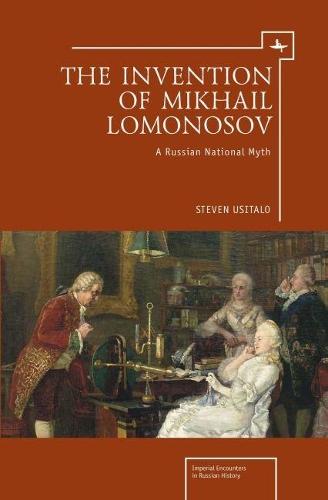
Overview
This study explores the evolution of Lomonosov's imposing stature in Russian thought from the middle of the eighteenth century to the closing years of the Soviet period. It reveals much about the intersection in Russian culture of attitudes towards the meaning and significance of science, as well as about the rise of a Russian national identity, of which Lomonosov became an outstanding symbol. Idealized depictions of Lomonosov were employed by Russian scientists, historians, and poets, among others, in efforts to affirm to their countrymen and to the state the pragmatic advantages of science to a modernizing nation. In setting forth this assumption, Usitalo notes that no sharply drawn division can be upheld between the utilization of the myth of Lomonosov during the Soviet period of Russian history and that which characterized earlier views. The main elements that formed the mythology were laid down in the eighteenth and nineteenth centuries; Soviet scholars simply added more exaggerated layers to existing representations.
Full Product Details
Author: Steven Usitalo
Publisher: Academic Studies Press
Imprint: Academic Studies Press
Weight: 0.525kg
ISBN: 9781618118066
ISBN 10: 1618118064
Pages: 298
Publication Date: 14 June 2018
Audience:
Professional and scholarly
,
Professional & Vocational
Format: Paperback
Publisher's Status: Active
Availability: Temporarily unavailable

The supplier advises that this item is temporarily unavailable. It will be ordered for you and placed on backorder. Once it does come back in stock, we will ship it out to you.
Reviews
The substance and merit of Usitalo's study is his richly documented and copiously footnoted critical reconstruction of the myth of Lomonosov the scientist and its growth and reconfigurations over time, set within the broader context of the pan-European perception of scientific biography. --Marcus C. Levitt Slavic and East European Journal, 58.2 (Summer 2014) [Usitalo's] book masterfully demonstrates the power of national narrative and tradition in constructing history. --Fillip Velgach New Books in History Steven A. Usitalo's The Invention of Mikhail Lomonosov: A Russian National Myth is a pioneering study of Mikhail Lomonosov's scholarly reputation in the Russian cultural imagination. As every Russian has been learning in school beginning in the mid-nineteenth century until the present, Lomonosov was a polymath, a genius to whom Russian culture is indebted for the creation of not only poetry but also of virtually every other scientific and social discipline, including chemistry, physics, geography, history, and linguistics. The author convincingly demonstrates the mythological nature of this reputation and traces its emergence from the eighteenth-century biographies of Lomonosov to the work of the most enthusiastic twentieth-century historian of Lomonosov's life and work, Boris Menshutkin, whose many articles and books have solidified and perpetuated the myth of Lomonosov as the greatest national genius. Erudite and skillfully argued, the book is bound to become obligatory reading for every Lomonosov scholar, science and literary historians alike. --Irina Reyfman, Columbia University With his book, Usitalo has proven that it is possible to write in an original way about an old topic and make it exciting and relevant. The author not only deconstructs and obliterates the old myth, but retraces the true story of Lomonosov, the scientist. . . . With this book Usitalo advances not just our understanding of Lomonosov, but opens the window to a larger study of the role of myth-making in the development of national consciousness. --Marina Swoboda Canadian Slavonic Papers, Vol. LVI, Nos. 1-2, March-June 2014 The Invention of Mikhail Lomonosov has potential appeal to a number of audiences. For historians of science, this study provides insight into the particularities of the Russian case and how it differs from, and is similar to, the veneration and self-fashioning of non-Russian scientists such as Galileo in early modern Europe or Benjamin Franklin in the United States. Historians of Russia and the Soviet Union will also profit from this book's intriguing ideas about the 'mythogenic' qualities of Russian culture, where cults of personality-- beginning with political figures and extending to the pantheon of literary, engineering, and cosmonaut heroes--play such a prominent role in politics and in the propagation of ideas about what it means to be a Russian. --Andrew Jenks Isis, Vol. 105, No. 3 (September 2014)
Author Information
Steven Usitalo (PhD McGill University) is an associate professor at the Department of History, Northern State University. He is the co-editor with William Benton Whisenhunt of Russian and Soviet History: From the Time of Troubles to the Collapse of the Soviet Union (2008).