Overview
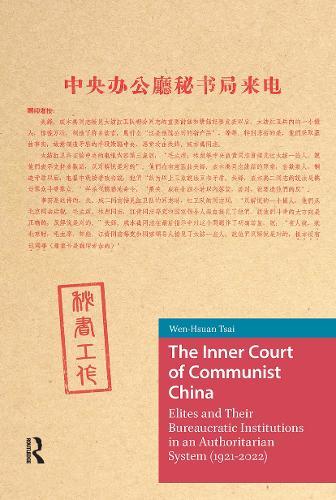
This book discusses the mishu (staff member, secretary) system and the operation of the Chinese Communist Party between 1921 and 2022, focusing on the system’s impact on high-level politics and decision-making during four key periods. Starting with the Revolutionary War (1921–1945), it moves to the founding of the People’s Republic of China and the beginning of the Cultural Revolution (1950–1966), the period of the Cultural Revolution (1966–1976), and finally the period of reform and opening up, bringing the history to the present day (1976–2022). This is the first systematic analysis of the mishu system, offering new insights on the history of the CCP and modern China.
Full Product Details
Author: Wen-Hsuan Tsai
Publisher: Pallas Publications
Imprint: Pallas Publications
Weight: 0.550kg
ISBN: 9789048562411
ISBN 10: 9048562414
Pages: 210
Publication Date: 04 March 2025
Audience:
Professional and scholarly
,
Professional & Vocational
Format: Hardback
Publisher's Status: Active
Availability: Manufactured on demand

We will order this item for you from a manufactured on demand supplier.
Reviews
Wen-Hsuan Tsai is one of the world’s finest researchers and analysts on how the Chinese political system operates. In this new book, he insightfully depicts how, through a century of trial and error, China has shaped a system of aides to Chinese leaders that today plays a vital role in the Party-state’s effectiveness and sustainability. --Jonathan Unger, Australian National University Chinese communist politics is often said a black box for its extremely low transparency, but now Professor Tsai’s book provides an exploration into its most hidden part by revealing the structure and operation of the mishu system. As bringing the readers to the Chinese leaders’ offices for an in-depth tour, this book is a must read for understanding China’s leadership politics, elite dynamics, and decision-making mechanisms. -- Guoguang Wu, Stanford University Dr. Wen-hsuan Tsai is an eminent Taiwanese expert on China studies, having been trained at the Graduate Institute of East Asian Studies at National Chengchi University (Taiwan). Over the past 15 years, he has published numerous acclaimed works on Chinese politics. In this book, Wen-hsuan provides an in-depth analysis of the development of the Chinese Communist Party's staff (mishu) system and institutions. On the one hand, it helps us understand the opaque workings of CCP politics; on the other hand, it lays a foundation for future research on the political networks of CCP elites. -- Chien-Wen Kou, National Chengchi University
Wen-Hsuan Tsai is one of the world's finest researchers and analysts on how the Chinese political system operates. In this new book, he insightfully depicts how, through a century of trial and error, China has shaped a system of aides to Chinese leaders that today plays a vital role in the Party-state's effectiveness and sustainability., --Jonathan Unger, Australian National University, Chinese communist politics is often said a black box for its extremely low transparency, but now Professor Tsai's book provides an exploration into its most hidden part by revealing the structure and operation of the mishu system. As bringing the readers to the Chinese leaders' offices for an in-depth tour, this book is a must read for understanding China's leadership politics, elite dynamics, and decision-making mechanisms.,-- Guoguang Wu, Stanford University, Dr. Wen-hsuan Tsai is an eminent Taiwanese expert on China studies, having been trained at the Graduate Institute of East Asian Studies at National Chengchi University (Taiwan). Over the past 15 years, he has published numerous acclaimed works on Chinese politics. In this book, Wen-hsuan provides an in-depth analysis of the development of the Chinese Communist Party's staff (mishu) system and institutions. On the one hand, it helps us understand the opaque workings of CCP politics; on the other hand, it lays a foundation for future research on the political networks of CCP elites.,- Chien-Wen Kou, National Chengchi University
Author Information
Wen-Hsuan Tsai is a Research Fellow at the Institute of Political Science, Academia Sinica (Taiwan). His main research is on Chinese political development, and authoritarian regimes. Tsai has published many articles in The China Journal, The China Quarterly, Journal of Contemporary China, and other journals in English and Chinese. In addition to publishing this book with Amsterdam University Press, he also has another monograph entitled A Tight Grip: State Power and Control in Modern China (Vancouver: University of British Columbia Press, 2024).