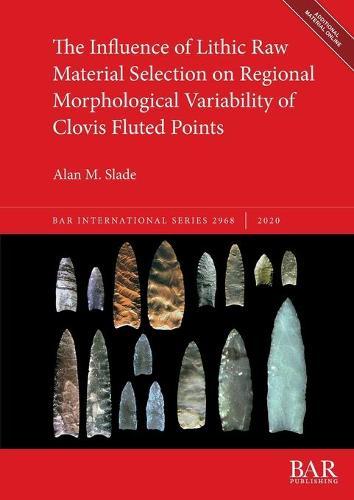
The Influence of Lithic Raw Material Selection on Regional Morphological Variability of Clovis Fluted Points

Author:   Alan M. Slade
Publisher:   BAR Publishing
ISBN:  

9781407353951


Pages:   112
Publication Date:   28 February 2020
Format:   Mixed media product
Availability:   Available To Order   Availability explained
We have confirmation that this item is in stock with the supplier. It will be ordered in for you and dispatched immediately.

Our Price $142.31 Quantity:  
Add to Cart

Share |

The Influence of Lithic Raw Material Selection on Regional Morphological Variability of Clovis Fluted Points


Overview

Clovis was once considered to be the first universal lithic technology to evolve in North America, occurring between 11,050 to 10,800 radiocarbon years before present (14C yr BP). These early hunter-gatherers left behind a sparse material record of their occupation that consists primarily of stone tools and the manufacturing debris associated with their production. The trademark tool of this earliest lithic technology to evolve in North America is a fluted point named after its type site discovery in a quarry at Blackwater Draw Locality No. 1, near Clovis, a town in New Mexico. These artefacts were made by widely separated groups throughout North America. The fluted points from Nova Scotia are much the same as those from New Mexico, not identical, but the similarities outweigh the differences. Not only are the fluted points similar across North America, but other technological aspects of the Clovis culture, i.e. blades, unifacial tools, and osseous tools, appear to be equally similar and widespread. In this study, the author identifies a number of Clovis and Clovis variants from seven environmentally different regions across North America. This monograph analyses the variability of Clovis fluted points and the lithic raw materials that they were produced on from a continental perspective. Complementing the research is a digital photographic dataset of the Clovis fluted points discussed, available online.

Full Product Details

Author:   Alan M. Slade
Publisher:   BAR Publishing
Imprint:   BAR Publishing
Weight:   0.766kg
ISBN:  

9781407353951


ISBN 10:   1407353950
Pages:   112
Publication Date:   28 February 2020
Audience:   Professional and scholarly ,  Professional & Vocational
Format:   Mixed media product
Publisher's Status:   Active
Availability:   Available To Order   Availability explained
We have confirmation that this item is in stock with the supplier. It will be ordered in for you and dispatched immediately.

Table of Contents

List of figures List of tables Foreword 1. Introduction 1.1 Clovis: an investigation into an early Paleoindian culture 1.2 Aims and objectives 1.3 Outline of research 2. Clovis: type description, dating, regional distribution, and site types 2.1 The archaeological record 2.2 Dating: what is the age of Clovis? 2.3 Regional distribution of Clovis fluted points 2.3.1 Region 1: Northeast 2.3.2 Region 2: Middle-Atlantic and Southeast 2.3.3 Region 3: Midcontinent and Great Lakes 2.3.4 Region 4: Northern Plains 2.3.5 Region 5: Southern Plains and Desert Southwest 2.3.6 Region. 6: Southwest, Great Basin and Colorado Plateau 2.3.7 Region 7: Northwest 2.4 Clovis site types 2.4.1 Clovis kill sites 2.4.2 Campsites 2.4.3 Source-area / Workshop sites 2.4.4 Clovis caches 2.4.5 Isolates and surface-collected Clovis points 2.5 Summary and discussion 3. Methods: samples, site selection criterion, and methodologies 3.1 Aims and objectives 3.2 The samples 3.2.1 Selection criteria: sample 1), M 3.2.2 Selection criteria: sample 2), C 3.2.3 Selection criteria: sample 3), S 3.3 Methods: quantative variables and geometric morphometrics 3.4 Clovis point and site selection 3.5 Data collection: artefact assemblages, replica casts and collections 3.6 Testing the methodology 3.7 Discussion: early conclusions and implications 4. Clovis lithic raw materials: regional variability, sourcing and procurement 4.1 Introduction 4.2 Regional analysis of the raw material 4.2.1 Region 1: Northeast 4.2.2 Region 2: Middle-Atlantic and Southeast 4.2.3 Region 3: Midcontinent and Great Lakes 4.2.4 Region 4: Northern Plains 4.2.5 Region 5: Southern Plains and Desert Southwest 4.2.6 Region 6: Southwest and Great Basin 4.2.7 Region 7: Northwest 4.3 Interpretation of regional and intraregional patterns 4.4 Recognition and identification of raw material sources 4.5 Summary: questions and early conclusions 5. Analysis: procedures and results 5.1 Introduction 5.2 Analysis of the samples and initial results 5.2.1 Region 1: Northeast 5.2.2 Region 2: Middle-Atlantic and Southeast 5.2.3 Region 3: Midcontinent and Great Lakes 5.2.4 Region 4: Northern Plains 5.2.5 Southern Plains and Desert Southwest 5.2.6 Southwest and Great Basin 5.2.7 Northwest 5.3 Synopsis: brief overview of the results 5.4 Summary: observations and implications 6. Conclusions: interpretations, discussion, and future research 6.1 Restating the research questions 6.2 Interpretation of regional results 6.2.1 Region 1: Northeast 6.2.2 Region 2: Middle-Atlantic and Southeast 6.2.3 Region 3: Midcontinent and Great Lakes 6.2.4 Region 4: Northern Plains 6.2.5 Region 5: Southern Plains and Desert Southwest 6.2.6 Region 6: Southwest and Great Basin 6.2.7 Region 7: Northwest 6.3 Discussion: Clovis points, people, and places 6.3.1 Discussion Pt. 1: Clovis in the North American landscape 6.3.2 Discussion Pt. 2: Clovis a human behavioural perspective 6.4 Directions for future research 6.5 Concluding comments 6.6 Endnote Bibliography Appendix A. Supporting information: regional association of Clovis-aged and related sites in North America A.1 Introduction A.2 Regional association of Clovis-aged sites and assemblages A.3 Comment: further north and farthest south Appendix B. Data collection: list of institutions and collections of Clovis points accessed for this research B.1 Institutions B.2 Private collections B.3 Miscellaneous collections Appendix C. Clovis point data collection methodologies C.1 Clovis point record sheet C.2 Photographic record: digital photographic database C.3 Clovis point sample: caliper-based metrics and visual observations C.4 Recording methodology Appendix D. U.S state abbreviations and Smithsonian Institution trinomial index D.1 State abbreviation and associated region D.2 Smithsonian Institution trinomial Clovis site index Appendix E. Dating: calibrated and radiocarbon age ranges E.1 Conversion tables: radiocarbon ages (14C yr BP) roughly calibrated to calendar-year ages (Cal yr BP)

Reviews

This work contributes significant new knowledge to the field of research as a specific demonstration of how raw material characteristics can influence technological and stylistic aspects of stone tool production. Dr Michael B. Collins, Gault School of Archaeological Research and the Texas Archaeological Research Laboratory at the University of Texas, Austin


Author Information

Alan M. Slade is a postdoctoral researcher with the University of Texas at Austin, Texas Archaeological Research Laboratory (TARL) and is also a team member of the Prehistory Research Project (PRP). Alan spent fifteen years as a Prehistoric and Palaeolithic field archaeologist in Britain and Europe, and a further decade helping to curate the lithic collections in the British Museum. He is a research fellow of the Centre for the Archaeology of Human Origins (CAHO) at the University of Southampton; on the committee for the Lithic Studies Society (LSS); and he is also an active member of the Society for Museum Archaeologists (SMA).

Tab Content 6

Author Website:  

Countries Available

All regions
Latest Reading Guide

April RG 26_2


Shopping Cart
Your cart is empty
Shopping cart
Mailing List