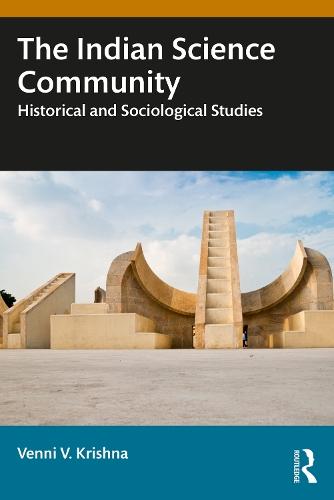
Full Product Details
Author: Venni V. Krishna (Professorial Fellow, University of New South Wales, Sydney, Australia)
Publisher: Taylor & Francis Ltd
Imprint: Routledge India
ISBN: 9781032844268
ISBN 10: 1032844264
Pages: 396
Publication Date: 21 May 2026
Audience:
College/higher education
,
Tertiary & Higher Education
Format: Paperback
Publisher's Status: Forthcoming
Availability: Not yet available

This item is yet to be released. You can pre-order this item and we will dispatch it to you upon its release.
Reviews
“Given its rich history, India’s place in science and technology has too often been neglected or forgotten. Yet, in the advancement of science lies the key to India’s modernisation. Nowhere is this better illustrated than in the writings of VV Krishna. To fully understand the historical relations of Indian science and society, this collection is essential reading.” Roy MacLeod, Professor Emeritus History, University of Sydney, Australia “The Indian Science Community” offers a sensitive perspective on how science, an apparent universal discipline guided by objective truth, is in fact embedded in a social and cultural context which shapes its dynamics and application. India has been a leading example of science deeply set within a very different social context since the 1870s when local knowledge perspectives started to interact with science within the invading force of British colonial domination. Revealed is the hidden power of wider social meaning to shape both scientific knowledge and how it is applied. Stephen Hill, Emeritus Professor, Faculty of Law, Humanities and the Arts, University of Wollongong, Australia We have been waiting for a book like this for at least the last two decades. There is no other book-length comprehensive survey of twentieth century science and technology in India, which is much required by students of modern history, policy studies, and education. This book will become a starting point for many further studies and become an essential anchor also for teaching. Jahnavi Phalkey, Director, Science Gallery, Bengaluri, India “History is important for the future. Dr. Krishna's book, ""The Indian Science Community: Historical and Sociological Studies"" builds on the existing literature, analyzes the recent past, and provides a crucial perspective for understanding the current and the future issues in the organization of Indian science and technology (S&T). Is science 'public good’ or ‘market good’? Isn't science for science's sake? Useful and profitable applications do come out, in its 'own' time, from the use of new tools and concepts emerging from fundamental research... Dr. Krishna's understanding of what is relevant in mapping social organization of science have come in handy. He offers a sociological unpacking of the problem why India has not been able to enlarge and expand excellence in research and exploit its intellectual capital. The book ends with a critical chapter on the challenging & changing social contract between science and society. A comprehensive and highly relevant book...” Rupamanjari Ghosh, Former Vice Chancellor, Shiv Nadar University, & Dean at the School of Physical Sciences, Jawaharlal Nehru University, India
Author Information
Venni V. Krishna, FRSN, Professor, School of Humanities and Languages, Faculty of Arts, Design & Architecture, University of New South Wales, Sydney, Australia.