Overview
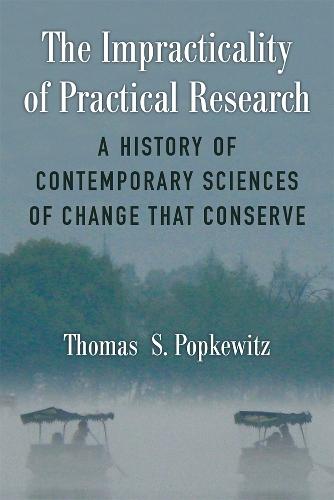
There is an alluring desire that research should lead us to find the practical knowledge that enables people to live a good life in a just and equitable society. This desire haunted the 19th century emergence of the social sciences as a discipline, then became more pronounced in the postwar mobilizations of research. Today that desire lives on in the international assessments of national schools and in the structure of professional education, both of which influence government modernization of schools and also provide for people’s well-being. American policy thus reflects research in which reforms are verified by “scientific, empirical evidences” about “what works” in experiments, and “will work” therefore in society. The book explores the idea that practical and useful knowledge changes over time, and shows how this knowledge has been (re)visioned in contemporary research on educational reform, instructional improvement, and professionalization. The study of science draws on a range of social and cultural theories and historical studies to understand the politics of science, as well as scientific knowledge that is concerned with social and educational change. Research hopes to change social conditions to create a better life, and to shape people whose conduct embodies these valued characteristics—the good citizen, parent, or worker. Yet this hope continually articulates the dangers that threaten this future. Thomas Popkewitz explores how the research to correct social wrongs is paradoxically entangled with the inscription of differences that ultimately hamper the efforts to include.
Full Product Details
Author: Thomas Stanley Popkewitz
Publisher: The University of Michigan Press
Imprint: The University of Michigan Press
Dimensions:
Width: 15.20cm
, Height: 2.30cm
, Length: 22.90cm
Weight: 0.394kg
ISBN: 9780472037742
ISBN 10: 0472037749
Pages: 298
Publication Date: 16 April 2020
Audience:
Professional and scholarly
,
Professional & Vocational
Format: Paperback
Publisher's Status: Active
Availability: In Print

This item will be ordered in for you from one of our suppliers. Upon receipt, we will promptly dispatch it out to you. For in store availability, please contact us.
Reviews
The book contributes to a broad intellectual program of rethinking the taken-for-granted terms and ideas of education. Showing the historical development of practical-oriented educational research pushes readers to consider a different epistemology regarding knowledge production around teacher education and schooling. - Nancy Lesko, Columbia University
"The book contributes to a broad intellectual program of rethinking the taken-for-granted terms and ideas of education. Showing the historical development of practical-oriented educational research pushes readers to consider a different epistemology regarding knowledge production around teacher education and schooling."" — Nancy Lesko, Columbia University"
“In this compelling book, Popkewitz shows how the pressure to produce practical research, to improve social institutions, may actually undermine their ability to produce desirable outcomes, turning scholars into social engineers, harnessed to the existing system and forced to tinker with it in its own terms.” —David F. Labaree, Stanford University, author of A Perfect Mess “A cautionary tale and an encouraging voice, this book acts as a mirror holding up the history of science and its application in civil society.” —William F. Tate, Edward Mallinckrodt Distinguished University Professor in Arts & Sciences, Washington University in St. Louis “Should school reforms be driven by data? Thomas Popkewitz shows here how ineffective and even counterproductive these ‘practical’ ideals of investigation can be unless informed by cultural understanding and a sense of the historical trajectory that got us to where we now are.” —Theodore Porter, Distinguished Professor of History of Science at UCLA, author of Trust in Numbers: The Pursuit of Objectivity in Science and Public Life “The book contributes to a broad intellectual program of rethinking the taken-for-granted terms and ideas of education. Showing the historical development of practical-oriented educational research pushes readers to consider a different epistemology regarding knowledge production around teacher education and schooling.” —Nancy Lesko, Columbia University
Author Information
Thomas S. Popkewitz is Professor of Curriculum and Instruction in the School of Education at the University of Wisconsin–Madison.