Overview
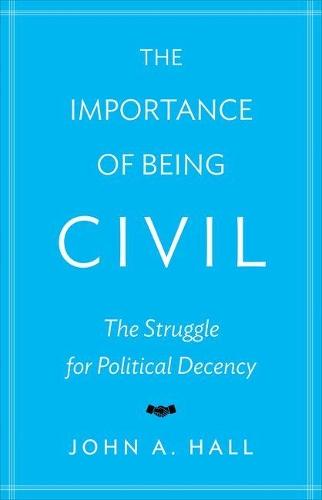
Civility is desirable and possible, but can this fragile ideal be guaranteed? The Importance of Being Civil offers the most comprehensive look at the nature and advantages of civility throughout history and in our world today. Esteemed sociologist John Hall expands our understanding of civility as related to larger social forces--including revolution, imperialism, capitalism, nationalism, and war--and the ways that such elements limit the potential for civility. Combining wide-ranging historical and comparative evidence with social and moral theory, Hall examines how the nature of civility has fluctuated in the last three centuries, how it became lost, and how it was reestablished in the twentieth century following the two world wars. He also considers why civility is currently breaking down and what can be done to mitigate this threat. The Importance of Being Civil is a decisive and sophisticated addition to the discussion of civility in its modern cultural and historical contexts.
Full Product Details
Author: John A. Hall
Publisher: Princeton University Press
Imprint: Princeton University Press
Dimensions:
Width: 14.00cm
, Height: 2.20cm
, Length: 21.60cm
Weight: 0.425kg
ISBN: 9780691153261
ISBN 10: 0691153264
Pages: 280
Publication Date: 05 May 2013
Audience:
College/higher education
,
Professional and scholarly
,
Tertiary & Higher Education
,
Professional & Vocational
Format: Hardback
Publisher's Status: Active
Availability: Temporarily unavailable

The supplier advises that this item is temporarily unavailable. It will be ordered for you and placed on backorder. Once it does come back in stock, we will ship it out to you.
Language: English
Reviews
"""In this insightful, well-argued examination of civility (defined as a tolerance and respect for different points of view), McGill University sociologist Hall argues that civility is the crucial foundation for a successful civil society... This is a much-needed book for today's contentious world.""--Publishers Weekly ""The Importance of Being Civil is a meandering tour through centuries of Western history in the company of Hall, a guide who has led such excursions for decades. As a narrative well-stocked with quotes from carefully chosen thinkers--Machiavelli, Adam Smith, and Tocqueville--and analytic observations that Hall has polished to brilliance through repeated delivery, the book will please both political scientists and casual readers with an interest in the tribulations, triumphs, and prospects of civility.""--ForeWord ""Tracing Western socio-structural development that created multiple centers of power, Hall ably presents the work of various theorists in ways that support the book's central theme: the utility and, indeed, the necessity of providing suitable alternatives to extreme reactions in various junctures of social stress and crises... Hall is careful to continually note the fragility of civility, not only as a chosen practice, but also with regard to the cultural and socio-structural backgrounds of various actors, ideologies, and philosophies diminishing the potential for civility. Of particular interest is Hall's skill in melding the micro- and macro-sociological.""--Choice"
In this insightful, well-argued examination of civility (defined as a tolerance and respect for different points of view), McGill University sociologist Hall argues that civility is the crucial foundation for a successful civil society... This is a much-needed book for today's contentious world. Publishers Weekly The Importance of Being Civil is a meandering tour through centuries of Western history in the company of Hall, a guide who has led such excursions for decades. As a narrative well-stocked with quotes from carefully chosen thinkers--Machiavelli, Adam Smith, and Tocqueville--and analytic observations that Hall has polished to brilliance through repeated delivery, the book will please both political scientists and casual readers with an interest in the tribulations, triumphs, and prospects of civility. ForeWord
In this insightful, well-argued examination of civility (defined as a tolerance and respect for different points of view), McGill University sociologist Hall argues that civility is the crucial foundation for a successful civil society... This is a much-needed book for today's contentious world. --Publishers Weekly The Importance of Being Civil is a meandering tour through centuries of Western history in the company of Hall, a guide who has led such excursions for decades. As a narrative well-stocked with quotes from carefully chosen thinkers--Machiavelli, Adam Smith, and Tocqueville--and analytic observations that Hall has polished to brilliance through repeated delivery, the book will please both political scientists and casual readers with an interest in the tribulations, triumphs, and prospects of civility. --ForeWord Tracing Western socio-structural development that created multiple centers of power, Hall ably presents the work of various theorists in ways that support the book's central theme: the utility and, indeed, the necessity of providing suitable alternatives to extreme reactions in various junctures of social stress and crises... Hall is careful to continually note the fragility of civility, not only as a chosen practice, but also with regard to the cultural and socio-structural backgrounds of various actors, ideologies, and philosophies diminishing the potential for civility. Of particular interest is Hall's skill in melding the micro- and macro-sociological. --Choice
In this insightful, well-argued examination of civility (defined as a tolerance and respect for different points of view), McGill University sociologist Hall argues that civility is the crucial foundation for a successful civil society... This is a much-needed book for today's contentious world. Publishers Weekly
Author Information
John A. Hall is the James McGill Professor of Comparative Historical Sociology at McGill University.