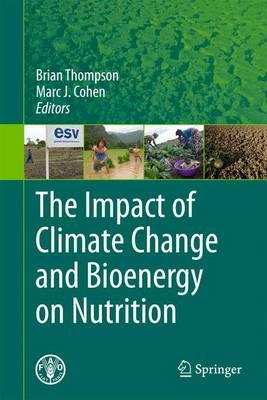
The Impact of Climate Change and Bioenergy on Nutrition

Author:   Brian Thompson ,  Marc J Cohen
Publisher:   Springer
Edition:   2012 ed.
ISBN:  

9789400792890


Pages:   120
Publication Date:   16 April 2014
Format:   Paperback
Availability:   Manufactured on demand   Availability explained
We will order this item for you from a manufactured on demand supplier.

Our Price $290.37 Quantity:  
Add to Cart

Share |

The Impact of Climate Change and Bioenergy on Nutrition


Overview

Climate changes will affect food production in a number of ways. Crop yields, aquatic populations and forest productivity will decline, invasive insect and plant species will proliferate and desertification, soil salinization and water stress will increase. Each of these impacts will decrease food and nutrition security, primarily by reducing access to and availability of food, and also by increasing the risk of infectious disease. Although increased biofuel demand has the potential to increase incomes among producers, it can also negatively affect food and nutrition security. Land used for cultivating food crops may be diverted to biofuel production, creating food shortages and raising prices. Accelerations in unregulated or poorly regulated foreign direct investment, deforestation and unsustainable use of chemical fertilizers may also result. Biofuel production may reduce women’s control of resources, which may in turn reduce the quality of household diets. Each of these effects increases risk of poor food and nutrition security, either through decreased physical availability of food, decreased purchasing power, or increased risk of disease. The Impact of Climate Change and Bioenergy on Nutrition articulates the links between current environmental issues and food and nutrition security. It provides a unique collection of nutrition statistics, climate change projections, biofuel scenarios and food security information under one cover which will be of interest to policymakers, academia, agronomists, food and nutrition security planners, programme implementers, health workers and all those concerned about the current challenges of climate change, energy production, hunger and malnutrition.

Full Product Details

Author:   Brian Thompson ,  Marc J Cohen
Publisher:   Springer
Imprint:   Springer
Edition:   2012 ed.
Dimensions:   Width: 15.50cm , Height: 1.00cm , Length: 23.50cm
Weight:   0.221kg
ISBN:  

9789400792890


ISBN 10:   9400792891
Pages:   120
Publication Date:   16 April 2014
Audience:   Professional and scholarly ,  Professional & Vocational
Format:   Paperback
Publisher's Status:   Active
Availability:   Manufactured on demand   Availability explained
We will order this item for you from a manufactured on demand supplier.

Table of Contents

1. Summary.- Background: Unacceptably Slow Progress against Hunger and Malnutrition.- Causations and Linkages: Conceptual and Analytical Frameworks.- Future Challenges, Major Issues and Risks.- Climate Change, Food Security and Nutrition.- Nutrition and Bioenergy .- Policies and Programmes for Improving Nutrition.- 2. Introduction.- Purpose.- Concept and Content.- 3. World Food Insecurity and Malnutrition: Scope, Trends, Causes and Consequences.- Dimensions of the Nutrition Problem.- Causations and Linkages: Conceptual and Analytical Frameworks.- Future Challenges, Major Issues and Risks 4. Climate Change,  Food Security and Nutrition.- Overview of Climate Change – Evidence and Effects.- Impacts of Climate Change on the Human and Global Environment.- Impacts on the Four Food Security Dimensions: Availability, Stability,.- Access and Utilization.- Links between Global Climate Change, Food Security, Hunger and Nutrition .- Social Impacts of Climate Change.- Adaptation and Mitigation Strategies.- 5. Nutrition and Bioenergy.- Overview.- Nutrition Impacts.- Mitigation of Negative Impacts of Biofuels.- 6. Policies and Programmes for Improving Nutrition .- International Initiatives.- Policies and Programmes.- Priorities and Approaches for Responding to Threats to Nutrition from.- Climate Change and Biofuel Demand.- 7. Conclusions and Recommendations.- Responding to Climate Change.- Assuring Pro-Poor and Sustainable Biofuel Development.- Making Nutrition a Development Priority.- 8. References.- 9. Appendices.- Appendix 1: Scenarios of the IPCC’s Special Report on Emissions Scenarios.- Appendix 2: IFPRI IMPACT Model.

Reviews

Author Information

Tab Content 6

Author Website:  

Countries Available

All regions
Latest Reading Guide

NOV RG 20252


Shopping Cart
Your cart is empty
Shopping cart
Mailing List