Overview
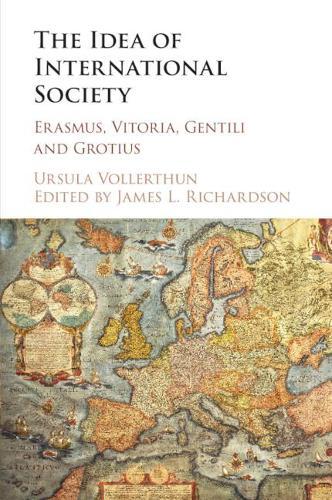
This book offers the first comprehensive account and re-appraisal of the formative phase of what is often termed the 'Grotian tradition' in international relations theory: the view that sovereign states are not free to act at will, but are akin to members of a society, bound by its norms. It examines the period from the later fifteenth to the mid-seventeenth centuries, focusing on four thinkers: Erasmus, Vitoria, Gentili and Grotius himself, and is structured by the author's concept of international society. Erasmus' views on international relations have been entirely neglected, but underlying his work is a consistent image of international society. The theologian Francisco de Vitoria concerns himself with its normative principles, the lawyer Alberico Gentili - unexpectedly, the central figure in the narrative - with its extensive practical applications. Grotius, however, does not re-affirm the concept, but wavers at crucial points. This book suggests that the Grotian tradition is a misnomer.
Full Product Details
Author: Ursula Vollerthun ,
James L. Richardson
Publisher: Cambridge University Press
Imprint: Cambridge University Press
Dimensions:
Width: 15.20cm
, Height: 1.50cm
, Length: 23.00cm
Weight: 0.450kg
ISBN: 9781108404631
ISBN 10: 1108404634
Pages: 266
Publication Date: 23 January 2020
Audience:
Professional and scholarly
,
Professional & Vocational
Format: Paperback
Publisher's Status: Active
Availability: Manufactured on demand

We will order this item for you from a manufactured on demand supplier.
Reviews
'Vollerthun provides an original and balanced reading of one of the critical phases in the formation of international law. Bringing unexpected authors, such as Erasmus, to the table, she shows in which respects Grotius failed to integrate a complex discussion that responded to urgent needs of his time and would become one of international law's main tenets, Grotian or not.' Andreas Wagner, Goete Universitat, Frankfurt am Main Advance praise: 'Vollerthun provides an original and balanced reading of one of the critical phases in the formation of international law. Bringing unexpected authors, such as Erasmus, to the table, she shows in which respects Grotius failed to integrate a complex discussion that responded to urgent needs of his time and would become one of international law's main tenets, Grotian or not.' Andreas Wagner, Goete Universitat, Frankfurt am Main
'Vollerthun provides an original and balanced reading of one of the critical phases in the formation of international law. Bringing unexpected authors, such as Erasmus, to the table, she shows in which respects Grotius failed to integrate a complex discussion that responded to urgent needs of his time and would become one of international law's main tenets, Grotian or not.' Andreas Wagner, Goete Universitat, Frankfurt am Main
Author Information
Ursula Vollerthun (1937‒2011) came relatively late to International Relations. With a background in Political Science and the History and Philosophy of Science, she pursued the present topic for her thesis in the Department of International Relations in the then Research School of Pacific Studies at the Australian National University. James L. Richardson was Professor of Political Science (1975‒85), later of International Relations (1986‒98), at the Australian National University, Canberra. He is author of Germany and the Atlantic Alliance (1966), Crisis Diplomacy (Cambridge, 1994) and Contending Liberalisms in World Politics (2001). After Ursula Vollerthun's death, he devoted himself to this work.