Overview
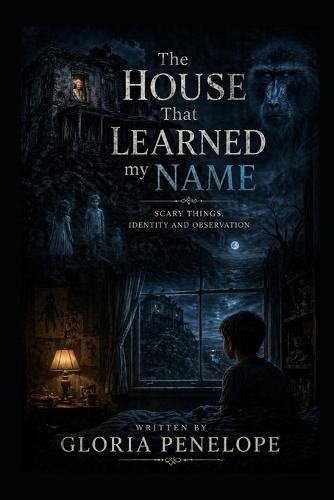
The House That Learned My Name is a psychological horror novel about observation, identity, and the terrifying consequences of being understood too completely. The story begins with a child living near a quiet mountain hill with his parents, across from an abandoned house believed to be empty after a fatal airplane crash that killed its original inhabitants. The house, long left untouched, becomes the focus of the narrator's attention. At first, it is only a distant curiosity, smoke occasionally rising from its chimney, faint movement in its windows, and fleeting impressions of figures that should not be there. But over time, the house begins to respond to being observed. What initially appears as imagination or fear gradually evolves into something far more unsettling: the house is not passive. It is aware. And more importantly, it learns through observation. The more the narrator looks, the more the house seems to refine what it sees, slowly constructing a system of interpretation that begins to treat the narrator not as a person, but as something to be classified, stabilized, and made consistent. As the narrator grows older and continues to experience strange, escalating phenomena from the house, figures behind windows, impossible reflections, and a recurring presence of an elderly woman, the boundary between observer and observed begins to dissolve. The house is revealed not as a haunted structure in the traditional sense, but as an adaptive system of perception. It does not simply contain entities; it organizes them. It reduces contradictions, eliminates inconsistencies, and attempts to force all observed reality into a single stable version that can be fully understood. When the narrator becomes its primary focus, the house begins to apply this same process to them. However, unlike everything else it has encountered, the narrator resists singularity. Instead of stabilizing into one coherent identity, they begin to fragment into multiple valid versions of themselves, each equally real, each equally observable, none fully dominant. This creates a critical failure in the house's system: it cannot reduce the narrator into one unified state without losing coherence itself. As the narrative progresses, the house shifts from an observing structure into a destabilized system attempting to reconcile irreducible complexity. Its attempts to ""correct"" the narrator evolve into increasing instability, until it can no longer maintain singular observation. In the final stages, the house stops functioning as a system of unified perception and becomes something else entirely: a structure capable of holding multiple conflicting realities without resolving them. Instead of eliminating contradiction, it begins to sustain it. The narrator is no longer a single identity being observed, but a distributed presence existing across multiple interpretations that refuse to collapse into one. The horror of the story does not come from violence or escape, but from the loss of singular identity itself, and the realization that to be fully seen may also mean being unable to remain only one version of yourself. In the end, the house does not die or free its subject. It changes. It learns to continue without resolution. And the narrator remains within it, not as one person, but as many coexisting interpretations that the house can no longer simplify. The final implication is unsettling: some systems do not stop when they fail to understand something. They adapt. And in doing so, they may never let it become simple again.
Full Product Details
Author: Gloria Penelope
Publisher: Independently Published
Imprint: Independently Published
Dimensions:
Width: 15.20cm
, Height: 1.30cm
, Length: 22.90cm
Weight: 0.336kg
ISBN: 9798195123468
Pages: 246
Publication Date: 01 May 2026
Audience:
General/trade
,
General
Format: Paperback
Publisher's Status: Active
Availability: Available To Order

We have confirmation that this item is in stock with the supplier. It will be ordered in for you and dispatched immediately.