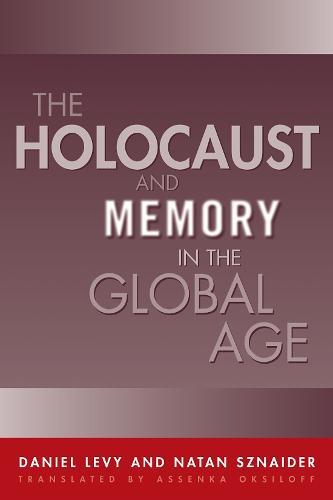
Full Product Details
Author: Daniel Levy ,
Natan Sznaider
Publisher: Temple University Press,U.S.
Imprint: Temple University Press,U.S.
Dimensions:
Width: 14.00cm
, Height: 2.30cm
, Length: 21.00cm
Weight: 0.372kg
ISBN: 9781592132751
ISBN 10: 1592132758
Pages: 240
Publication Date: 08 December 2005
Audience:
Professional and scholarly
,
Professional & Vocational
Format: Hardback
Publisher's Status: Active
Availability: Awaiting stock

The supplier is currently out of stock of this item. It will be ordered for you and placed on backorder. Once it does come back in stock, we will ship it out for you.
Reviews
The authors' rich text comprises a journey covering, first, silence about the Holocaust, then public awareness, which turned into national memories, which later changed to global concerns generating social action on behalf of the victims around the globe...This new cosmopolitan memory is]beautifully captured, conceptualized, and analyzed in this engaging book. American Journal of Sociology Many have noted that the Holocaust is remembered differently in the United States than in Israel, which in turn remembers the event differently than any number of other nations. Levy and Sznaider's book attempts to break this mould...they present a lucid and convincing argument that the Holocaust has increasingly come to represent the paradigmatic event of twentieth-century evil within a universal ethic of internationalized human rights...As an attempt to draw some of the attention in discussion of Holocaust memory away from the context of the nation and onto an international context, this work is a success. The Journal of Jewish Studies By raising these issues, by showing how the Holocaust has been transformed into a model for global collective memory, the authors demonstrate that certain norms for human rights must, at the very least, be acknowledged in these uncertain times. This conclusion, in the end, could leave the reader with some hope, even as the struggle over the Holocaust's meaning for the future continues. ...This volume provides an interesting addition to ongoing debates over the memory of the Holocaust...Those wishing to read something beyond the long list of works on the Germans' struggle over their past and consider questions about the future might wish to give this work a glance. While there is obviously no answer yet to how the role of the Holocaust in our future will unfold, those who read this volume will, at the very least, have the opportunity to consider questions that are likely to become even more serious in the coming decades. H-Net [A]n insightful and stimulating study that offers a solid contribution to our understanding of the Holocaust's evolving global legacy. Holocaust and Genocide Studies
""The authors' rich text comprises a journey covering, first, silence about the Holocaust, then public awareness, which turned into national memories, which later changed to global concerns generating social action on behalf of the victims around the globe...This new cosmopolitan memory is]beautifully captured, conceptualized, and analyzed in this engaging book."" American Journal of Sociology ""Many have noted that the Holocaust is remembered differently in the United States than in Israel, which in turn remembers the event differently than any number of other nations. Levy and Sznaider's book attempts to break this mould...they present a lucid and convincing argument that the Holocaust has increasingly come to represent the paradigmatic event of twentieth-century evil within a universal ethic of internationalized human rights...As an attempt to draw some of the attention in discussion of Holocaust memory away from the context of the nation and onto an international context, this work is a success."" The Journal of Jewish Studies ""By raising these issues, by showing how the Holocaust has been transformed into a model for global collective memory, the authors demonstrate that certain norms for human rights must, at the very least, be acknowledged in these uncertain times. This conclusion, in the end, could leave the reader with some hope, even as the struggle over the Holocaust's meaning for the future continues. ...This volume provides an interesting addition to ongoing debates over the memory of the Holocaust...Those wishing to read something beyond the long list of works on the Germans' struggle over their past and consider questions about the future might wish to give this work a glance. While there is obviously no answer yet to how the role of the Holocaust in our future will unfold, those who read this volume will, at the very least, have the opportunity to consider questions that are likely to become even more serious in the coming decades."" H-Net ""[A]n insightful and stimulating study that offers a solid contribution to our understanding of the Holocaust's evolving global legacy."" Holocaust and Genocide Studies
Levy and Sznaider successfully demonstrate why 'holocaust'is no longer an exclusively Jewish or German concern. Their treatment of how the Holocaust is remembered, taught, memorialized, studied, and incorporated into law and policy in each of the three countries [Israel, Germany, and the US] as well as internationally is empirically rich and informative. Their larger argument about the decoupling of collective memory from national boundaries and the emergence of cosmopolitan meanings and concern is ingenious. -David Abraham, University of Miami School of Law The Holocaust and Memory in the Global Age by Daniel Levy and Natan Sznaider is the definitive study of the Shoah in our new, global world. The authors analyze the Holocaust as a key to our understanding the construction of collective memory in a world driven by media. They examine the claims of the competing cultural uses of the Holocaust in film, popular history, and high theory, from Spielberg to Goldhagen to Bauman, and beyond. This is an important book not only because of the subtlety and intelligence of the authors, but because they take seriously the implications of using the Holocaust to pattern our own understanding of events in the twenty-first century. -Sander L. Gilman, Weidenfeld Professor of European Comparative Literature, St. Anne's College / Oxford The authors have provided an excellent and insightful analysis of the way the Holocaust provides a core for modern society and a catalyst for a globalized human rights culture that privileges the identity of victims as a form for redressing their suffering. -Elazar Barkan, Professor of History and Cultural Studies, Claremont Graduate University This translation makes a highly original contribution to holocaust, human rights, and globalization scholarship. Levy and Sznaider's rich comparative and historical analysis of responses to the Holocaust over time yields significant theoretical insights, which illuminate how memory culture is being constructed and diffused in an increasingly global world, and persuasively argues for its importance in laying a basis for cosmopolitan identity. -Ruti Teitel, Ernst C. Stiefel Professor of Comparative Law, New York Law School, and author of Transitional Justice
Author Information
Daniel Levy is Assistant Professor of Sociology at the State University of New York, Stony Brook. Natan Sznaider is Associate Professor of Sociology at the Academic College of Tel-Aviv-Yaffo, Israel.