Overview
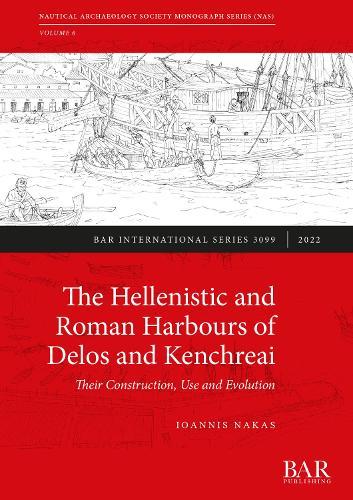
This book proposes a new approach to the Hellenistic and Roman harbours of the Aegean, based on the combined study of harbours and contemporary ships, seamanship, and commerce. It focuses on the capacity of harbours to accommodate and serve certain numbers of ships, their cargo, their crews, and their passengers. This is achieved through the study of a variety of archaeological, written, and geomorphological data on harbour configuration, and subsequent analysis relating these harbours with the ships that were most likely to use them. Two harbours are used as cases studies, the important commercial centres of Delos and Kenchreai. The results reached concerning these harbours are then discussed in a wider perspective and contextualized with other contemporary sites in the Aegean, as well as within a wider scientific discussion over commerce and seamanship in the Hellenistic and Roman Mediterranean.
Full Product Details
Author: Ioannis Nakas
Publisher: BAR Publishing
Imprint: BAR Publishing
Weight: 0.734kg
ISBN: 9781407359816
ISBN 10: 1407359819
Pages: 184
Publication Date: 31 October 2022
Audience:
Professional and scholarly
,
Professional & Vocational
Format: Paperback
Publisher's Status: Active
Availability: Available To Order 
We have confirmation that this item is in stock with the supplier. It will be ordered in for you and dispatched immediately.
Table of Contents
Abstract List of figures List of tables 1. Introduction 1.1 The research question and the aims of this study 1.2 Why harbours? 1.3 The research of Hellenistic and Roman harbours and ships 1.3.1 Harbours, architecture and urbanism 1.3.2 Harbours as commercial centres 1.3.3 Harbour technology and infrastructure 1.3.4 Politics, patronage, and symbolism 1.3.5 Harbours and geosciences 1.3.6 Ships and harbours: towards a combined study 1.4 Methodology 1.4.1 Methodological principles and tools 1.4.2 The case studies 1.4.3 The selection and handling of the material 2. Ships and cargoes in the Hellenistic and Roman Mediterranean 2.1 Ship typology, tonnage, and draught 2.1.1 Merchantmen 2.1.2 Galleys 2.1.3 Harbour vessels 2.1.4 Special cargoes and vessels 2.2 The handling and operation of ships and cargoes 2.2.1 Anchoring 2.2.2 Docking 2.2.3 Beaching 2.2.4 Towing and piloting 2.2.5 The handling of special cargoes 2.3 Conclusions 3. The case-study harbours 3.1 Delos 3.1.1 Geomorphology and climatic conditions 3.1.2 Ships, cargoes, and people in the harbours of Hellenistic and Roman Delos 3.1.3 The harbours of Delos: operation and capacity 3.1.4 The use and function of the harbours of Delos 3.1.5 Conclusions 3.2 Kenchreai 3.2.1 Geomorphology and climatic conditions 3.2.2 Ships and cargoes in the harbour of Kenchreai 3.2.3 The harbour of Kenchreai and its reconstruction 3.2.4 Harbour capacity 3.2.5 Approachability and circulation 3.2.6 The handling of ships and cargoes 3.2.7 Construction technology, planning and architecture 3.2.8 Conclusions 4. Discussion: harbours in context 4.1 Harbour size and configuration 4.2 Ship capacity and circulation 4.3 The methods of using the harbours 4.3.1 Docking 4.3.2 Beaching 4.3.3 Anchoring in the open 4.3.4 The handling of stone and marble cargoes and ships 4.3.5 The organization and control of space in harbours 4.4 Technology, planning, funding, and patronage 4.4.1 Technology and planning 4.4.2 Funding, patronage, and euergetism 4.5 Harbour networks and harbours within commercial networks 4.6 Harbour organisation, urbanism, hinterlands, and forelands 4.6.1 Space organisation around harbour basins 4.6.2 Urban and rural hinterlands 4.6.3 Storage facilities 4.6.4 Harbours as monuments 4.7 From Hellenistic to Roman harbours 4.8 Ship and harbour technology and development 5. Conclusions and epilogue 5.1 New understandings of Hellenistic and Roman harbours 5.2 A new methodology 5.3 Epilogue Appendix I: Tables Appendix II: Written sources List of references
Reviews
'This book emphasises a different approach to the study of the harbours by examining the relationship of the harbours with the ships and seamanship of the period. The work focuses on a region and sites that are of international interest for scholars of Roman and classical archaeology, as well as potentially for those in maritime archaeology more widely.' Dr Adam Rogers, University of Leicester 'The author is for the first time analysing two of the most promising harbour sites of the Aegean. Both the material/data of the case studies, and the aim/approach/methodology of the work is new and of great importance.' Dr Alkiviadis Ginalis, Deutsches Archaologisches Institut
Author Information
Ioannis Nakas is a maritime archaeologist and archaeological illustrator living in Athens, Greece. After finishing his BA at the University of his hometown, Ioannina, he obtained an MA from the University of Southampton and a PhD from the University of Birmingham, UK. His interests include ancient harbours, ships and seamanship, ship iconography, commercial amphorae and fortifications, subjects on which he has published a series of articles.
Tab Content 6
Author Website:
Countries Available
All regions
|