Overview
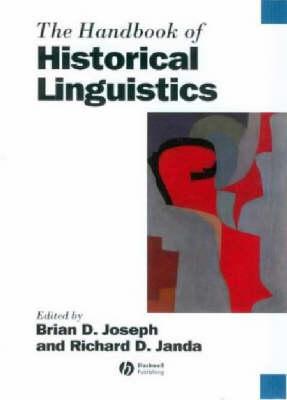
The Handbook of Historical Linguistics provides a detailed account of the numerous issues, methods, and results that characterize current work in historical linguistics, the area of linguistics most directly concerned with language change as well as past language states. Contains an extensive introduction that places the study of historical linguistics in its proper context within linguistics and the historical sciences in general Covers the methodology of historical linguistics and presents sophisticated overviews of the principles governing phonological, morphological, syntactic, and semantic change Includes contributions from the leading specialists in the field
Full Product Details
Author: Brian Joseph (Ohio State University) ,
Richard Janda (Ohio State University)
Publisher: John Wiley and Sons Ltd
Imprint: Wiley-Blackwell
Edition: New edition
Dimensions:
Width: 17.20cm
, Height: 4.90cm
, Length: 24.80cm
Weight: 1.551kg
ISBN: 9781405127479
ISBN 10: 1405127473
Pages: 904
Publication Date: 30 December 2004
Audience:
Professional and scholarly
,
Professional & Vocational
Format: Paperback
Publisher's Status: Active
Availability: Out of stock

The supplier is temporarily out of stock of this item. It will be ordered for you on backorder and shipped when it becomes available.
Reviews
The Handbook of Historical Linguistics proves an atypical handbook in several positive senses, beginning with the introduction's bold tackling of foundational issues. While many chapters offer the expected compact overviews of familiar topics, others are, we hope, destined to become influential as needed lucid statements on particular issues... and thought-provoking, original contributions... The value of The Handbook of Historical Linguistics is multifaceted; its influence will be far-reaching and long-lasting. Journal of Linguistics The editors have assembled a remarkable array of contributors who can introduce readers to the professional standards of scholarship and scientific reasoning that characterize the field. William Labov, University of Pennsylvania An authoritative collection, by a stellar group of contributors, that presents historical linguistics as it really is - a multifaceted study that is both a branch of general linguistics and a field in its own right. No other survey covers the territory half so well. Jay Jasanoff, Harvard University
The Handbook of Historical Linguistics proves an atypical handbook in several positive senses, beginning with the introduction's bold tackling of foundational issues. While many chapters offer the expected compact overviews of familiar topics, others are, we hope, destined to become influential as needed lucid statements on particular issues... and thought-provoking, original contributions... The value of The Handbook of Historical Linguistics is multifaceted; its influence will be far-reaching and long-lasting. Journal of Linguistics ?The editors have assembled a remarkable array of contributors who can introduce readers to the professional standards of scholarship and scientific reasoning that characterize the field.? William Labov, University of Pennsylvania ?An authoritative collection, by a stellar group of contributors, that presents historical linguistics as it really is ? a multifaceted study that is both a branch of general linguistics and a field in its own right. No other survey covers the territory half so well.? Jay Jasanoff, Harvard University
"""The Handbook of Historical Linguistics proves an atypical handbook in several positive senses, beginning with the introduction's bold tackling of foundational issues. While many chapters offer the expected compact overviews of familiar topics, others are, we hope, destined to become influential as needed lucid statements on particular issues... and thought-provoking, original contributions... The value of The Handbook of Historical Linguistics is multifaceted; its influence will be far-reaching and long-lasting."" Journal of Linguistics “The editors have assembled a remarkable array of contributors who can introduce readers to the professional standards of scholarship and scientific reasoning that characterize the field.” William Labov, University of Pennsylvania “An authoritative collection, by a stellar group of contributors, that presents historical linguistics as it really is – a multifaceted study that is both a branch of general linguistics and a field in its own right. No other survey covers the territory half so well.” Jay Jasanoff, Harvard University"
The Handbook of Historical Linguistics proves an atypical handbook in several positive senses, beginning with the introduction's bold tackling of foundational issues. While many chapters offer the expected compact overviews of familiar topics, others are, we hope, destined to become influential as needed lucid statements on particular issues... and thought-provoking, original contributions... The value of The Handbook of Historical Linguistics is multifaceted; its influence will be far-reaching and long-lasting. Journal of Linguistics ?The editors have assembled a remarkable array of contributors who can introduce readers to the professional standards of scholarship and scientific reasoning that characterize the field.? William Labov, University of Pennsylvania ?An authoritative collection, by a stellar group of contributors, that presents historical linguistics as it really is ? a multifaceted study that is both a branch of general linguistics and a field in its own right. No other survey covers the territory half so well.? Jay Jasanoff, Harvard University
Author Information
Brian D. Joseph is Professor of Linguistics and Kenneth E. Naylor Professor of South Slavic Linguistics at The Ohio State University. Within historical linguistics, his research focuses mainly on Indo-European languages. He has written and edited numerous books – including Language History, Language Change, and Language Relationship (with Hans H. Hock, 1996) and The Synchrony and Diachrony of the Balkan Infinitive (1983) – and has published over 160 articles. He became editor of the journal Language in 2002. Richard D. Janda is Senior Lecturer and Coordinator for Undergraduate Education in the Department of Linguistics at The Ohio State University. A specialist in both Germanic and Romance linguistics, he has written widely not only on diachronic but also on synchronic issues in phonology, morphology, and morphosyntax, as well as on historical linguistics in general. His more than 70 publications focus on drawing broader implications from the application of theory to specific problems of structure, function, variation, and change in individual languages.