Overview
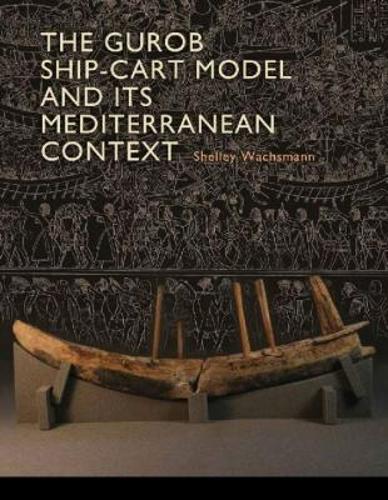
When Shelley Wachsmann began his analysis of the small ship model excavated by assistants of famed Egyptologist W. M. F. Petrie in Gurob, Egypt, in 1920, he expected to produce a brief monograph that would shed light on the model and the ship type that it represented. Instead, Wachsmann discovered that the model held clues to the identities and cultures of the enigmatic Sea Peoples, to the religious practices of ancient Egypt and Greece, and to the oared ships used by the Bronze Age Mycenaean Greeks. Although found in Egypt, the prototype of the Gurob model was clearly an Aegean-style galley of a type used by both the Mycenaeans and the Sea Peoples. The model is the most detailed representation presently known of this vessel type, which played a major role in changing the course of world history. Contemporaneous textual evidence for Sherden—one of the Sea Peoples—settled in the region suggests that the model may be patterned after a galley of that culture. Bearing a typical Helladic bird-head decoration topping the stempost, with holes along the sheer strakes confirming the use of stanchions, the model was found with four wheels and other evidence for a wagon-like support structure, connecting it with European cultic prototypes. The online resources that accompany the book illustrate Wachsmann’s research and analysis. They include 3D interactive models that allow readers to examine the Gurob model on their computers as if held in the hand, both in its present state and in two hypothetical reconstructions. The online component also contains high-resolution color photos of the model, maps and satellite photos of the site, and other related materials. Offering a wide range of insights and evidence for linkages among ancient Mediterranean peoples and traditions, The Gurob Ship-Cart Model and Its Mediterranean Context presents an invaluable asset for anyone interested in the complexities of cultural change in the eastern Mediterranean at the end of the Bronze Age and the beginning of the Iron Age.
Full Product Details
Author: Shelley Wachsmann ,
Alexis Catsambis ,
Donald H. Sanders ,
Dan Davis
Publisher: Texas A & M University Press
Imprint: Texas A & M University Press
Dimensions:
Width: 22.30cm
, Height: 2.50cm
, Length: 28.40cm
Weight: 1.400kg
ISBN: 9781603444293
ISBN 10: 1603444297
Pages: 352
Publication Date: 30 January 2013
Audience:
General/trade
,
General
Format: Hardback
Publisher's Status: Active
Availability: Temporarily unavailable

The supplier advises that this item is temporarily unavailable. It will be ordered for you and placed on backorder. Once it does come back in stock, we will ship it out to you.
Reviews
This richly textured book about a remarkable find of a wooden ship model on wheels from Egypt becomes the starting point for a tour de force into the decades of turmoil during the period of the Sea Peoples in the East Mediterranean. Wachsmann convincingly reconstructs the historical context of the Gurob model as belonging to the Sherden and Weshesh - Sea-Peoples of Urnfield origin that settled in Egypt and quickly became assimilated. --Kristian Kristiansen, professor of archaeology at University of Gothenburg, Sweden; Bronze Age researcher; co-author of The Rise of Bronze Age Society (Cambridge University Press, 2005)<br><br>
The book begins with a detailed description of this humble model, down to the loose fragments. Those familiar with Wachsmann's Seagoing Ships and Seamanship in the Bronze Age Levant know the author's predilection for (and skill at) assembling extensive references of both period and ethnographic parallels. It is not different in the current volume. While both books cover overlapping ground their aims are different, and the present book, while focusing on one small model rather than an enormous region-wide corpus of iconography, offers additional evidence and argument. Wachsmann's primary aim - solving the puzzle of the Gurob ship-cart, its origin, why it was made, what it was doing in a grave in Egypt - requires delving into eclectic topics at some length, as one might expect from a book this size about an object so small. Whatever weaknesses might be present, dismantling Wachsmann's argument and proposing an alterntive would surely be a work unto itself, because Wachsmann's arguments are very well made. A study such as Wachsmann has performed of an object such as this demonstrates that it is not the conclusion that matters as much as the process by which that conclusion is achieved. Great analysis can transcend its object. One need not have any interest at all in the ship-cart itself, or indeed in watercraft, to need The Gurob Ship-Cart Model and Its Mediterranean Context . An interest in virtually any aspect of the Late Bronze Age, Eastern Mediterranean or Egypt will do./i><br>--JAEI Staff Journal of Ancient Egyptian Interconnections (03/12/2013)
Professor Wachsmann has written a masterly account of an extraordinary archaeological find, the Gurob ship-cart model. From his comprehensive knowledge of second millennium B.C. nautical technology, he has identified the prototype for the model as a Helladic galley of Mycenaean type. This extraordinary insight has illuminated the Eastern Mediterranean world at a time of upheaval in which cultural cross-currents from Central Europe to Egypt provided a rich array of influences that lay behind the fashioning of this unique object.<br><br><br><br>Combining wide-ranging scholarship with deep knowledge of shipbuilding techniques, Professor Wachsmann has reconstructed the manufacture of the ship-cart model, and has created a remarkably complete virtual impression of its original form. Then, from this single artifact, he has gone on to delineate a system of maritime contacts and exchanges that embraces movements of peoples, ideologies and religious practices across the Aegean, Asia Minor, the Levant, and North Africa. It is a remarkable achievement. <br><br> Professor Wachsmann has, through brilliant analysis based on a lifetime of scholarly endeavor, put together a book of astonishing insight and great import that has brought to life a lost world three thousand years old. --Andrew M.T. Moore, First Vice President for the Archaeological Institute of America; Former Dean of Graduate Studies at the Rochester Institute of Technology in Rochester, New York<br><br>
Shelley Wachsman has carried out an exemplary and exhaustive study of a relatively forgotten wooden ship model that was found by Petrie in Gurob in 1920. By closely examining the model itself and various parallels from throughout the Mediterranean, he quite convincingly demonstrates that this is a model, most probably made in Egypt, of a Helladic style ship, which probably represents a ship of one of the so-called Sea Peoples, perhaps the Sherden. Through his meticulous analysis, turning over every stone on the way, Prof. Wachsman has uncovered an important piece of evidence relevant for the study of early Mediterranean shipping and evidence of the origin of the ships of the Sea Peoples. Written in an engaging and convincing manner, using a wide and impressive range of evidence, this book is recommended for scholars of many fields - maritime archaeology, Egyptology, Aegean archaeology, Levantine and Biblical Archaeology, to name a few. Well done! --Dr. Aren Maeir, professor Bar Ilan University University and director of the Tell es-Safi/Gath Archaeological Project
The Gurob Model is a unique artifact, highly important for the light it sheds on ancient ship design in the eastern Mediterranean. Up to now it has received only passing mention in books and articles. It deserves a book of its own . . . an authoritative and detailed description of the ship model . . . This book will be the first in its field. --John R. Hale, director of Liberal Studies, University of Louisville<br><br>
Author Information
The Meadows Associate Professor of Biblical Archeology at Texas A&M University, SHELLEY WACHSMANN is also the author of Seagoing Ships and Seamanship in the Bronze Age Levant (Texas A&M University Press, 1998), which received the Irene Levi-Sala Book Prize in the Archaeology of Israel, and The Sea of Galilee Boat: An Extraordinary 2000-Year-Old Discovery (Texas A&M University Press, 2009), which won the Biblical Archeology Society’s Award for best popular book.