Overview
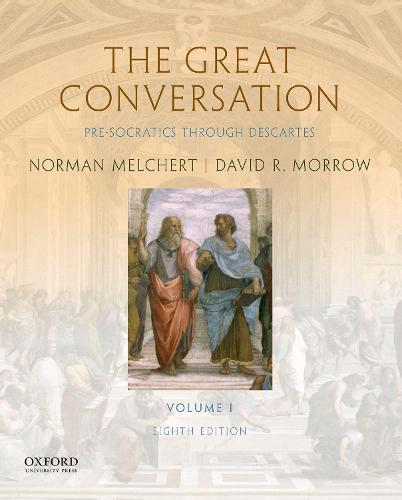
Tracing the exchange of ideas among history's key philosophers, The Great Conversation: A Historical Introduction to Philosophy, Eighth Edition, provides a generous selection of excerpts from major philosophical works and makes them more easily understandable to students with lucid and engaging explanations. Extensive cross-referencing shows students how philosophers respond appreciatively or critically to the thoughts of other philosophers.The Great Conversation, Eighth Edition, is also available in two separate volumes to suit your course needs:The Great Conversation: Volume I: Pre-Socratics through Descartes, Eighth EditionThe Great Conversation: Volume II: Descartes through Derrida and Quine, Eighth Edition
Full Product Details
Author: Melchert , Morrow
Publisher: Oxford University Press Inc
Imprint: Oxford University Press Inc
Edition: 8th edition
Dimensions:
Width: 19.10cm
, Height: 1.50cm
, Length: 23.10cm
Weight: 0.703kg
ISBN: 9780190670627
ISBN 10: 0190670622
Pages: 464
Publication Date: 17 September 2018
Audience:
College/higher education
,
Tertiary & Higher Education
Format: Paperback
Publisher's Status: Active
Availability: To order 
Stock availability from the supplier is unknown. We will order it for you and ship this item to you once it is received by us.
Table of Contents
"*=New to this Edition A Word to Instructors: A Word to Students: Acknowledgments: 1. Before Philosophy: Myth in Hesiod and Homer Hesiod: War among the Gods Homer: Heroes, Gods, and Excellence 2. Philosophy before Socrates Thales: The One as Water Anaximander: The One as the Boundless Xenophanes: The Gods as Fictions Sketch: Pythagoras: Heraclitus: Oneness in the Logos Parmenides: Only the One Zeno: The Paradoxes of Common Sense Atomism: The One and the Many Reconciled The Key: An Ambiguity: The World: The Soul: How to Live: * 3. Appearance and Reality in Ancient India * The Vedas and the Upanisads * The Buddha * The Four Noble Truths and the Eightfold Noble Path: * Right View: * Non-Self and Nagasena * The Brahmanical Schools * Vaisesika: * Nyaya: * The Great Conversation in India 4. The Sophists: Rhetoric and Relativism in Athens Democracy The Persian Wars The Sophists Rhetoric: Relativism: Physis and Nomos: Athens and Sparta at War Aristophanes and Reaction * 5. Reason and Relativism in China * A Brief History of Ancient China * Mozi * The School of Names * The Later Mohists * Zhuangzi * Sketch: Laozi: 6. Socrates: To Know Oneself Character Is Socrates a Sophist? What Socrates ""Knows"" We Ought to Search for Truth: Human Excellence Is Knowledge: All Wrongdoing Is Due to Ignorance: The Most Important Thing of All is to Care for Your Soul: 7. The Trial and Death of Socrates Euthyphro: Translator's Introduction The Dialogue Commentary and Questions Apology: Translator's Introduction The Dialogue Commentary and Questions Crito: Translator's Introduction The Dialogue Commentary and Questions Phaedo (Death Scene) Translator's Introduction The Dialogue Commentary and Questions 8. Plato: Knowing the Real and the Good Knowledge and Opinion Making the Distinction: We Do Know Certain Truths: The Objects of Knowledge: The Reality of the Forms: The World and the Forms How Forms Are Related to the World: Lower and Higher Forms: The Form of the Good: The Love of Wisdom What Wisdom Is: Love and Wisdom: The Soul The Immortality of the Soul: The Structure of the Soul: Morality The State Problems with the Forms 9. Aristotle: The Reality of the World Aristotle and Plato Logic and Knowledge Terms and Statements: Truth: Reasons Why: The Syllogism: Knowing First Principles: The World Nature: The Four ""Becauses"": Is There Purpose in Nature?: Teleology: First Philosophy Not Plato's Forms: What of Mathematics?: Substance and Form: Pure Actualities: God: The Soul Levels of Soul: Soul and Body: Nous: The Good Life Happiness: Virtue or Excellence (Areté): The Role of Reason: Responsibility: The Highest Good: * 10. Confucius, Mencius, and Xunzi: Virtue in Ancient China * Confucius * The Way of Confucius: * Ritual Propriety: * Good Government: *Mencius * Differentiated Love: * Xunzi: * The Confucians' Legacy: 11. Epicureans, Stoics, and Skeptics: Happiness for the Many The Epicureans The Stoics Profile: Marcus Aurelius: The Skeptics 12. Jews and Christians: Sin, Salvation, and Love Background Jesus The Meaning of Jesus 13. Augustine: God and the Soul Wisdom, Happiness, and God God and the World The Great Chain of Being: * Sketch: Hypatia of Alexandria: Evil: Time: Human Nature and Its Corruption Human Nature and Its Restoration Augustine on Relativism The Two Cities Augustine and the Philosophers Reason and Authority: Intellect and Will: Epicureans and Stoics: * 14. Philosophy in the Islamic World: The Great Conversation Spreads Out * A Sea Change in the Mediterranean Basin * Al-Kindi, the ""Philosopher of the Arabs"" * Al-Farabi, the ""Second Master"" * Religion as Subordinate to Philosophy: * Emanation and the Active Intellect: * Sketch: The Celestial Spheres: * Certitude, Absolute Certitude, and Opinion: * Avicenna, the ""Preeminent Master"" * Existence and Essence: * The Necessary Existent, God: * The Soul and Its Faculties: * Al-Ghazali Sketch: Maimonides (Moses ben Maimon): * The Great Conversation in the Islamic World 15. Anselm and Aquinas: Existence and Essence in God and the World Anselm: On That, Than Which No Greater Can Be Conceived The Transfer of Learning Thomas Aquinas: Rethinking Aristotle Sketch: Averro:es, the Commentator: Philosophy and Theology: From Creation to God: The Nature of God: Humans: Their Souls: Humans: Their Knowledge: Humans: Their Good: Ockham and Skeptical Doubts--Again 16. From Medieval to Modern Europe The World God Made for Us Reforming the Church Revolutions Humanism: Skeptical Thoughts Revived: Copernicus to Kepler to Galileo: The Great Triple Play: The Counter-Reformation 17. René Descartes: Doubting Our Way to Certainty The Method Meditations on First Philosophy (each Meditation is followed by Commentary and Questions): Meditation I Meditation II Meditation III Meditation IV Meditation V Meditation VI What Has Descartes Done? A New Ideal for Knowledge: A New Vision of Reality: Problems: The Place of Humans in the World of Nature: The Mind and the Body: God and the Problem of Skepticism: The Preeminence of Epistemology: Afterword: Appendix: Writing a Philosophy Paper: Glossary: Credits: Index:"
Reviews
The Great Conversation is the best introductory text I have come across in twenty-five years of teaching. It's an extremely useful and insightful book with a particularly appropriate balance of depth and breadth. The writing style is easily accessible without sacrificing clarity and specificity. --Douglas Howie, North Lake College Both my students and I enjoy the integration of philosophy outside of typical Western thought. The writing is easily understood by introductory students who normally don't have a background in the material. --Susan M. Mullican, University of Southern Mississippi, Gulf Coast Campus The Great Conversation is a solid introduction. More than other texts, it takes the time in plain English to flesh out important concepts. It also tells a tight story, with the chapters building on one another, which is useful for introducing students to philosophical thinking. --Eric Boynton, Allegheny College The chapters on classical Chinese philosophy, with selections from numerous texts and figures, are a welcome addition. Giving students exposure to non-Western traditions of thought at the introductory level provides them with a more expansive sense of the range and possibility of philosophical thought. --Hagop Sarkissian, Baruch College and The City University of New York Graduate Center
Author Information
Norman Melchert is Selfridge Professor of Philosophy Emeritus and a former Acting Dean of the College of Arts and Sciences at Lehigh University. He is the author of Who's to Say? A Dialogue on Relativism (1994) and numerous journal articles. David R. Morrow is a Visiting Fellow at the Institute for Philosophy and Public Policy at George Mason University. College. He is the coauthor of A Workbook for Arguments, Second Edition (2015) and numerous papers in applied ethics.
Tab Content 6
Author Website:
Countries Available
All regions
|