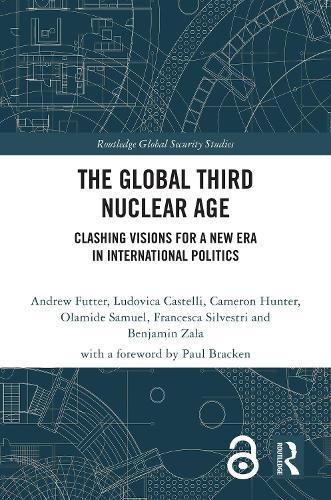
Full Product Details
Author: Andrew Futter (University of Leicester, UK) ,
Ludovica Castelli (University of Leicester, UK) ,
Cameron Hunter ,
Olamide Samuel
Publisher: Taylor & Francis Ltd
Imprint: Routledge
Weight: 0.700kg
ISBN: 9781032943794
ISBN 10: 1032943793
Pages: 276
Publication Date: 17 January 2025
Audience:
College/higher education
,
Professional and scholarly
,
Tertiary & Higher Education
,
Professional & Vocational
Format: Hardback
Publisher's Status: Active
Availability: In Print

This item will be ordered in for you from one of our suppliers. Upon receipt, we will promptly dispatch it out to you. For in store availability, please contact us.
Reviews
‘Nuclear strategists across the globe are grappling with a new global nuclear landscape dotted by many players, and facing simultaneous headwinds from plummeting political trust levels, galloping technological advancements, vanishing treaties and fraying norms. This book uses an inclusive lens to examine perspectives of 20 countries by categorising them on their affinity to nuclear weapons and their response to changing global nuclear politics. A novel take and interesting read.’ Manpreet Sethi, Distinguished Fellow at the Centre for Air Power Studies, New Delhi, India ‘The Global Third Nuclear Age advances our understanding of the full range of actors, technologies, and norms that are shaping the current nuclear age with its growing nuclear risks and eroding consensus on the ways to reduce them. Impressive in its scope, exhaustively researched, and clearly written, this book should be read by policymakers, academics, analysts, and students alike.‘ James Acton, co-director of the Nuclear Policy Program at the Carnegie Endowment for International Peace, Washington DC, USA 'We have moved into a new technological and geopolitical configuration after the Cold War. The norms-based international order so painstakingly constructed since 1945 is being undermined and arms control treaties and recent norms concerning nuclear weapons lack universal support. This is the context of the new nuclear age described here. This excellent volume examines its impact on and the influence of 20 states with a fine feeling for the peculiarities of each.' Beatrice Heuser, Distinguished Professor, Brussels School of Governance, Vrije Universiteit Brussel, Belgium 'The book is an excellent addition to scholarship on the third nuclear age and its focus on assessing elites’ perspectives on technological innovations, geopolitics and norms will enrich the debate on nuclear politics. Scholars should build on this book’s insights to develop non-western theoretical frameworks to evaluate the shifting nuclear landscape.' Rabia Akhtar, University of Lahore, International Affairs, July 2025
‘Nuclear strategists across the globe are grappling with a new global nuclear landscape dotted by many players, and facing simultaneous headwinds from plummeting political trust levels, galloping technological advancements, vanishing treaties and fraying norms. This book uses an inclusive lens to examine perspectives of 20 countries by categorising them on their affinity to nuclear weapons and their response to changing global nuclear politics. A novel take and interesting read.’ Manpreet Sethi, Distinguished Fellow at the Centre for Air Power Studies, New Delhi, India ‘The Global Third Nuclear Age advances our understanding of the full range of actors, technologies, and norms that are shaping the current nuclear age with its growing nuclear risks and eroding consensus on the ways to reduce them. Impressive in its scope, exhaustively researched, and clearly written, this book should be read by policymakers, academics, analysts, and students alike.‘ James Acton, co-director of the Nuclear Policy Program at the Carnegie Endowment for International Peace, Washington DC, USA 'We have moved into a new technological and geopolitical configuration after the Cold War. The norms-based international order so painstakingly constructed since 1945 is being undermined and arms control treaties and recent norms concerning nuclear weapons lack universal support. This is the context of the new nuclear age described here. This excellent volume examines its impact on and the influence of 20 states with a fine feeling for the peculiarities of each.' Beatrice Heuser, Distinguished Professor, Brussels School of Governance, Vrije Universiteit Brussel, Belgium
Author Information
Andrew Futter is Professor of International Politics at the University of Leicester, UK. Ludovica Castelli is a PhD candidate at the University of Leicester, UK. Cameron Hunter is a postdoctoral researcher at the University of Copenhagen, Denmark. Olamide Samuel is a special envoy for the African Commission on Nuclear Energy (AFCONE). Francesca Silvestri is Teaching Fellow at the University of Leicester, UK. Benjamin Zala is Senior Lecturer in Politics and International Relations at Monash University, Australia.