Overview
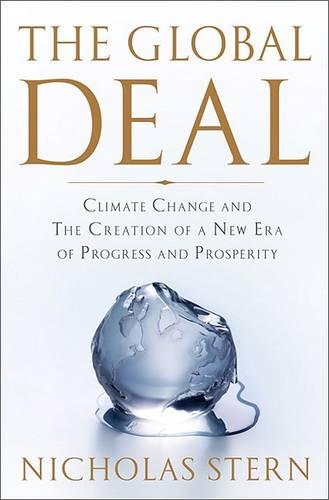
In October 2006, Nicholas Stern, one of the greatest economists and public intellectuals of our day, made headlines around the world with his report, which reviewed the costs and benefits of dealing with global warming. The worlds community has learned that it must act to mitigate global climate change, but until the Stern Review, no one knew how much it would cost, and how to do it. Now, Stern has transformed his report into a powerful narrative book for general readers. The Global Deal evaluates the economic future, and the essential steps we must take to protect growth and reduce poverty while managing climate change. The future Stern outlines is optimistic and pragmatic; he believes we have the capacity and creativity to change. But we need the will to inspire our political leaders to drive a new global strategy.
Full Product Details
Author: Nicholas Stern
Publisher: PublicAffairs,U.S.
Imprint: PublicAffairs,U.S.
Dimensions:
Width: 15.60cm
, Height: 2.80cm
, Length: 23.60cm
Weight: 0.454kg
ISBN: 9781586486693
ISBN 10: 1586486691
Pages: 256
Publication Date: 01 May 2009
Audience:
General/trade
,
General
Format: Hardback
Publisher's Status: Out of Stock Indefinitely
Availability: In Print

Limited stock is available. It will be ordered for you and shipped pending supplier's limited stock.
Reviews
Kirkus, 3/15 Erudite and effective Bill McKibben, New York Review of Books 2009 may well turn out to be the decisive year in the human relationship with our home planet. By December, when the world's leaders plan to gather in Copenhagen to sign a new global accord on global warming, we'll know whether or not our political systems are up to the unprecedented challenge that climate change represents....Nicholas Stern's new book provides the best scorecard we have for keeping track of this drama as it unfolds. Kirkus , 3/15 Erudite and effective Bill McKibben, New York Review of Books 2009 may well turn out to be the decisive year in the human relationship with our home planet. By December, when the world's leaders plan to gather in Copenhagen to sign a new global accord on global warming, we'll know whether or not our political systems are up to the unprecedented challenge that climate change represents....Nicholas Stern's new book provides the best scorecard we have for keeping track of this drama as it unfolds.
Kirkus , 3/15<br> Erudite and effective <br><p>Bill McKibben, New York Review of Books <br> 2009 may well turn out to be the decisive year in the human relationship with our home planet. By December, when the world's leaders plan to gather in Copenhagen to sign a new global accord on global warming, we'll know whether or not our political systems are up to the unprecedented challenge that climate change represents....Nicholas Stern's new book provides the best scorecard we have for keeping track of this drama as it unfolds.
"Kirkus, 3/15 ""Erudite and effective"" Bill McKibben, New York Review of Books ""2009 may well turn out to be the decisive year in the human relationship with our home planet. By December, when the world's leaders plan to gather in Copenhagen to sign a new global accord on global warming, we'll know whether or not our political systems are up to the unprecedented challenge that climate change represents....Nicholas Stern's new book provides the best scorecard we have for keeping track of this drama as it unfolds."" ""Kirkus"", 3/15 ""Erudite and effective"" Bill McKibben, ""New York Review of Books"" ""2009 may well turn out to be the decisive year in the human relationship with our home planet. By December, when the world's leaders plan to gather in Copenhagen to sign a new global accord on global warming, we'll know whether or not our political systems are up to the unprecedented challenge that climate change represents....Nicholas Stern's new book provides the best scorecard we have for keeping track of this drama as it unfolds."""
Scholarly treatise suggests that only collective action can forestall the onrushing disaster of global warming.The former chief economist of the World Bank, Stern takes a centrist approach to the thorny matter of how nations and industries should respond to this threat. Asked by then-Chancellor of the Exchequer Gordon Brown in 2005 to undertake an economic analysis of climate change, Stern concluded that the potential risks to large swaths of the population were enormous, but so too were the opportunities for innovation and international cooperation. We have to anticipate the catastrophe to avoid it, he writes. We have to act together, to create a global deal. The author begins by sketching a grim, albeit familiar portrait of the dangers posed by a five-degree rise in global temperatures over the next several decades. That seems to be the scientific community's worst-case consensus, but Stern points out that even a one- or two-degree temperature rise would drastically alter numerous regions, including Florida and the mid-Atlantic. Yet his tone remains optimistic, in part due to the departure of the intransigent Bush Administration; contrastingly, he notes of Barack Obama, no American president has ever been more forthright on the subject. Stern takes a jaundiced view of the role business has played in amplifying the problem, declaring that greenhouse gas emissions constitute the greatest market failure the world has seen. He notes that developing nations like India and China will bear the brunt of necessary change, even though Western nations, particularly the United States, have already benefited from the practices that led to global warming in the first place. Moving to a low-carbon growth path will involve real economic and political costs, he warns, and those costs will be inequitably distributed. His assessment that distinct actions can be pursued by individuals, communities and business firms suggests that the greatest obstacle to collective change - a lack of political will - is not insurmountable.Erudite and effective, but also dense and repetitive, hence less likely to find a mainstream audience. (Kirkus Reviews)
<b><i>Kirkus</i>, 3/15</b> Erudite and effective <b>Bill McKibben, <i>New York Review of Books</i></b> 2009 may well turn out to be the decisive year in the human relationship with our home planet. By December, when the world's leaders plan to gather in Copenhagen to sign a new global accord on global warming, we'll know whether or not our political systems are up to the unprecedented challenge that climate change represents....Nicholas Stern's new book provides the best scorecard we have for keeping track of this drama as it unfolds.
Author Information
Professor Nicholas Stern is the IG Patel Chair and Chairman of the Grantham Institute on Climate Change and the Environment, and Director of the India Observatory at the London School of Economics and Political Science. As Baron Stern of Brentford, he is a member of the UK House of Lords. He was Chief Economist and Senior Vice President of the World Bank from 2000-2003, head of the UK Government Economic Service from 2003-2007, and head of the Stern Review on the Economics of Climate Change from 2005-2007.