Overview
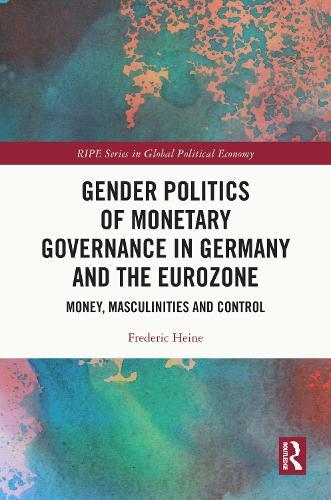
Gender Politics of Monetary Governance in Germany and the Eurozone provides a nuanced reading of how gender politics matter in monetary governance, contributing to a gendered critique of the political economy of Germany and the Eurozone and to efforts of ‘de-patriarchalising’ monetary and economic governance. While gender aspects of economic governance have increasingly been made visible in critical scholarship, less focus has been placed on the role of masculinities and monetary governance. This book shows that the intersection of gender politics and monetary governance plays a fundamental role in the making of the political economy. It argues that, materially, monetary governance amplifies gendered power hierarchies in (re)productive relations. Culturally, gendered narratives play an important role in establishing the credibility and legitimacy of monetary governance. They do so by metaphorically making sense of monetary policy through masculinised gender qualities of authority, (self-) control, toughness, while disavowing feminised qualities such as temptation and excess. The book shows how these narratives have been mobilised at key junctures to promote a prioritisation of monetary and fiscal ‘discipline’ in German economic history, the institutional design of EMU, and in the governance of the Eurozone crisis. These narratives are vital in producing opportunities for some and restricting them for others, enabling particular, hierarchical forms of accumulation while foreclosing possibilities for different ways of doing economic relations. Yet, meanings are contingent, incomplete, and open to challenge, and thus monetary governance can be re-signified to facilitate social thriving beyond the strictures of heteronormativity and austerity. This book will be of great interest to students and scholars researching International Political Economy, Gender and Politics, Men and Masculinity Studies, Economic Sociology and Cultural Economy, and European Studies.
Full Product Details
Author: Frederic Heine (Johannes Kepler University Linz, Austria)
Publisher: Taylor & Francis Ltd
Imprint: Routledge
Weight: 0.500kg
ISBN: 9781032584355
ISBN 10: 1032584351
Pages: 176
Publication Date: 24 November 2025
Audience:
College/higher education
,
Professional and scholarly
,
Tertiary & Higher Education
,
Professional & Vocational
Format: Hardback
Publisher's Status: Active
Availability: Manufactured on demand

We will order this item for you from a manufactured on demand supplier.
Author Information
Frederic Heine is a researcher and lecturer at the Institute of Women’s and Gender Studies at Johannes Kepler University Linz and holds a PhD in Politics and International Studies from the University of Warwick (2020). Frederic’s research focusses on the intersection of gender and global political economy and currently investigates right-wing politics and contestations of gender justice. Recent publications include ‘performing hard money’ (2022, Journal of Cultural Economy) and ‘men behaving badly?’ (2021, International Feminist Journal of Politics).