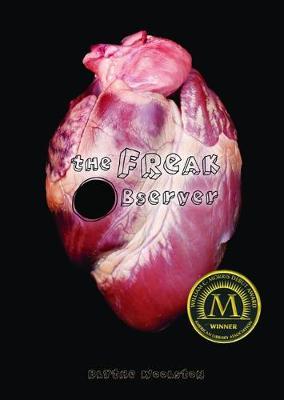
Awards
- Commended for Moonbeam Children's Book Award (Y/A Fiction/General) 2010
- Winner of William C. Morris YA Debut Award 2011
Overview
The Freak Observer is rich in family drama, theoretical physics, and an unusual, tough young woman--Loa Lindgren. For eight years, Loa Sollilja's world ran like one of those mechanical models of the solar system, with her baby sister, Asta, as the sun. Asta suffered from a genetic disorder that left her a permanent infant, and caring for her was Loa's life. Everything spun neatly and regularly as the whole family orbited around Asta. But now Asta's dead, and 16-year-old Loa's clockwork galaxy has collapsed. As Loa spins off on her own, her mind ambushes her with vivid nightmares and sadistic flashbacks a textbook case of PTSD. But there are no textbook fixes for Loa's short-circuiting brain. She must find her own way to pry her world from the clutches of death. The Freak Observer is a startling debut about death, life, astrophysics, and finding beauty in chaos.
Full Product Details
Author: Blythe Woolston
Publisher: Carolrhoda Books
Imprint: Carolrhoda Books
Dimensions:
Width: 15.50cm
, Height: 2.00cm
, Length: 19.70cm
Weight: 0.318kg
ISBN: 9780761362128
ISBN 10: 0761362126
Pages: 202
Publication Date: 01 August 2010
Audience:
Children/juvenile
,
Children / Juvenile
Format: Hardback
Publisher's Status: Out of Stock Indefinitely
Availability: In Print

Limited stock is available. It will be ordered for you and shipped pending supplier's limited stock.
Reviews
Woolston's morbid and layered debut delves into the shattered life of 16-year-old Loa, whose younger sister, Asta, died of a genetic mutation and who, more recently, lost a friend in a tragic accident. Loa suffers the effects of PTSD, including vivid nightmares and flashbacks, which are gracefully written and interspersed throughout. Amid their grief over Asta's death and financial problems, Loa's parents neglect her pain as the family tries to scrape by. 'After all those years of fighting hard, we lost. Now we get drunk. We hit each other. When the truck won't start, we punch the windshield so hard the shatterproof glass breaks. Is this depression or anger?' she asks. Loa is strong, but overburdened and isolated; laced with bleak humor, her deadened, searching narration carries this dark and highly promising first novel. The chapters begin with questions or statements, usually drawn from physics, biology, or math, which tie in to Loa's struggles ('What should you do if you are stuck on frictionless ice? Assume you are nude and there is no atmospheric resistance') as she tries to find her way. --Publishers Weekly --Journal Loa's little sister dies of Rett syndrome; not long after, Loa sees her friend splattered on the road by a logging truck. Then the screaming nightmares begin. Woolston draws a realistic picture of a family in trouble while focusing firmly on her deeply cerebral protagonist. Readers will be won by the vivid characterization of Loa and her strong narrative voice. --The Horn Book Guide --Journal Sixteen-year-old Loa Lindgren witnesses a gruesome car accident that takes the life of her best friend, Esther. The event leaves Loa with a debilitating case of post-traumatic stress disorder. A mysterious figure known as the Bony Guy--death incarnate--terrifies her through vivid hallucinations and haunts her dreams at night. When Loa's cherished baby sister Asta dies from medical complications, her already-broken family unravels even more. Loa meets Corey, a confident and peculiar schoolmate, who persuades her to join the debate team. But as their strange friendship blossoms, Corey abruptly leaves for Europe. Without friends or family to help, Loa begins to cope with her condition through, of all things, theoretical astrophysics. Loa's mom enrolls at a university and the once-private and rural family find themselves connecting to each other and learning what it means to move on. --The ALAN Review --Journal A strong narrative voice and a wave of tragedies define this character-driven first novel. After Loa's little sister dies of Rett syndrome, no one talks about the loss, but Loa and her parents drink to escape the pain. Not long after, Loa sees her friend Esther splattered on the road by a logging truck. When the screaming nightmares begin, Loa gets six therapy sessions-all that's covered by insurance-but the terrifying bony guy still appears every time she closes her eyes. Loa makes coffee and cleans the bathroom grout to stay awake; when her dad loses his job, Loa also keeps busy washing dishes at a senior residence. Woolston draws a realistic picture of a family in trouble while focusing firmly on her protagonist. Loa is smart and interested in school, especially her physics class. Her obsession with science makes sense given her sister's death from a genetic disorder; each chapter opens with a physics problem or scientific theory of some kind. The motif reflects Loa's deeply cerebral existence as she fights through the pain of loss; her strength makes the tentatively hopeful ending credible. The bold cover photo of a human heart suggests the dark and sometimes graphic nature of the story. Those readers drawn inside will be won by the vivid characterization and fresh style. --The Horn Book Magazine --Journal Sixteen-year-old Loa Lindgren's family is emotionally splintered and drifting following the death of her younger sister Asta, whose Rett syndrome necessitated constant care and kept the family on a rigid schedule. Plagued by PTSD and nightmares about death, Loa clings to household chores, watching over her younger brother, and her beloved physics to rebuild a sense of normalcy. With no real plot, the novel feels fragmentary, mirroring the protagonist's feelings of disconnection. Incidents such as the death of her classmate in the opening pages, Loa's extra-credit physics project on the phenomenon of the freak observer (Boltzmann brain paradox), and her failed relationship with her debate partner are explained in chunks of narrative scattered throughout the text, which may confuse some readers. However, the author has created a likable narrator in Loa. Readers will root for a happy ending, though probably not be surprised by the deliberately ambiguous one that nonetheless hints at a hopeful future. Teens will either love or loathe the book with no middle ground likely for such a unique, disturbing, creative story. --School Library Journal --Journal Sixteen-year-old Loa's story begins in a tangle of turmoil. She witnesses a truck kill her friend Esther, an event that too vividly brings back memories of the death of Loa's sister, who suffered complications from Rett syndrome. Loa's parents are angered and haunted by the cruel turns of their lives, so Loa focuses upon her desultory job and her way-out-there astrophysics homework. Woolston's talent for dialogue and her unique approach to scenes makes what sounds standard about this story feel fresh and vital. What is most surprising and rewarding, though, is how the novel deprioritizes these dramatic elements to follow the flow of Loa's life--it's difficult to move on from trauma, but sometimes you just can't help it. A nebulous sexual relationship with a boy who posts pictures of himself and Loa on the Internet provides much of the push-and-pull, but it's a new friendship with an odd boy at her new school that offers the best chance of relief. A strong debut about learning to see yourself apart from the reflection you cast off others. --Booklist --Journal Loa has post-traumatic stress disorder (PTSD) stemming from the death of her little sister, and the more recent death of a classmate--which she witnessed. She is on her own dealing with her nightmares of the Bony Guy (death) and panic attacks. She uses physics and alcohol to help herself through it. She has family, but they are in their own stages of grief and cannot reach out to Loa. Only side characters, Corey and Jack, breach the pain and grief to help her. Each chapter begins with pseudo-math and physics questions that set the tone of the chapters. Loa's voice is the story's strength. She's wry, observant, and honest in her narration. Without the strength of her voice, the book would completely fail. The story unravels very slowly which will leave readers wondering what has made Loa the way she is. The abrupt change of scenery and the introduction of Jack, the non-neurotypical guy, bring about the tidy, yet hopeful, ending. This melancholic contemporary novel has many stellar moments that will appeal to issue-driven novel readers, but will need to be handsold through booktalking to reach a wider teen audience. --VOYA --Journal Readers meet 16-year-old Loa in her guidance counselor's office as she is being encouraged to return to her schoolwork after witnessing her friend's death in a road accident. Although physically battered and bruised, Loa seems disengaged, which is surprising until it quickly becomes clear that this horrific event is one in a series, including the death of her baby sister, that has torn her family to shreds. This text provides a sharp snapshot of Loa's life as she battles PTSD from these events and attempts to conquer related vivid death-related dreams and hallucinations. Anchoring each chapter is a short question or statement, generally related to science, that ties to the forthcoming chapter--although Woolston makes readers work to see the connection, enabling them to understand Loa on another deeper level. A keenly observant narrator noticing life's small details, Loa holds nothing back, which is both riveting and heartbreaking. An auspicious debut for both the author and Carolrhoda's new Lab imprint. --Kirkus Reviews --Journal
Author Information
Blythe Woolston is a reader. Right now, she makes her living indexing scholarly books. She has also worked as a writing teacher, library clerk, and production coordinator for a computer book publisher. Writing books is a new way for her to love reading.