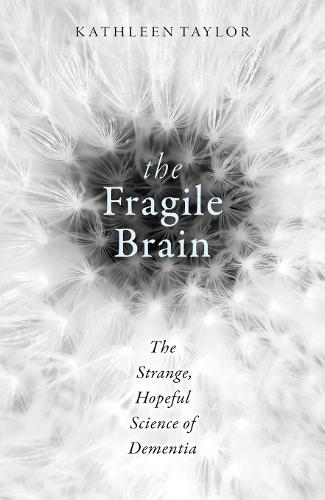
Full Product Details
Author: Kathleen Taylor (Research scientist in the Department of Physiology, Anatomy and Genetics at the University of Oxford)
Publisher: Oxford University Press
Imprint: Oxford University Press
Dimensions:
Width: 16.90cm
, Height: 3.00cm
, Length: 23.30cm
Weight: 0.574kg
ISBN: 9780198726081
ISBN 10: 0198726082
Pages: 336
Publication Date: 24 November 2016
Audience:
College/higher education
,
Professional and scholarly
,
General/trade
,
Tertiary & Higher Education
,
Professional & Vocational
Format: Hardback
Publisher's Status: Active
Availability: To order

Stock availability from the supplier is unknown. We will order it for you and ship this item to you once it is received by us.
Reviews
Taylor has crafted a personal, astonishingly coherent review of our current state of knowledge about the causes of Alzheimer's disease and dementia, as well as possible solutions, from lifestyle adjustments to drug developments. Michael Heneka, Nature The Fragile Brain addresses how people interact with those who have dementia, and how both information and respect are needed. This is of utmost importance: information can quell many fears. Michael Heneka, Nature Taylor has the talent to make complex biology easy, but not trivial. Michael Heneka, Nature The Fragile Brain, as a trove of accessible, up-to-date science, has something to offer caregivers and families of people with dementia; medical professionals in dementia diagnosis and treatment; and specialists in memory clinics. Michael Heneka, Nature
Taylor has crafted a personal, astonishingly coherent review of our current state of knowledge about the causes of Alzheimer's disease and dementia, as well as possible solutions, from lifestyle adjustments to drug developments. Michael Heneka, Nature The Fragile Brain addresses how people interact with those who have dementia, and how both information and respect are needed. This is of utmost importance: information can quell many fears. Michael Heneka, Nature Taylor has the talent to make complex biology easy, but not trivial. Michael Heneka, Nature The Fragile Brain, as a trove of accessible, up-to-date science, has something to offer caregivers and families of people with dementia; medical professionals in dementia diagnosis and treatment; and specialists in memory clinics. Michael Heneka, Nature detailed and accessible book Leon Burakowski, South Shropshire Journal
Author Information
Dr Kathleen Taylor studied physiology and philosophy at the University of Oxford. After a research MSc at Stirling University, working on brain chemistry, she returned to Oxford to do a DPhil in visual neuroscience and postdoctoral work on cognitive neuroscience. In 2002 she won two writing competitions run by the Times Higher Education Supplement, one for science writing and one for an essay in the humanities/social sciences. She has written on a range of topics from consciousness to cruelty, including several books published by OUP in the last decade: Brainwashing (2004), Cruelty (2009) and The Brain Supremacy (2012).