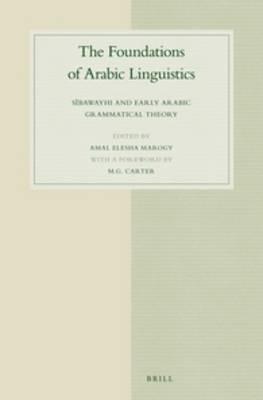
Overview
This volume is intended as the first in a series of studies on traditional Arab linguistic theories concentrating on Sībawayhi and his grammatical legacy. Here, the reader is introduced to the major issues and themes that have determined the development of Arabic grammar and presents Sībawayhi in the context of his intellectual and social environment. The papers make significant contributions to and offer in-depth introductions into major aspects of the foundations of Arab Linguistics, early Syriac and medieval Hebrew linguistic traditions. This is a unique reference on the three main Semitic linguistic traditions, accompanied by a detailed analysis of some grammatical and pragmatic aspects of Kitāb Sībawayhi in the light of modern theories and scholarship. Contributors include: M. G. Carter, Hanadi Dayyeh, Manuela E.B. Giolfo, Mohamed Hnid, Almog Kasher, Geoffrey Khan, Daniel King, Amal Marogy, Avigail S. Noy, Arik Sadan, Haruko Sakaedani
Full Product Details
Author: Amal Elesha Marogy ,
M. G. Carter
Publisher: Brill
Imprint: Brill
Volume: 65
Dimensions:
Width: 15.50cm
, Height: 1.90cm
, Length: 23.50cm
Weight: 1.160kg
ISBN: 9789004223592
ISBN 10: 9004223592
Pages: 248
Publication Date: 10 May 2012
Audience:
Professional and scholarly
,
Professional & Vocational
Format: Hardback
Publisher's Status: Active
Availability: Manufactured on demand

We will order this item for you from a manufactured on demand supplier.
Reviews
To sum up, The Foundations of Arabic Linguistics is a significant contribution to our increasing knowledge of this important branch in the history of linguistic thinking. The book makes it plain how rich and profound is the Arabic grammatical tradition. Michal Marmorstein, The Hebrew University of Jerusalem in Studies in Language vol. 37, issue 2, pp. 445-453. Der von Amal Marogy sorgfaltig edierte Band, de in keiner Fachbibliothek fehlen sollte, bietet ausnahmslos anregende Lekture und stellt eine wirkliche Bereicherung der Literatur zur nativen arabischen Sprachwissenschaft dar. - Lutz Edzard, Erlangen/Oslo.
To sum up, The Foundations of Arabic Linguistics is a significant contribution to our increasing knowledge of this important branch in the history of linguistic thinking. The book makes it plain how rich and profound is the Arabic grammatical tradition. Michal Marmorstein, The Hebrew University of Jerusalem in Studies in Language vol. 37, issue 2, pp. 445-453.
Author Information
Amal E. Marogy, Ph.D. (2007) in Oriental Languages and Cultures, is lector of Arabic at Cambridge University. She is organiser of the Foundations of Arabic linguistics Conferences, FAL1 (2010) and FAL2 (2012) and her publications include Kitāb Sībawayhi: Syntax and Pragmatics (2010).